
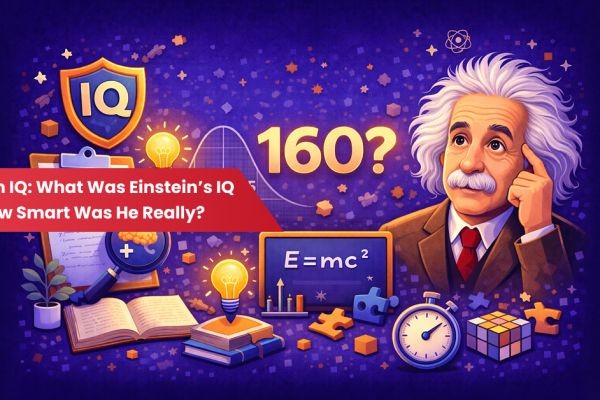
Albert Einstein is one of the most recognized scientific minds in history. His groundbreaking work on the theory of relativity transformed modern physics and changed the way people understand space, time, and gravity. Because of his remarkable achievements, many people often ask, what is Einstein's IQ? It is one of the most searched questions about the famous physicist, yet the answer is surprisingly complex.
Unlike many modern public figures, Einstein never took the type of standardized intelligence tests that are commonly associated with IQ scores today. As a result, every number you see online is only an estimate rather than an officially documented score. Understanding why this estimate is so difficult requires a closer look at IQ testing, Einstein's life, and the nature of human intelligence itself.
What Is IQ?
IQ stands for Intelligence Quotient. It is a numerical score designed to measure certain cognitive abilities, including reasoning, logical thinking, problem solving, memory, and pattern recognition. Modern IQ tests compare an individual's performance with that of people in the same age group.
The average IQ score is set at 100. Most people score somewhere between 85 and 115. A score above 130 is generally considered gifted, while scores above 145 are exceptionally rare.
Although IQ tests can provide useful insights into specific mental abilities, they do not measure every aspect of intelligence. Creativity, emotional intelligence, leadership, determination, curiosity, and imagination all contribute to success but are not fully captured by traditional IQ testing.
What Is Einstein's IQ?
The simple answer is that nobody knows Einstein's actual IQ.
Albert Einstein never publicly took a standardized IQ test, and there are no official records showing his score. Despite this, countless websites claim his IQ was between 160 and 180. Some even suggest it was over 200. These figures have been repeated so often that many people assume they are factual.
The reality is very different. Historians and psychologists agree that these numbers are educated guesses rather than verified measurements. Since Einstein never completed an official IQ assessment, any exact figure is speculative.
Most experts believe that if Einstein had taken a modern intelligence test, he likely would have scored exceptionally high. However, assigning an exact number remains impossible.
Why Do People Estimate Einstein's IQ at Around 160?
The estimate of approximately 160 comes from indirect observations rather than actual testing.
Einstein demonstrated extraordinary abilities throughout his life. He showed remarkable mathematical reasoning, conceptual thinking, and scientific creativity. His ability to imagine complex physical situations using thought experiments was unlike that of most scientists of his era.
For example, Einstein famously imagined what it would be like to ride alongside a beam of light. This mental exercise eventually contributed to the development of special relativity, one of the most important scientific theories ever created.
Because individuals with exceptional intellectual achievements often score highly on IQ tests, many researchers estimate Einstein's intelligence would likely have placed him well above the gifted range.
Still, this remains an informed opinion rather than documented evidence.
Why Is It So Difficult to Estimate Einstein's IQ?
There are several reasons why estimating Einstein's IQ is extremely challenging.
He Never Took an Official IQ Test
The biggest reason is simple. Einstein never completed the modern IQ assessments that psychologists use today.
Without actual test results, no one can accurately determine his numerical IQ score.
Modern IQ Tests Were Still Developing
During Einstein's lifetime, intelligence testing was still evolving. Early IQ tests were not as standardized or scientifically refined as those used today.
Even if Einstein had participated in one of these early assessments, comparing his results to modern scores would be difficult.
Genius Is More Than Test Performance
Einstein's achievements involved extraordinary creativity rather than simply solving logical puzzles.
IQ tests mainly evaluate structured reasoning under controlled conditions. Scientific breakthroughs often require imagination, persistence, curiosity, and unconventional thinking, qualities that cannot be fully measured by standardized testing.
Einstein himself valued imagination highly. One of his most famous quotes states that imagination is more important than knowledge because it allows people to explore possibilities beyond existing facts.
Historical Records Are Limited
Much of what we know about Einstein comes from biographies, personal letters, academic publications, and historical accounts. None of these sources contain verified IQ scores.
Many websites repeat the same estimated numbers without citing reliable evidence, which has contributed to widespread misinformation.
Did Einstein Consider Himself a Genius?
Interestingly, Einstein did not describe himself as unusually gifted.
He often credited his success to persistence, curiosity, and deep thinking rather than extraordinary intelligence.
One of his most famous quotes says, "It's not that I'm so smart. It's just that I stay with problems longer."
Whether taken literally or not, this statement reflects Einstein's belief that determination and sustained effort played a major role in his accomplishments.
Einstein's Academic Performance
Many myths surround Einstein's education.
One persistent misconception claims he failed mathematics in school. This story is false.
Historical records show that Einstein excelled in mathematics and physics from a young age. He mastered advanced mathematical concepts well before attending university.
However, he sometimes struggled with subjects that did not interest him and occasionally clashed with teachers because he questioned traditional teaching methods.
His academic record demonstrates strong intellectual ability but also highlights his independent personality.
Can IQ Alone Explain Einstein's Success?
The answer is almost certainly no.
Many individuals with exceptionally high IQ scores never produce groundbreaking scientific discoveries. Likewise, numerous successful innovators excel because of qualities that extend beyond raw intelligence.
Einstein possessed several characteristics that contributed to his remarkable achievements.
He had an exceptional curiosity about how the universe worked.
He demonstrated extraordinary patience when solving difficult scientific problems.
He showed creativity by visualizing situations that had never been experimentally observed.
He questioned accepted beliefs instead of simply accepting established theories.
These traits combined with his mathematical ability allowed him to revolutionize physics.
How Does Einstein Compare to Other Famous Geniuses?
Many people enjoy comparing estimated IQ scores among famous historical figures. However, these comparisons should be viewed with caution.
For example, Leonardo da Vinci is often estimated to have had an IQ between 180 and 220, although no official records exist.
Isaac Newton is similarly believed to have possessed extraordinary intelligence, but he also never completed a modern IQ assessment.
Stephen Hawking was frequently asked about his IQ. He reportedly dismissed the question, suggesting that people who boast about IQ are losers. Like Einstein, Hawking believed scientific contributions mattered more than intelligence scores.
These examples demonstrate that assigning precise IQ values to historical figures is often impossible.
What Modern Psychologists Say About Estimating Historical IQ
Most psychologists discourage assigning exact IQ scores to historical figures.
Intelligence tests depend on standardized testing conditions, consistent scoring methods, and comparisons with modern populations. None of these requirements can be applied to someone who lived more than a century ago.
Instead of focusing on numerical estimates, experts often evaluate historical achievements, originality, influence, and documented cognitive abilities.
By these standards, Einstein clearly ranks among history's greatest scientific thinkers regardless of any hypothetical IQ score.
Why Are People So Fascinated by Einstein's IQ?
The question what is einstein's iq [https://blog.fastlearner.ai/what-was-einsteins-iq-and-how-smart-was-he-really/] continues to attract attention because people naturally seek measurable explanations for extraordinary talent.
An IQ number appears to offer a simple way to understand genius. Unfortunately, human intelligence is much more complicated than a single score.
Einstein's work reshaped multiple branches of physics and influenced technologies ranging from GPS systems to nuclear energy research. His impact resulted from years of careful thinking, creativity, collaboration, and perseverance rather than one numerical measurement.
His life reminds us that intellectual achievement depends on a combination of knowledge, imagination, discipline, and passion.
Final Thoughts
When people ask what is Einstein's IQ, they are usually hoping for a definitive number. The truth is that no verified IQ score for Albert Einstein exists. Estimates ranging from 160 to 180 are widely circulated, but they are based on educated speculation rather than official testing.
The difficulty in estimating Einstein's IQ highlights an important lesson about intelligence itself. Standardized tests can measure certain cognitive skills, but they cannot fully capture creativity, innovation, determination, or the ability to change the course of human knowledge.
Einstein's legacy was built on his relentless curiosity, original thinking, and willingness to challenge conventional ideas. Whether his hypothetical IQ was 160, 170, or even higher matters far less than the revolutionary discoveries he left behind. His work continues to inspire scientists, students, and curious minds around the world, proving that true genius cannot be reduced to a single number.






