
Android apps have become an essential digital channel for businesses looking to connect with customers, streamline operations, and expand their reach. From eCommerce and healthcare to finance, logistics, travel, and on-demand services, businesses across industries are investing in Android applications to deliver convenient and personalized experiences.
However, developing a successful Android app involves much more than writing code. A professional Android app development company typically handles everything from understanding business requirements and designing the user interface to development, testing, deployment, and post-launch maintenance. Knowing what to expect from the development team can help businesses plan their projects better, avoid unexpected challenges, and build an application that supports long-term goals.
What Does an Android App Development Company Do?
An Android app development company helps businesses transform an app concept into a functional, secure, and scalable mobile application. The process generally starts with understanding the business model, target audience, competitors, and technical requirements.
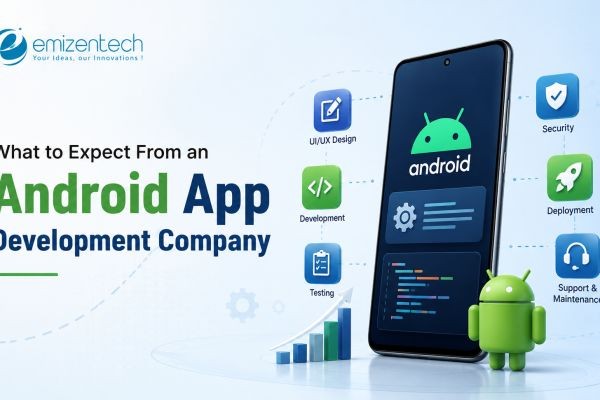
Depending on the project, the development team may handle:
-
Business and technical requirement analysis
-
UI/UX design and prototyping
-
Android app development
-
Backend and API development
-
Third-party integrations
-
Quality assurance and testing
-
Google Play Store deployment
-
Post-launch maintenance and updates
A structured development approach ensures that the final application is aligned with both user expectations and business objectives.
Key Things to Expect From an Android App Development Company
Business and Requirement Analysis
The first stage of development should focus on understanding what the business actually needs. A professional team will discuss the app's purpose, target users, expected functionality, business goals, and long-term requirements.
The development team may also analyze competitors and identify opportunities to differentiate the application. Based on this information, they can define the minimum viable product (MVP), prioritize features, and establish the project's technical scope.
This stage helps reduce unnecessary development work and provides a clear direction before actual coding begins.
UI/UX Design and Prototyping
An Android app needs to be visually appealing while remaining simple and intuitive to use. Therefore, UI/UX design is an important part of the development process.
Designers generally create wireframes and prototypes to demonstrate how users will navigate through the application. They consider elements such as screen layouts, navigation, typography, buttons, forms, colors, and accessibility.
A good design should also work effectively across different Android screen sizes and devices. Before development begins, businesses can review prototypes and provide feedback, helping ensure that the final interface matches their expectations.
Custom Android App Development
Once the requirements and designs are finalized, developers begin building the application. The development process may involve creating the frontend, backend, database, APIs, and administrative components required to operate the app.
The technology stack is selected according to the application's functionality, scalability, performance requirements, and budget. Developers may also integrate APIs and third-party services for features such as maps, payments, authentication, analytics, communication, and cloud services.
A well-structured application should not only meet current requirements but also provide room for future upgrades and feature additions.
Advanced Features and Integrations
Modern Android applications often require more than basic functionality. Depending on the business model, an app development company may integrate advanced technologies and services to improve functionality and user engagement.
Common integrations include:
-
AI-powered recommendations and automation
-
Push notifications
-
GPS and location-based services
-
Payment gateways
-
Social media login
-
Chat and communication features
-
Real-time tracking
-
Cloud services
-
Analytics tools
-
Third-party APIs
The right integrations can help businesses automate processes, improve customer experiences, and collect useful insights from app usage.
Testing and Quality Assurance
Testing is one of the most important stages of Android app development because Android applications need to work across a wide range of devices and operating system versions.
A professional quality assurance team may perform functional, usability, performance, security, and compatibility testing. Developers also check how the application behaves under different network conditions and screen sizes.
Testing helps identify problems such as crashes, slow loading, broken features, navigation issues, security vulnerabilities, and compatibility errors before the application reaches users.
App Deployment and Google Play Store Launch
After development and testing are completed, the application needs to be prepared for release. This includes configuring the production environment, creating the required app assets, preparing the store listing, and meeting Google Play Store requirements.
The development team can assist with the technical aspects of deployment and help resolve issues that may occur during the submission process.
After launch, performance and user feedback can be monitored to identify opportunities for improvement.
Post-Launch Support and Maintenance
Launching an Android application is not the end of the development process. Android devices, operating systems, security standards, and user expectations continue to change. Regular maintenance helps keep an application secure, functional, and competitive.
Post-launch services may include:
-
Bug fixing
-
Performance optimization
-
Security updates
-
Android OS compatibility updates
-
Server and API maintenance
-
New feature development
-
UI improvements
-
Technical monitoring
Ongoing maintenance is particularly important for businesses that rely heavily on their mobile application for customer interactions or internal operations.
How Does the Android App Development Process Work?
Although every project is different, the Android app development process generally follows these stages:
1. Requirement Gathering: The team understands the business model, users, objectives, features, and technical requirements.
2. UI/UX Design: Designers create wireframes, prototypes, and final interface designs based on the agreed requirements.
3. Development: Developers build the application, backend systems, APIs, databases, and required integrations.
4. Testing: The application undergoes different testing procedures to identify and resolve technical and usability issues.
5. Deployment: Once approved, the app is prepared and submitted to the Google Play Store.
6. Maintenance: After launch, the development team provides updates, improvements, fixes, and technical support.
Following a structured process helps businesses maintain better control over timelines, costs, and development quality.
Common Challenges in Android App Development
Android development can present several technical challenges because of the diversity of devices and software environments. Screen sizes, hardware capabilities, operating system versions, and manufacturer-specific configurations can affect application performance.
Other challenges may include maintaining app security, integrating third-party services, handling large amounts of data, ensuring smooth performance, and scaling the application as the user base grows.
Working with an experienced development team can help businesses identify these challenges early and create suitable technical solutions.
How Much Does It Cost to Develop an Android App?
The cost of Android app development varies depending on the project's requirements. A simple application with limited functionality will generally require fewer development resources than a complex platform with advanced integrations and real-time features.
Factors that can influence development costs include:
-
Number and complexity of features
-
UI/UX design requirements
-
Backend infrastructure
-
Third-party integrations
-
AI or automation requirements
-
Security requirements
-
Testing requirements
-
Development team location
-
Post-launch maintenance
Businesses should define their requirements clearly before requesting cost estimates so that development teams can provide more realistic project budgets.
How to Choose the Right Android App Development Company?
Selecting the right development company can significantly influence the success of an Android application. Businesses should evaluate technical expertise, previous projects, development processes, communication practices, and post-launch support before making a decision.
It is also useful to review the company's portfolio and determine whether it has worked on applications with similar functionality or industry requirements. Businesses should ask about security practices, testing procedures, project timelines, communication methods, and how future updates will be handled.
A suitable development team should be able to understand business requirements while also providing practical technical recommendations throughout the project.
Conclusion
Working with an Android app development company involves much more than simply outsourcing app coding. Businesses should expect a complete development process covering requirement analysis, UI/UX design, custom development, integrations, testing, deployment, and ongoing maintenance.
The right team can help transform an initial concept into a secure, scalable, and user-friendly application while preparing it for future growth. For businesses looking for structured Android app development services, EmizenTech can be considered for handling projects from initial planning through post-launch support.
FAQs
What services does an Android app development company provide?
An Android app development company typically provides requirement analysis, UI/UX design, custom development, API integration, testing, deployment, maintenance, and ongoing technical support.
How long does it take to develop an Android app?
Development time depends on the app's complexity, number of features, design requirements, integrations, testing, and backend infrastructure. A basic app may take less time than a feature-rich enterprise application.
How much does Android app development cost?
The cost depends on factors such as app complexity, features, integrations, design, development resources, security requirements, and maintenance needs. A detailed project scope is usually required for an accurate estimate.
What technologies are used for Android app development?
Android applications can be developed using technologies such as Kotlin and Java, along with modern Android development tools and frameworks. The technology stack is selected according to the project's requirements.






