
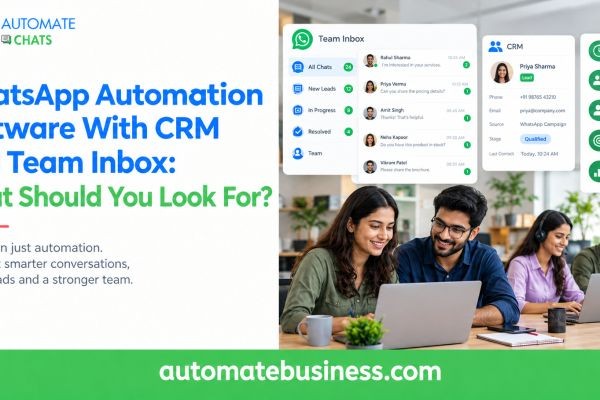
Good WhatsApp automation software should do three things: automate repeat conversations, connect chats to a CRM, and give your whole team one shared inbox. It should run on the official WhatsApp Business API, so you can send campaigns and scale without risk. If any of these is missing, leads still slip through the cracks.
Automate Chats WhatsApp API Marketing combines all three in one workspace for growing businesses. This guide explains what to look for in WhatsApp automation software, how a WhatsApp CRM and team inbox work together, and the questions to ask before you buy.
Why Automation, CRM and Inbox Must Work Together
Many businesses use one tool for bulk messages, another for chats and a spreadsheet for leads. This creates gaps. A customer replies to a campaign, but the sales team never sees it.
A connected setup solves this. Automation handles routine messages, the WhatsApp CRM tracks every lead, and the WhatsApp team inbox lets people step in when a human is needed.
When these three parts share the same data, nothing gets lost. An agent can open a chat and see who the customer is, what they asked and what was already sent.
So the real question is not “which tool automates the most?” It is “which tool keeps the whole customer journey in one place?”
What to Look For in WhatsApp Automation Software
Start with the automation itself. Strong software should cover the daily jobs that eat up your team’s time. Look for automated replies, scheduled follow-ups, reminders and after-hours responses. For example, a new website lead can get a welcome message at once, a product guide the next day and a check-in after three days.
Next, check for common business uses. Good software supports sales follow-ups, order updates, appointment reminders and customer support routing. It should also support marketing broadcasts to segmented audiences.
Most importantly, test how easy the setup is. If your team needs a developer to change a message, the automation will soon become outdated. Choose a tool that non-technical staff can edit on their own.
Look for No-Code Chatbots and AI Assistants
Chatbots are the engine of WhatsApp automation. They answer first, collect details and guide the customer to the next step.
A no-code WhatsApp chatbot lets you build step-by-step flows without writing code. A good flow asks a question, saves the answer, routes the chat by response and assigns it to the right person. Automate Chats, for example, can send a hot lead to sales by round-robin assignment in under two minutes.
AI assistants go one step further. They answer common questions using the information you provide, such as your product catalogue or return policy.
Check that the AI hands over to a human when needed. For instance, a refund above a set amount should go to your team. An AI that knows when to stop protects your brand.
Why the WhatsApp CRM Connection Matters
A WhatsApp CRM turns chats into a sales pipeline. Without it, conversations stay trapped inside the inbox. Look for a CRM link that works in both directions. When a lead moves to a new stage, the software should send the right WhatsApp message automatically. When a customer replies, the lead record should update.
Also check what the CRM covers beyond chat. Useful features include follow-up reminders, quotations, payments and lead import from sources such as IndiaMART and TradeIndia. Automate CRM, part of the same Automate Business suite, supports these and offers unlimited users. Finally, ask about contact management. Tags, groups and owners help you segment audiences for campaigns and keep customer details tidy.
Don’t Overlook the WhatsApp Team Inbox
Automation cannot handle everything. Some customers want a person, and your inbox decides how well that goes. A good WhatsApp team inbox puts all sales and support chats in one view. You should see which chats are waiting and which are unassigned. Then check the teamwork tools. You need chat assignment, internal notes and full conversation history. Agents should be able to ask a colleague a question inside the chat without the customer seeing it.
Also look at access control. Role-based permissions and audit logs let you decide who sees which contacts. This matters as your team grows. A simple test works well in a demo. If one agent is absent tomorrow, can another person pick up the chat without asking the customer to repeat everything?
Campaigns, Analytics and Integrations
Three more capabilities complete the picture.
- Broadcast campaigns. WhatsApp marketing uses approved message templates. Your software should let you choose an audience, personalize messages and see delivered, read and reply results in one place.
- Analytics. You should see conversation volume, first reply time, resolution rate and team workload. Campaign, chatbot and AI results should appear in the same dashboard, so you do not need to build spreadsheet reports.
- APIs and webhooks. Customer requests should flow into your other systems. Look for REST APIs, webhooks and connections to tools like Google Sheets, Slack and Gmail. Also confirm that onboarding is simple. Bulk upload of contacts by CSV and help from the provider should get you live in days, not weeks.
How Automate Chats Is Different
Many tools handle just one part of the job. Some focus on bulk messaging, others on a basic shared screen, and others on bots alone. You then pay for, learn and connect several products. Automate Chats takes a different approach. It brings the team inbox, broadcast campaigns, WhatsApp automation, no-code chatbots, AI assistants, contact management, analytics and APIs into one shared workspace.
It also connects naturally to a CRM. As part of the Automate Business suite, it sits alongside CRM, tasks, forms and attendance. A WhatsApp lead can move into your sales pipeline without copy-pasting. It is built for MSMEs, too. Small teams with limited budgets and no IT staff can set it up quickly. It runs on the official WhatsApp Business API as a Meta Business Partner product, and you can start with a 7-day free trial.
Quick Checklist Before You Buy
Before choosing any WhatsApp automation software, ask these questions.
Does it use the official WhatsApp Business API? Can non-technical staff build chatbots and follow-ups? Does it connect to a CRM and update lead stages?
Can many agents share one number with clear ownership? Does the AI hand over to humans? Do analytics show response times and team load?
If most answers are yes, book a demo and test your own workflow.
Frequently Asked Questions
- What is WhatsApp automation software?
WhatsApp automation software sends replies, reminders and follow-ups automatically through the WhatsApp Business API. Good tools also add chatbots, campaigns and a shared inbox. This saves time and keeps customers engaged. - Why do I need a WhatsApp CRM with a team inbox?
A WhatsApp CRM tracks every lead, while the team inbox lets your staff reply together. Combined, they stop leads being lost and give agents full context. You also get one view of the whole customer journey. - Can WhatsApp chatbots replace my team?
No. Chatbots and AI assistants handle common questions and collect details. Your team should still step in for complex or sensitive requests, which a shared inbox makes easy. - Is Automate Chats good for small businesses?
Yes. It is designed for MSMEs and growing businesses, with simple setup and a 7-day free trial.
Final Thoughts
The best WhatsApp automation software does more than send messages. It links automation, a CRM and a team inbox, so every chat becomes a clear next step. Use the points above as your checklist, then see the features working together in a live demo. Ready to start? Try Automate Chats free for 7 days or book a demo at automatechats.com.