
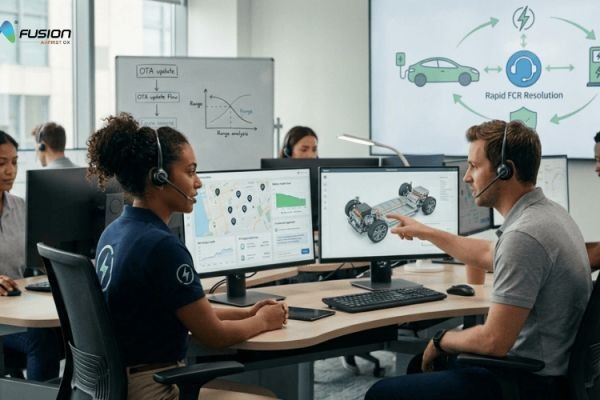
The electric vehicle revolution is roaring ahead across the US, Canada, and Europe. But here's the uncomfortable truth that's keeping automotive executives up at night: we've gotten really good at making EVs, but we're struggling badly at supporting them.
The numbers don't lie. A staggering 68% of EV owners [https://www.fusioncx.com/blog/high-tech/automotive-and-emobility/why-ev-owners-are-frustrated-with-after-sales-support-and-how-bpos-bridge-the-gap/] say their biggest headache isn't range anxiety or charging speed—it's the quality of after-sales support they receive. And honestly? I get it.
Here's the thing about modern EVs—they're not really cars anymore. They're giant computers on wheels. When something goes wrong, you can't just pop down to your local mechanic who's been fixing combustion engines since the 90s. You need someone who understands battery management systems, firmware updates, and charging network protocols.
For the automakers, charging station operators, and fleet managers trying to keep up, building this kind of specialized support in-house is both astronomically expensive and operationally exhausting. So what's the answer? Let's dive in.
What's Actually Going Wrong with EV Support?
Traditional car support was built for a simpler world. Need a oil change? Here's your nearest dealer. Stuck on the highway? We'll send a tow truck. Basic stuff, right?
But EV owners are calling about completely different problems. When their car acts up, it's rarely a mechanical failure. Instead, they're wrestling with:
-
Software bugs from a recent over-the-air (OTA) update
-
Battery management system errors
-
Charging synchronization issues with smart grids
-
Payment gateway failures at public charging stations
Here's a reality check: if your support agent can't tell the difference between a dying 12V auxiliary battery and a thermal management software glitch, your customer satisfaction scores are going to plummet. And when frustrated drivers start venting on social media, that damage spreads fast.
The result? Longer call handling times, lower first-call resolution rates, and a whole lot of angry customers who just want their expensive car to work properly.
The Three Headaches That Make EV Support So Tricky
1. OTA Updates That Go Sideways
Modern EVs improve over time through software updates. Sounds great, right? Until an update stalls mid-download or introduces an unexpected bug in the powertrain control module. Suddenly your driver is staring at a dashboard full of warning lights, convinced their car is bricked.
Resolving these issues isn't like walking someone through a password reset. It requires genuine technical diagnostic skills—the kind that standard call center training just doesn't provide.
2. Charging Network Chaos
Let's be honest: public charging infrastructure still has major reliability issues across North America and Europe. Broken stations, grid power drops, payment system failures—the list goes on.
When you're running low on battery and the charger won't cooperate, you need help immediately. Not tomorrow. Not after navigating a phone tree. Right now. And that help needs to be both technically competent and genuinely empathetic.
3. The Paperwork Nightmare
Green subsidies and tax credits are great—until you have to actually claim them. With different programs across the US, Canada, and EU, processing these incentives has become a bureaucratic minefield. Miss a document or make a processing error, and suddenly your customer is waiting months for money they were counting on.
How Smart Outsourcing Is Changing the Game
Forward-thinking EV companies are realizing they don't have to build this expertise from scratch. Instead, they're partnering with specialized automotive BPO [https://www.fusioncx.com/industries/high-tech/automotive-and-emobility/] providers like Fusion CX who already speak the language of e-mobility.
Real Technical Knowledge, Not Scripts
Fusion CX [https://www.fusioncx.com/] isn't your generic call center. Their agents receive specialized training on EV product lines, battery health analytics, and charging architecture. They actually understand the terminology and technical concepts their customers are dealing with.
But here's where it gets interesting: they also use an AI assistant called Arya that provides real-time knowledge lookups during live calls. So when a customer is describing a complex issue, the agent gets instant recommendations on diagnosis and next steps. This dramatically reduces handle times while improving accuracy.
Support That Never Sleeps
EV drivers don't keep regular business hours, and neither should your support. Fusion CX provides 24/7 coverage across voice, chat, email, SMS, and social media—in 28+ languages. Whether your customer is in rural Texas, downtown Berlin, or somewhere in between, they get consistent, high-quality support.
Taking the Back-Office Burden Off Your Plate
Beyond customer-facing support, there's a mountain of operational work that comes with running an EV brand: vehicle registrations, warranty claim processing, roadside assistance coordination. These tasks consume enormous resources and distract from core product development.
By offloading these functions to a specialized partner, automakers can keep their engineering and marketing teams focused on what they do best—building better EVs and growing the brand.
Why This Actually Matters for Your Bottom Line
Here's the business case for outsourcing EV support:
-
Cost savings: Switching to a specialized global support model can slash overhead costs by 40-60%. That's real money that can be reinvested in R&D and innovation.
-
Better customer metrics: When customers reach a knowledgeable agent who resolves their issue on the first call, satisfaction scores and brand loyalty increase dramatically.
-
Flexibility: Support capacity can scale up or down based on product launches, seasonal demand, or unexpected software issues. No expensive infrastructure changes required.
The Bottom Line
The future of electric mobility isn't just about the vehicles—it's about the experience that comes after the sale. Software glitches will happen. Charging networks will have issues. That's inevitable.
What separates the brands that thrive from those that struggle is how effectively and empathetically they handle those moments of friction. By partnering with experts who genuinely understand the EV ecosystem, automakers can turn these routine challenges into opportunities for building lasting customer trust.
Because at the end of the day, satisfied EV owners don't just stay loyal—they become advocates who help drive the sustainable revolution forward.






