
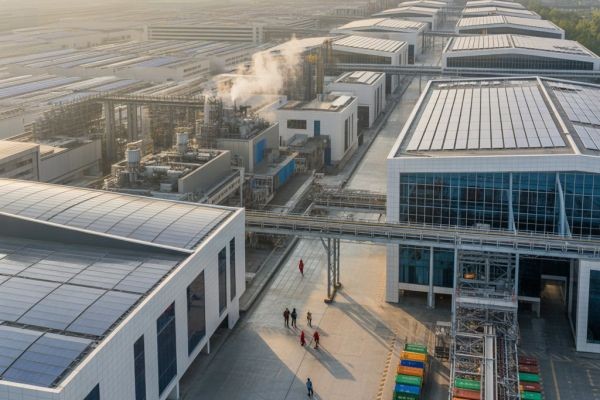
Walk into any mid-sized food manufacturing facility in Guangdong or Zhejiang, and you'll often see the same problem: outdated equipment struggling to meet modern demands.
Production lines that were cutting-edge a decade ago now bottleneck output. Manual processes create hygiene risks that fail international audits. Energy consumption eats into already thin margins. And when export orders require certifications like HACCP, ISO 22000, or FDA compliance, older equipment simply can't deliver the documentation or consistency needed.
This isn't just an operational headache it's an existential threat. Chinese food producers face mounting pressure from three directions: domestic consumers demanding higher quality and safety, international buyers requiring stricter compliance, and competitors who've already modernized gaining market share.
In 2026, the gap between factories running legacy systems and those equipped with advanced processing technology isn't narrowing it's widening. The manufacturers investing in modern, compliant equipment are scaling faster, winning premium contracts, and operating at significantly lower per-unit costs.
This guide examines why upgrading production equipment has become non-negotiable, what capabilities modern systems must deliver, and how Chinese manufacturers are solving these challenges through strategic equipment partnerships.
The Real Cost of Outdated Food Processing Equipment
Let's be specific about what "outdated" actually means in practical terms.
Production Inefficiency and Downtime
Older mixing, filling, or packaging machines break down more frequently. Parts become hard to source. Maintenance windows extend from hours to days. When you're committed to shipping 50,000 units by month-end and your filling line goes down for three days, you don't just miss deadlines you lose contracts.
Inconsistent Product Quality
Manual control systems can't maintain the precise temperature, pressure, or timing that modern food processing requires. Batch-to-batch variation increases. Rejection rates climb. Your reputation suffers, especially when servicing quality-conscious markets like Japan, the EU, or North America.
Hygiene and Contamination Risks
Equipment with complex joints, non-food-grade materials, or designs that trap residue becomes a contamination vector. In an era where a single food safety incident can destroy a brand overnight and trigger recalls costing millions this risk is unacceptable.
Compliance Failures
International standards require documented traceability, validated cleaning procedures, and equipment design that prevents cross-contamination. Older systems can't generate the data trails required for certification. You either fail audits or spend excessive resources trying to retrofit compliance into incompatible equipment.
Energy and Resource Waste
Legacy machines consume 30-50% more energy and water than modern counterparts. In an industry where margins are often single-digit percentages, this inefficiency directly impacts profitability.
What Modern Food Production Equipment Must Deliver
The baseline has shifted. Equipment purchased in 2026 must meet substantially higher standards than what was acceptable even five years ago.
1. Automated Process Control
Modern systems integrate PLCs (programmable logic controllers) and HMI (human-machine interface) panels that allow precise control over every production parameter. Temperature, flow rate, mixing speed, filling volume all monitored and adjusted in real-time.
This automation doesn't just improve consistency; it generates the data logs required for traceability and compliance documentation.
2. Hygienic Design Standards
Equipment must follow internationally recognized hygienic design principles:
- 304 or 316 stainless steel construction
- Smooth, crevice-free surfaces
- Self-draining components
- Tool-free disassembly for cleaning
- FDA or 3-A compliant materials
These aren't luxury features they're requirements for anyone serious about food safety or export markets.
3. Modular and Scalable Architecture
Production needs change. Seasonal products, new SKUs, and market expansion require flexibility. Modern equipment uses modular designs that allow capacity increases or product changeovers without replacing entire lines.
4. Energy Efficiency and Sustainability
Heat recovery systems, variable frequency drives, and optimized fluid dynamics reduce energy consumption by 25-40%. Water recycling and CIP (clean-in-place) systems minimize waste.
These features aren't just environmentally responsible they're financially strategic in regions facing rising utility costs.
5. Integration Capability
Standalone machines are increasingly obsolete. Modern facilities need equipment that integrates with MES (manufacturing execution systems), ERP platforms, and quality management software. Real-time production monitoring, predictive maintenance alerts, and automated reporting become standard.
6. Support for Multiple Product Types
The ability to process various viscosities, handle different packaging formats, or switch between hot-fill and cold-fill operations within the same line maximizes equipment ROI and market responsiveness.
Why Chinese Manufacturers Are Leading the Modernization Wave
China's food processing sector is undergoing rapid transformation, driven by several converging factors.
Rising Domestic Quality Expectations
Chinese consumers are increasingly quality-conscious. The days when price alone drove purchasing decisions are over. Food safety scandals of the past decade created demand for transparency, traceability, and premium products.
Manufacturers serving the domestic market must upgrade or lose ground to competitors who can prove quality through certified processes.
Export Market Requirements
Accessing premium export markets requires meeting international standards that simply can't be achieved with outdated equipment. European buyers demand EU machinery directive compliance. U.S. importers require FDA-compatible processes. Middle Eastern markets want halal certification all of which require specific equipment capabilities.
Government Regulatory Pressure
Chinese food safety regulations have tightened substantially. The 2015 Food Safety Law and subsequent updates impose strict liability. Provincial inspections are more frequent and thorough. Non-compliant facilities face shutdowns, fines, and public exposure.
Modern equipment is often the only practical path to compliance.
Labor Cost Pressures
Wages have risen significantly across coastal manufacturing regions. Automation that was once a luxury is now an economic necessity. Equipment that reduces headcount while improving output quality delivers rapid payback.
Technology Accessibility
Advanced processing equipment that was previously only available from European or Japanese manufacturers at premium prices is now produced domestically with comparable quality at 40-60% lower cost.
How Mekantra Technology Addresses Modern Processing Challenges
Let's examine what differentiated equipment solutions look like in practice.
Mekantra Technology has positioned itself as a provider specifically focused on the challenges Chinese food manufacturers face when modernizing production lines.
Comprehensive Equipment Range
Rather than forcing manufacturers to source mixing equipment from one supplier, filling machines from another, and packaging systems from a third creating integration headaches and finger-pointing when issues arise Mekantra offers complete processing line solutions.
This includes:
- Mixing and blending systems for liquid, paste, and powder products
- Homogenizers and emulsifiers for stable suspensions
- Pasteurization and sterilization equipment
- Filling and capping machines for various container types
- Labeling and packaging automation
- CIP systems and hygiene infrastructure
Compliance-Ready Design
All equipment follows international hygienic design standards and comes documentation-ready for ISO 22000, HACCP, GMP, and FDA compliance. This isn't about selling certificates it's about equipment design that makes compliance achievable and auditable.
For manufacturers targeting export markets, this eliminates the common problem of buying equipment that technically works but can't pass international audits.
Customization for Chinese Production Realities
Not all facilities have unlimited floor space, three-phase power availability, or sophisticated maintenance teams. Mekantra designs equipment accounting for these practical constraints while still meeting international standards.
This includes space-efficient layouts, adaptable power configurations, and maintenance procedures that don't require specialized training or hard-to-source parts.
Technology Transfer and Training
Buying advanced food processing industry machinery is one thing; operating it effectively is another. Mekantra provides comprehensive technical training, operation manuals in Chinese, and ongoing support that helps manufacturers maximize equipment capability.
This addresses a common failure point where sophisticated equipment underperforms because operators don't fully understand its capabilities or maintenance requirements.
Practical ROI Focus
Equipment sales in the food industry often involve impressive specifications that don't translate to real operational benefits. Mekantra's approach focuses on measurable outcomes: reduced downtime, lower rejection rates, energy savings, increased throughput, and compliance achievement.
This practical orientation resonates with manufacturers who've been burned by previous equipment purchases that promised much and delivered little.
Real-World Applications Across Product Categories
Modern processing equipment isn't one-size-fits-all. Different food categories present unique challenges.
Dairy and Beverage Production
Milk, yogurt, juice, and tea beverages require precise temperature control, sterile processing, and gentle handling to preserve nutritional value and flavor. Equipment must support pasteurization or UHT treatment, aseptic filling, and extended shelf-life packaging.
Modern systems achieve this while reducing product loss during changeovers and minimizing cleaning downtime between batches.
Sauces, Condiments, and Seasonings
Products like soy sauce, chili paste, vinegar, and liquid seasonings involve complex mixing, fermentation monitoring, filtration, and hot-fill or retort processing. Equipment must handle varying viscosities, prevent settling or separation, and ensure seal integrity.
Automated systems maintain consistency across massive production volumes while reducing labor requirements.
Baked Goods and Snack Foods
Mixing dough, forming products, baking, cooling, and packaging require integrated lines where timing and environmental control are critical. Modern equipment provides precise recipe management, automated forming, and packaging that extends shelf life.
Prepared Foods and Ready-to-Eat Meals
This rapidly growing category demands equipment that can handle cooking, cooling, portioning, and modified atmosphere packaging all while maintaining strict hygiene and traceability.
The Strategic Decision: When to Upgrade vs. Replace
Not every facility needs complete line replacement. Sometimes targeted upgrades deliver better ROI.
Signs You Need Complete Replacement
- Equipment regularly fails compliance audits
- Downtime exceeds 15% of production time
- Spare parts are unavailable or prohibitively expensive
- Product rejection rates remain high despite process optimization
- You're losing contracts specifically due to equipment limitations
When Targeted Upgrades Work
- Core equipment is sound but lacks automation
- Bottlenecks exist at specific production stages
- You're adding new product lines requiring specialized capability
- Compliance gaps involve specific process stages, not entire systems
Implementation: How to Actually Make the Transition
Buying equipment is the easy part. Successful implementation requires planning.
Assess Current State Honestly
Document your actual production capacity, downtime causes, quality issues, and compliance gaps. Manufacturers often discover that "equipment problems" are actually process or training issues, or vice versa.
Define Specific Outcomes
"Better equipment" isn't a goal. "Reduce product rejection from 3.2% to under 1%" or "achieve HACCP certification by Q3" or "increase line speed by 40% while maintaining quality" are goals. Equipment specifications should map directly to these outcomes.
Plan for Installation Downtime
Production doesn't stop just because you're upgrading. Develop realistic installation timelines, temporary production alternatives, and customer communication plans.
Invest in Training
The best equipment fails without proper operation. Budget time and resources for comprehensive operator and maintenance training.
Validate and Document
New equipment must undergo installation qualification (IQ), operational qualification (OQ), and performance qualification (PQ). This documentation is essential for compliance and provides baseline performance metrics.
Looking Forward: Where Food Processing Technology Is Headed
Understanding emerging trends helps future-proof equipment investments.
AI-Driven Quality Control
Computer vision systems and machine learning algorithms increasingly handle real-time quality inspection, detecting defects or contamination that human operators miss.
Predictive Maintenance
IoT sensors and data analytics predict equipment failures before they occur, shifting maintenance from reactive to preventive and eliminating unexpected downtime.
Greater Sustainability Integration
Equipment designed for water recycling, energy recovery, and minimal waste generation becomes standard rather than optional as environmental regulations tighten.
Flexible Manufacturing Systems
The ability to rapidly reconfigure production lines for different products, batch sizes, or packaging formats becomes crucial as market demands become less predictable.
Final Thoughts: Modernization as Competitive Necessity
The Chinese food manufacturing sector stands at an inflection point. Producers who modernize their processing capabilities will capture growing domestic demand and premium export opportunities. Those who delay will find themselves increasingly unable to compete on quality, efficiency, or compliance.
Modern processing equipment isn't about keeping up with competitors it's about defining new standards they'll struggle to match.
Mekantra Technology has built its approach around the specific challenges Chinese manufacturers face: balancing international quality standards with domestic production realities, achieving compliance without prohibitive costs, and modernizing incrementally without disrupting existing operations.
Frequently Asked Questions
What is the typical payback period for modern food processing equipment?
Payback periods vary based on production volume, labor costs, and energy prices, but most manufacturers see ROI within 18-36 months. High-volume operations replacing particularly inefficient equipment often achieve payback in under 18 months through reduced downtime, lower rejection rates, decreased energy consumption, and reduced labor requirements. Smaller operations or those adding capacity rather than replacing may see 3-4 year payback periods.
How do Chinese-manufactured processing machines compare to European or Japanese equipment?
Quality gaps have narrowed significantly. Leading Chinese manufacturers now produce equipment meeting the same hygienic design standards, using comparable materials (304/316 stainless steel), and achieving similar performance specifications as European counterparts typically at 40-60% lower cost. The main differences often involve brand reputation and after-sales support networks rather than fundamental engineering quality. For manufacturers focused on domestic or regional markets, Chinese equipment often provides better value; for those requiring specific European certifications or serving markets with strong brand preferences, imported equipment may still be preferred despite higher costs.
What compliance certifications should food processing equipment have?
Essential certifications depend on your target markets. For domestic Chinese production, equipment should meet GB (national standard) requirements and facilitate HACCP and ISO 22000 compliance. For export markets, look for CE marking (Europe), FDA compliance or 3-A certification (United States), and hygienic design conformity to EHEDG guidelines. The equipment itself may not need certification, but its design and materials must enable your facility to achieve required process certifications. Always verify that suppliers provide the documentation (material certificates, design specifications, validation protocols) needed for your compliance audits.






