
Introduction
As products move from development into commercial production, manufacturers need a process that delivers consistent quality, fast production speeds, and cost-effective scalability. Plastic injection moulding [https://forgelabs.com.au/injection-moulding] has become the preferred manufacturing method for businesses worldwide because it combines precision engineering with high-volume production capabilities. From consumer goods and electronics to automotive and medical devices, injection moulding enables the efficient production of durable plastic components with exceptional repeatability.
Forge Labs provides comprehensive injection moulding services across Australia, helping businesses transition from prototypes to full-scale manufacturing. With expertise in tooling, engineering polymers, T1 sampling, and production management, Forge Labs supports projects ranging from 100-part bridge runs to multi-million-unit production programs.
What Is Injection Moulding?
Injection moulding is a manufacturing process where plastic resin is heated and injected into a precision-machined mould cavity under pressure. Once cooled, the material solidifies into the desired shape and is ejected from the mould. This process repeats rapidly, allowing manufacturers to produce large quantities of identical components with remarkable consistency.
Because tooling is reused throughout production, injection moulding offers one of the lowest per-unit manufacturing costs available for medium and high-volume production.
Key Benefits of Injection Moulding
Cost Efficiency at Scale
Although tooling requires an upfront investment, the cost per part decreases significantly as production volumes increase. This makes injection moulding ideal for products with ongoing manufacturing requirements.
Exceptional Consistency
Every component is produced using the same mould, ensuring uniform dimensions, surface finish, and performance across the entire production run.
Fast Production Cycles
Modern injection moulding equipment can manufacture thousands of parts quickly, reducing lead times and improving production efficiency.
Wide Material Selection
Manufacturers can choose from a broad range of engineering polymers to meet specific strength, flexibility, temperature, and durability requirements.
Complex Part Geometry
Injection moulding can produce intricate designs, snap-fit features, internal structures, and cosmetic finishes that may be difficult to achieve using alternative manufacturing methods.
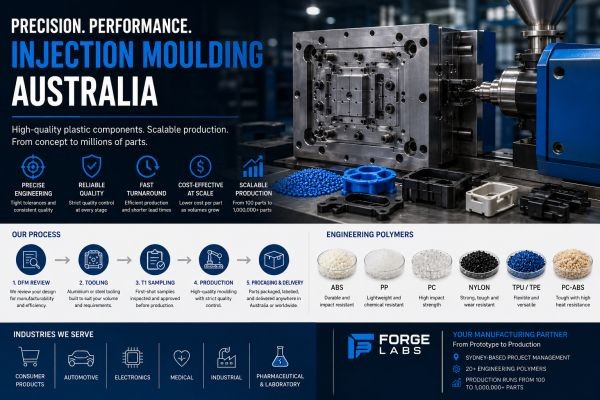
Forge Labs' Manufacturing Process
Forge Labs follows a structured workflow designed to reduce manufacturing risks and improve production outcomes.
Design for Manufacturing (DFM) Review
Every project begins with an engineering assessment that evaluates:
- Wall thickness
- Draft angles
- Gate placement
- Material selection
- Production volume requirements
This process helps identify potential issues before tooling is manufactured.
Tooling Development
Forge Labs offers both aluminium and steel tooling solutions.
Aluminium Tooling
- Faster lead times
- Lower initial investment
- Ideal for prototypes and bridge production
- Suitable for 100–10,000 parts
Steel Tooling
- Designed for long-term manufacturing
- Excellent durability
- Supports 10,000–1,000,000+ parts
T1 Sampling
Before production begins, first-shot sample parts are produced and inspected. Customers approve these samples before manufacturing proceeds, ensuring quality expectations are met.
Production and Logistics
Once approved, Forge Labs manages production, quality control, packaging, labelling, and freight coordination to provide a complete manufacturing solution.
Engineering Polymers Available
Forge Labs works with more than 20 engineering-grade plastics, including:
ABS
Durable and versatile for consumer products and housings.
Polypropylene (PP)
Lightweight, flexible, and suitable for food-contact applications.
Polycarbonate (PC)
Offers high impact resistance and optical clarity.
PC-ABS
Combines toughness and heat resistance for demanding applications.
Nylon (PA6 & PA66)
Ideal for structural and wear-resistant components.
TPU & TPE
Flexible materials used for grips, seals, and over-moulding.
ASA
UV-resistant plastic designed for outdoor use.
Industries Served
Injection moulding supports a wide variety of industries, including:
Consumer Products
Retail-ready products, packaging, and accessories.
Automotive
Clips, brackets, housings, trims, and aftermarket components.
Electronics
Protective enclosures and production-grade housings.
Medical Devices
Equipment housings, disposable products, and fluid-handling components.
Industrial Manufacturing
Machine components, covers, handles, and equipment housings.
Pharmaceutical & Laboratory
Containers, packaging systems, and specialised plastic products.
Why Australian Businesses Choose Forge Labs
Forge Labs has become a trusted manufacturing partner by combining engineering expertise with scalable production capabilities.
Key advantages include:
- Sydney-based project management
- Transparent tooling pricing
- Production runs from 100 to 1,000,000+ parts
- Aluminium and steel tooling options
- T1 sample approval process
- Access to 20+ engineering polymers
- End-to-end manufacturing support
- Packaging and freight management
Whether you're developing a new product or expanding production capacity, Forge Labs provides the expertise and infrastructure needed for successful manufacturing outcomes.
Conclusion
Injection moulding remains the most effective solution for producing high-quality plastic components at scale. By combining precision tooling, advanced materials, and efficient production workflows, businesses can achieve lower manufacturing costs, improved consistency, and faster time-to-market.
Forge Labs delivers complete injection moulding services throughout Australia, helping businesses move from concept and prototyping to commercial production with confidence. From 100-part bridge runs to million-unit manufacturing programs, Forge Labs provides reliable, scalable, and cost-effective plastic manufacturing solutions.






