
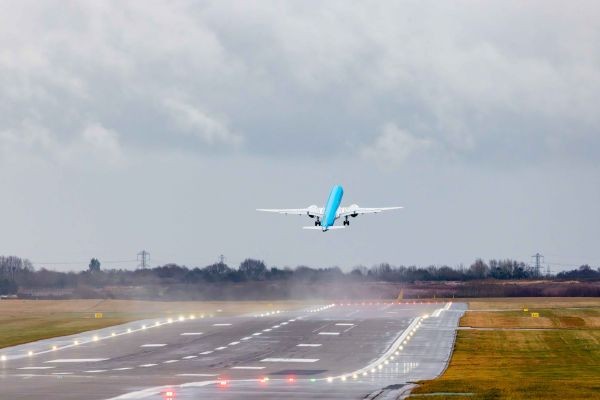
Aviation is an industry built on precision. From the engineering of an aircraft's wing to the timing of its arrival slot, every element is designed to eliminate uncertainty. Yet, the final minutes of a flight—the approach and landing—remain the most demanding phase, where the margin for error is smallest. It is here, often in challenging weather, that one of the most vital technologies in aviation history demonstrates its worth.
Creating a Pathway of Confidence
This is the problem that Instrument Landing Systems [https://www.bayanatengineering.qa/instrument-landing-system-guide/] were designed to solve. They remove the need for visual guesswork by providing the flight crew with continuous, objective data about their position relative to the runway. The system generates two radio beams: a "localizer" for horizontal (left/right) guidance and a "glideslope" for vertical (up/down) guidance.
In the cockpit, these signals are translated into simple visual indicators on the primary flight display. A pilot's job is to keep the crosshairs centered. This seemingly simple task has profound implications for safety.
The ability to land an aircraft safely when fog, rain, or snow obscures the runway is not a matter of luck. It is a carefully managed procedure enabled by ground-based radio navigation. For decades, this capability has been synonymous with one system above all others. This technology provides a reliable, invisible highway in the sky, guiding pilots with unerring accuracy to the runway threshold.
This article explores why these guidance systems are a cornerstone of modern aviation safety. We will examine how they reduce pilot workload, mitigate human error, and function as a fail-safe when visual references disappear, and how robust engineering ensures they operate flawlessly in any environment.
The Challenge of Landing Blind
To appreciate the system's importance, one must first understand the difficulty of landing without it in poor weather. A pilot relies on a constant stream of visual cues during approach: the angle of the runway, the approach lights, and the horizon. These cues allow for continuous micro-adjustments to maintain a stable descent path.
When visibility drops, these cues vanish. The human brain, deprived of its primary spatial reference, becomes susceptible to disorientation. A pilot might perceive the aircraft is level when it is actually banking, or that the descent rate is stable when it is increasing. This is where the risk of a Controlled Flight Into Terrain (CFIT) accident—where a perfectly functioning aircraft is flown into the ground, water, or an obstacle—becomes a serious threat.
Reducing Pilot Workload and Human Error
During a low-visibility approach, a pilot's cognitive load is immense. They are monitoring airspeed, altitude, engine parameters, and communicating with air traffic control. By providing a clear, unambiguous steering command, the ILS frees up mental capacity. Instead of searching for visual cues that are not there, the pilot can focus on flying the aircraft smoothly and precisely along the designated path.
This is particularly crucial in preventing one of the most common landing errors: an unstabilized approach. This occurs when an aircraft is too high, too fast, or not properly configured for landing. An ILS guides the plane onto a predetermined 3-degree glideslope, establishing a stabilized descent from miles out and drastically reducing the chances of a last-minute, high-risk correction.
Enabling All-Weather Operations
Beyond individual flight safety, the widespread adoption of this technology has had a transformative effect on the entire aviation network. Before its invention, airports would simply shut down when thick fog rolled in, leading to massive disruptions. Today, properly equipped airports can continue operations safely in visibility conditions that would have been unthinkable a generation ago.
This reliability is categorized by precision levels:
- CAT I approaches allow for landings with visibility down to about 550 meters.
- CAT II pushes this to around 300 meters.
- CAT III enables landings in near-zero visibility, often with the autopilot flying the aircraft directly onto the runway.
Each category requires progressively more precise ground equipment and crew training, but the result is the same: the safe continuation of air travel when nature attempts to intervene. This operational continuity is not just a matter of convenience; it ensures that critical medical flights can land and that global supply chains keep moving, regardless of the weather.
The Unseen Importance of Engineering and Maintenance
The guidance provided by an ILS is only as reliable as the ground infrastructure that generates it. The radio signals are incredibly sensitive. A vehicle parking in the wrong spot, a new building, or even deep snow can reflect or bend the beams, potentially leading to inaccurate guidance.
For this reason, airports establish protected "critical areas" around the ILS antennas. During low-visibility operations, these zones are kept clear to ensure the signal remains pure. The system itself is designed with fail-safe principles at its core. It continuously self-monitors; if the signal deviates from its specified tolerance by even a fraction of a degree, it will automatically shut down and alert air traffic control in less than a second. This ensures that pilots are never given dangerous, misleading information.
Engineering for Resilience in Extreme Climates
Maintaining this level of precision in harsh environmental conditions presents a formidable challenge. In regions with extreme heat and dust, standard electronic equipment is prone to failure. The sophisticated airport engineering Qatar [https://www.bayanatengineering.qa/] has deployed at its international hubs showcases how to build resilience into this critical infrastructure.
In an environment where temperatures can exceed 50°C (122°F), thermal expansion can cause minute shifts in antenna alignment, and fine, abrasive dust can clog cooling systems. To counteract this, transmitter equipment is housed in climate-controlled shelters with redundant cooling systems. Antennas are built on deep, stable foundations to prevent any movement, and their components are sealed against the corrosive effects of saline humidity. This meticulous engineering guarantees that the system delivers the same level of safety and precision whether it's a cold, foggy morning in London or a hot, hazy afternoon in Doha.
Integration with Modern Avionics
The ILS does not operate in isolation. It is a key component of a deeply integrated flight management system. The signals feed directly into the aircraft’s autopilot, allowing for a "coupled approach" where the plane flies the path automatically with a level of precision a human pilot cannot match.
This integration is the foundation of CAT III auto-land capabilities. The autopilot, guided by the ILS, can flare the aircraft, reduce thrust to idle, and touch down on the runway centerline without any pilot intervention. The pilot's role shifts from "flying" to "monitoring," ready to take over if needed. This level of automation is the ultimate defense against human spatial disorientation in the final, critical phase of flight.
Conclusion
The Instrument Landing System is a quiet guardian of the skies. It does not have the visible power of a jet engine or the sleek profile of a wing, but its contribution to aviation safety is immeasurable. By providing a clear, reliable path through the most challenging weather, it replaces uncertainty with confidence.
It empowers pilots to manage high-workload situations, mitigates the risk of human error, and allows the global air transportation system to function with a level of reliability that would otherwise be impossible. The next time your flight descends through a solid layer of clouds and touches down smoothly on a runway you could not see until the last second, you are experiencing the legacy of a system that has been making landings safe for over 75 years.






