
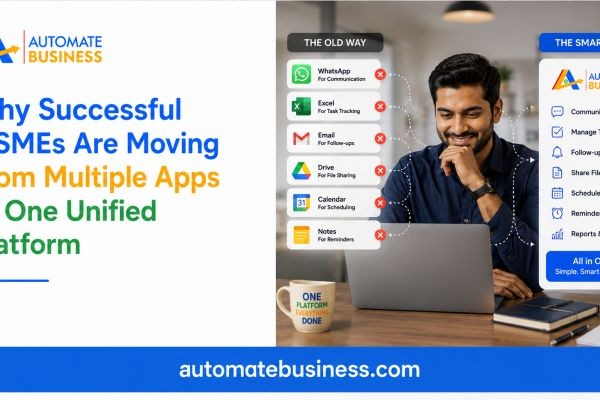
There is a pattern that appears consistently across growing MSMEs in India. In the early days, the business runs on instinct and hustle. A WhatsApp group here, a spreadsheet there, maybe a separate app for attendance and another for invoicing. Each tool solves an immediate problem. Each feels like progress. And for a while, the combination works well enough.
Then the business grows. More customers. More staff. More processes. And suddenly the stack of tools that once felt like solutions starts feeling like the problem itself. Data is scattered across platforms. Teams operate in silos. The owner spends more time chasing updates from multiple apps than making decisions from them.
This is the moment successful MSMEs make the shift from a collection of disconnected tools to a single, unified platform designed to run the entire business from one place.
Automate Business [https://www.automatebusiness.com/] is built for exactly this moment. With five powerful apps in one connected workspace Automate Tasks, Automate CRM, Leave and Attendance, Automate Forms, and Automate Chats it gives growing MSME teams one platform where tasks, leads, attendance, forms, and WhatsApp communication all stay visible, connected, and actionable. Over 12,000 MSMEs across India have already made this shift. Here is why it is happening and why the businesses moving first are gaining a significant operational edge.
The Hidden Cost of Running a Business on Multiple Apps
Before understanding why MSMEs are moving to unified platforms, it helps to understand what the multi-app problem actually costs.
The obvious cost is money. Subscriptions for a CRM, a task management app, an attendance tracker, a form builder, and a WhatsApp marketing platform add up quickly often significantly more than a single platform covering all five functions.
But the less visible cost is far more damaging: the cost of fragmentation. When a new customer inquiry arrives in the CRM but the follow-up task sits in a separate tool and communication happens on WhatsApp three pieces of the same workflow exist in three disconnected places. No single view shows the complete picture. The manager context-switches between apps, mentally connects the dots, and hopes nothing falls through the gaps.
This overhead the constant switching, the manual data transfer, the effort of maintaining coherence across platforms consumes hours every week. It is invisible on any balance sheet, but it is one of the most significant drains on MSME productivity.
Why Disconnected Tools Create Disconnected Teams
The problem with multiple apps goes beyond inefficiency it shapes how teams behave and communicate.
When the CRM team uses one platform, operations uses another, and HR uses a third, invisible silos develop. Information that should flow naturally between departments instead requires manual handoffs an email here, a WhatsApp message there, a call to confirm an update in the other system. These handoffs are friction. And friction at scale becomes failure.
A lead that converts in the CRM should automatically trigger an onboarding task. An attendance exception should notify the relevant manager. A form submission should create a CRM record and alert the assigned team member simultaneously. None of this happens automatically with separate tools. All of it happens seamlessly on a unified platform.
When information flows better, teams collaborate more effectively, managers make faster decisions, and customers receive more consistent service.
What a Unified Platform Actually Looks Like for an MSME
A unified platform for an MSME is not a monolithic tool that does everything adequately. It is a suite of purpose-built applications each designed for a specific function that share a common data layer, a common user base, and a common interface. Switching between functions feels like moving between rooms in the same building, not travelling between different cities.
The sales team manages leads and follow-ups in the CRM and the operations team sees immediately when a deal closes and a delivery task needs to be created. The HR manager tracks attendance in the same platform where department heads assign daily tasks to the same employees. Form submissions from clients route automatically into the CRM and trigger a WhatsApp notification to the assigned team member.
Everything is connected. Nothing needs to be manually transferred. Automate Business [https://www.automatebusiness.com/partner-with-us/] is built around this model its five integrated apps sharing one workspace where data and workflows connect naturally across functions.
The Five Specific Reasons MSMEs Are Making the Switch
- Reason 1: Owners Get Back Hours They Were Spending on Coordination
The average MSME owner running a business on multiple disconnected tools spends a significant portion of their day doing one thing: coordination. Checking which tasks were completed in one app. Reviewing lead status in another. Asking HR for an attendance report from a third system. Manually forwarding information from one platform to another.
A unified platform eliminates most of this. When tasks, CRM data, attendance records, and communication all live in one place, the owner opens one dashboard and sees everything. The coordination overhead collapses. Hours that were spent connecting dots are freed for strategy, customer relationships, and growth. - Reason 2: Teams Stop Falling Through the Cracks Between Tools
In a multi-app environment, the gaps between tools are where work goes to die. A lead follows up in the CRM but the task to prepare the proposal never gets created because the CRM does not talk to the task tool. An attendance exception is logged but the manager responsible is never notified because the attendance app and the task app are separate.
When apps are unified, these gaps disappear. Actions in one part of the platform automatically trigger the appropriate response in another. Work flows through the system rather than stopping at the boundary of each individual tool. - Reason 3: Data Accuracy Improves Significantly
Every time data moves between disconnected systems manually by a staff member or through a patched integration there is an opportunity for error. Numbers get entered incorrectly. Updates applied in one system are missed in another. Reports from different tools produce contradictory figures.
A unified platform has one data layer. There is no manual transfer and no synchronization problem because all functions draw from the same source. The attendance data feeding the payroll report is identical to what the manager sees on their dashboard. Data accuracy becomes a given rather than a constant concern. - Reason 4: Onboarding New Team Members Becomes Simpler
When a business runs on five separate tools, onboarding a new team member means five separate access grants, five different interfaces to learn, and the near-certainty that the new person will default back to WhatsApp because it is simpler.
A unified platform is one login, one interface, one mental model. The new team member learns the platform once and gains access to every function needed for their role. Onboarding time drops. Adoption is faster. The team operates from the same system rather than building individual workarounds around the gaps. - Reason 5: The Business Becomes Genuinely Scalable
An MSME running on disconnected tools can grow to a point. But as team size increases and operational complexity deepens, the friction from multiple tools compounds. Coordination takes more time. Errors increase. The owner's attention becomes the bottleneck.
A unified platform scales without this friction. Adding twenty new team members means twenty new logins not twenty onboarding sessions across five tools. Doubling the customer base means more leads and tasks in the system not a spreadsheet that collapses under volume. Scalability means systems where growth makes operations more capable rather than more chaotic.
The Advantage of Moving Early
The businesses that build unified operational systems while still at a manageable size enter their growth phase with a structural advantage. Their teams are already working in a coherent system. Their data is centralized. Their processes are automated.
Businesses that wait until chaos becomes undeniable spend their growth phase firefighting rather than scaling. Teams using Automate Business report a 70% increase in productivity, 40% time saved in operations, and a 20% reduction in operational costs advantages that compound when established early rather than retrofitted after the problems become severe.
Explore how Automate Business [https://www.automatebusiness.com/features/] gives MSMEs one connected workspace tasks, CRM, attendance, forms, and WhatsApp automation built to replace the stack of disconnected apps that growing teams outgrow.






