
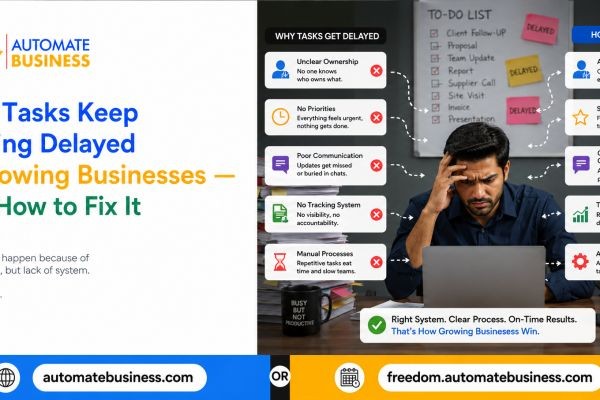
Growing Businesses Don't Have a Motivation Problem. They Have a Systems Problem.
There's a conversation that happens in almost every growing MSME, almost every week. A task didn't get done on time. The owner or manager wants to know why. The team member has an explanation didn't see the message, thought someone else was handling it, got pulled into something more urgent. The conversation ends without a real resolution. And two weeks later, a different task gets delayed for exactly the same reason.
This pattern delayed tasks, explanations, no structural change, repeat is one of the most common and most expensive operational problems in growing Indian businesses. And the reason it keeps repeating isn't that the team doesn't care. It's that the system underneath the work hasn't been designed to prevent delays. It's been designed to create them.
When tasks are assigned through WhatsApp messages, tracked in spreadsheets that nobody updates, reminded manually when the manager remembers, and owned vaguely by "the team," delays aren't accidents. They're the natural output of a system that provides no structural support for on-time completion. Automate Task [https://www.automatebusiness.com/] changes this by giving every task a clear owner, deadline, priority, and status, with automated reminders and visibility for managers. Fix the system, and delays drop dramatically—not because people changed, but because the environment that was producing delays has been replaced by one that produces completion.
This blog breaks down the six root causes of task delays in growing businesses and maps each one to a specific, practical fix.
- Root Cause 1: Work Is Assigned Without a Clear Owner
The first and most fundamental reason tasks get delayed is that they don't have a single, named, accountable owner. In most MSME environments, tasks are assigned in one of three ways that all fail in the same direction: sent to a group chat where everyone assumes someone else is handling it, given to "the team" without specifying who exactly, or discussed in a meeting where action items aren't formally logged.
When ownership is diffuse, responsibility is diffuse. Every individual in the group can truthfully say "I wasn't sure it was my job" and they're right, because the system never made it their job specifically. The task sits, waiting for someone to pick it up, until the deadline passes.
The fix is structural, not motivational. Every task needs exactly one named assignee from the moment it's created not a group, not a department, one person. Platforms like Automate Tasks enforce this at the point of task creation, requiring a single assignee before a task can be saved. When one person's name is on a task, the question of who is responsible has a definitive, documented answer. "I thought someone else was doing it" becomes a factually incorrect statement, not a plausible defense.
For complex tasks involving multiple people, sub-tasks solve the same problem at each step each sub-task has its own named owner, its own deadline, and its own status, so multi-person work maintains single accountability at every stage rather than losing it in the handoff. - Root Cause 2: Deadlines Exist Only in Someone's Memory
The second root cause of task delays is the absence of a visible, documented deadline attached to the task itself. In chat-based and spreadsheet-based systems, deadlines are communicated "get this done by Friday" but they aren't attached to the task in a structured way that remains visible over time.
By Wednesday, the message with Friday's deadline is buried under forty other messages. By Thursday evening, the team member either remembers or doesn't. By Friday morning, the manager is asking "is this done?" the same question they'd have been asking regardless of whether they'd set a deadline, because the deadline existed nowhere except in the original message and in two people's memories.
A deadline that's only in a message is not functionally a deadline. It's a suggestion with an expiry date.
The fix is to attach deadlines to tasks structurally, not conversationally. In Automate Tasks, every task carries a due date and a separate reminder date both permanently visible in the task record and in the dashboard, regardless of how many other messages have been sent since the task was created. The reminder date is set earlier than the due date, giving the assignee advance notice rather than a last-minute alert. Both dates are visible to the manager in the dashboard at all times, making "I forgot the deadline" an answer that's verifiable rather than accepted on faith. - Root Cause 3: No Reminder System Exists Except the Manager
The third root cause is the most time-consuming one for managers to live with: in most MSME operations, the only reminder system that exists is the manager themselves. If the manager doesn't follow up, nothing gets reminded. If the manager is in a meeting, travelling, or simply overwhelmed, follow-ups stop and with them, a portion of the team's output.
This creates a business that runs at the speed of the manager's availability, which is never fast enough. Every manager has dozens of tasks to follow up on simultaneously. The follow-ups that happen are the ones the manager has time and energy for, not necessarily the ones that are most at risk or most urgent.
The fix is to remove the manager from the reminder loop entirely. Automate Tasks sends automatic reminders through WhatsApp and email the channels where Indian MSME teams actually pay attention without any human intervention. When a task's reminder date arrives, the system sends the notification to the assignee automatically. If the task passes its due date without being marked complete, overdue reminder sequences continue automatically until the task is closed.
For recurring work daily checklists, weekly reports, monthly compliance submissions recurring task schedules with holiday-skip logic mean the reminder cycle runs permanently without the manager doing anything after the initial configuration. A daily machine pre-check that the manager used to assign every morning now assigns itself, reminds the responsible person via WhatsApp, and flags itself as overdue if it isn't completed before the threshold all without the manager being involved.
The manager's role shifts from being the reminder system to reviewing whether the automated reminders produced completion. That's a 60–90 minute daily time saving for most managers, and a significant reduction in the tasks that fall through when the manager isn't watching. - Root Cause 4: There's No Visibility Into What's Overdue Until It's Too Late
The fourth root cause is a visibility problem. In a WhatsApp and spreadsheet system, overdue tasks are invisible until they cause a problem downstream. The quality check that was due Tuesday isn't noticed until Thursday, when the dispatch team can't complete their step because the quality step hasn't been signed off. The client follow-up that was due Monday isn't noticed until the client calls Friday to say they've gone with a competitor.
By the time the delay becomes visible, it's already too late to prevent the consequence — only to manage it. And managing consequences costs significantly more time and credibility than preventing delays in the first place.
The fix is real-time visibility into task status before delays become consequences. The dashboard in Automate Tasks shows every task across the team filtered by status, assignee, priority, project, and date in real time. An overdue task appears as overdue on the dashboard the moment its due date passes, without anyone needing to notice it or report it. The manager opens the dashboard in the morning and sees not just what's pending today, but what was overdue yesterday and the day before with enough lead time to intervene before the cascade effect reaches the client.
Dashboard scoring tracks each team member's completion rate and timeliness over time, making chronic delay patterns visible before they've already damaged a relationship or a production schedule. A team member with a consistent 65% completion rate is a visible risk in the data weeks before the next missed deadline giving the manager time to support, redirect, or redistribute workload rather than discover the problem after it's happened. - Root Cause 5: Recurring Work Gets Recreated or Forgotten Every Cycle
The fifth root cause is specific to operational work the daily, weekly, and monthly tasks that should happen every cycle but currently depend on someone remembering to assign them. In every growing business, there's a category of recurring work that is critically important and almost never missed in the first few months of operation, because the founder or early manager is personally triggering it each time. As the business grows and that person's attention is spread thinner, the triggering becomes inconsistent. By the time the business has 15-20 people, a meaningful percentage of recurring operational work is happening sporadically rather than consistently.
Daily startup checklists happen four days a week instead of five. Weekly sales pipeline reviews happen twice a month instead of four times. Monthly compliance submissions happen on time nine months and late three always the months when something else was demanding attention.
Each individual instance seems minor. The cumulative effect across a year of inconsistent recurring work is significant — in quality, in compliance risk, and in operational reliability.
The fix is to remove the human trigger from recurring work entirely. In Automate Tasks, recurring tasks are configured once with a schedule, an assignee, and reminder settings then run permanently without any manual intervention. The task creates itself, assigns to the right person, and sends WhatsApp reminders automatically every cycle. Holiday-skip logic prevents tasks from firing on non-working days or national holidays without the manager having to adjust schedules manually. Once configured, the only management involvement is reviewing whether the task was completed not triggering it, assigning it, or reminding about it. - Root Cause 6: Accountability Is Conversational Rather Than Documented
The sixth root cause is the one that makes all the others harder to fix: in systems built on WhatsApp messages and verbal instructions, accountability is always a conversation rather than a documented fact. When a task is delayed, the resulting discussion is between two people with different memories of what was agreed, who was responsible, and what reminders were sent. Nobody is necessarily lying they genuinely remember it differently. But the ambiguity makes accountability nearly impossible to enforce fairly, which means the conversation tends to end without a real outcome and the pattern continues.
The fix is making accountability factual rather than conversational. In Automate Tasks, every task carries a timestamped record of its entire lifecycle when it was created, who it was assigned to, what deadline was set, when reminder notifications were sent via WhatsApp and email, when the assignee last updated the status, and when it was marked complete. When a task is delayed, this record is the basis for the conversation rather than two people's memories.
Workspace activity logs make the record accessible to any manager-level or admin-level user at any time. The conversation shifts from "why didn't you do this?" meeting "I didn't see the message" a dispute with no resolution to "the task was assigned on Monday, two WhatsApp reminders were sent on Tuesday and Wednesday, and the last status update was Wednesday afternoon at 3pm" a factual sequence that grounds the accountability discussion in evidence.
Over time, documented accountability creates a culture shift. When team members understand that task assignment, reminder delivery, and completion status are all recorded and visible, the incentive to complete work on time rather than explaining why it wasn't done increases naturally. Not because of surveillance, but because the system makes accountability inevitable rather than optional.
How the Fix Looks in Practice Across a Growing Business
When all six root causes are addressed simultaneously through a structured task management platform, the operational rhythm of a growing business changes in ways that compound over time.
In the first two weeks, completion rates typically improve as single-owner assignment and WhatsApp reminders eliminate the two most common immediate causes of delay unclear ownership and missed reminders. Team members who were completing 50-60% of assigned tasks on time move toward 80-85% without any change in motivation or skill simply because the system now makes the requirement clear and the reminder automatic.
In the first month, managers reclaim the hours they were spending on manual follow-up and redirect them to higher-value work. The morning status-checking round shrinks from 90 minutes to 15 as the dashboard replaces individual conversations for routine status collection. Recurring work starts happening consistently because the trigger is no longer dependent on the manager's memory.
In the first quarter, accountability culture begins shifting. Team members build track records in the dashboard completion rates, timeliness, overdue patterns that become the basis for factual performance conversations. Chronic delay patterns are identified and addressed weeks before they've produced a client-facing failure. And the business owner starts spending evening time on strategy rather than scrolling through WhatsApp groups to reconstruct the day.
What to Look for in a Task Management Tool for Fixing Delays
Not every task management platform addresses all six root causes. When evaluating a tool specifically for reducing task delays in a growing business, the criteria should map directly to the causes above.
Single-owner task assignment should be enforced at creation the tool should not allow tasks to be saved without a named assignee. WhatsApp reminders should be a primary delivery channel, not an afterthought for Indian MSME teams, this is the channel that determines whether a reminder is actually seen. Recurring task automation should include holiday-skip logic and time zone-aware delivery, not just a simple repeat interval. Real-time dashboards should show overdue status the moment a deadline passes, with filtering by assignee and project. Timestamped activity logs should be available to managers without requiring manual reporting from the team.
Automate Tasks [https://www.automatebusiness.com/partner-with-us/] delivers all of these as core features built around the specific operational environment of growing Indian MSMEs rather than enterprise software teams.
The Delay Is the Symptom. The System Is the Cause.
Every delayed task is a data point. It's telling you that somewhere in the chain ownership, deadline visibility, reminders, accountability there's a gap that the current system isn't closing. The solution isn't to work harder at filling the gap manually. It's to build a system that closes the gap automatically.
When every task has a single owner, a visible deadline, an automatic WhatsApp reminder, and a documented accountability trail — delays don't disappear entirely, but they stop being the default outcome of how work moves through the business. They become the exception rather than the rule, and when they do happen, the system shows exactly why.
That's the difference between a growing business that's always firefighting and one that's building the operational foundation to scale. See how Automate Tasks [https://www.automatebusiness.com/products/task/] eliminates the root causes of task delays.






