
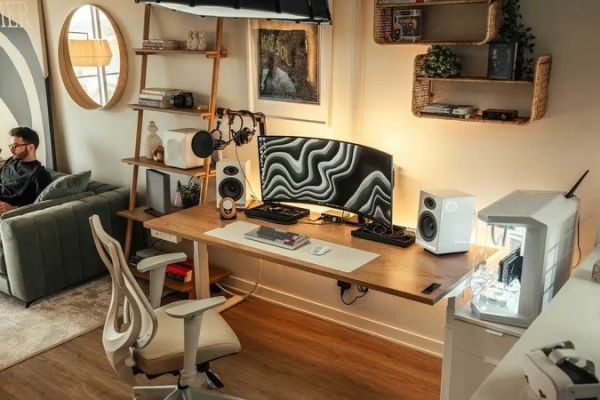
According to the latest market analysis by Future Market Insights, the global work from home setup market, valued at USD 24.95 billion in 2026 and projected to reach USD 41.55 billion by 2036, is transitioning from a pandemic-driven necessity into a long-term productivity investment category.
As hybrid work stabilizes across global economies, demand is increasingly shaped by comfort, efficiency, and durable home office solutions rather than temporary setups.
Quick Stats Snapshot
- Market size (2026):USD 24.95 billion
- Forecast (2036):USD 41.55 billion
- CAGR (2026-2036):4%
- Top growth market:India (8.2% CAGR)
- Leading product segment:Ergonomic furniture (38% share by 2026)
- Dominant distribution channel:E-commerce (63% share by 2026)
- Key buyer segment:Individual buyers (54% share)
Get detailed market forecasts, competitive benchmarking, and pricing trends: https://www.futuremarketinsights.com/reports/sample/rep-gb-33041
Market Size and Growth Outlook
The work from home setup market is projected to grow steadily from USD 24.95 billion in 2026 to USD 41.55 billion by 2036, reflecting a CAGR of 5.4%.
Unlike the initial surge driven by emergency remote work adoption, current growth is fueled by replacement cycles, ergonomic upgrades, and sustained hybrid work policies.
Growth Drivers: Hybrid Work Meets Productivity Investment
Three structural trends are shaping market demand:
- Hybrid Work Normalization
Employees now require functional workspaces both at home and in offices, driving consistent demand for dual setups. - Ergonomic Upgrade Demand
Long working hours at home have increased awareness around posture, comfort, and health, boosting demand for ergonomic chairs, desks, and monitor setups. - Video Collaboration Dependency
Daily use of video conferencing tools continues to drive demand for webcams, headsets, and lighting solutions for improved communication quality.
Key Challenges: Budget Sensitivity and Workspace Constraints
Despite steady growth, the market faces several constraints:
- Price sensitivity among mid-income consumers
- Limited space in urban apartments restricting large furniture purchases
- Demand variability due to return-to-office policies
- Difficulty in evaluating ergonomic products online
Brands that fail to balance affordability, functionality, and compact design may struggle to scale adoption.
Emerging Opportunities: Modular Design and Mid-Range Ergonomics
Opportunities in the market are centered on practical innovation:
- Development of compact and foldable furniture for small homes
- Growth in mid-priced ergonomic solutions
- Expansion of bundled product offerings (chair + desk + peripherals)
- Employer-sponsored home office equipment programs
Customize insights for your business strategy: https://www.futuremarketinsights.com/customization-available/rep-gb-33041
Segmentation Insights: Productivity-Focused Spending
By Product Type:
Ergonomic furniture leads with 38% share, reflecting its central role in long-term comfort and productivity.
By Workspace Type:
Hybrid setups dominate with 57% share, as employees split time between home and office.
By Buyer Type:
Individual buyers account for 54% share, driven by personal preferences and home constraints.
By Sales Channel:
E-commerce leads with 63% share, supported by product comparisons, reviews, and convenience.
Regional Analysis: Asia-Pacific Leads Growth Momentum
- India (8.2% CAGR):Driven by IT services growth and urban apartment living
- China (7.6% CAGR):Supported by strong e-commerce infrastructure
- United States (5.2% CAGR):Stable demand driven by hybrid work adoption
- United Kingdom (4.9% CAGR):Sustained by professional hybrid workforce
- Canada (4.7% CAGR):Growth concentrated in metro areas with high remote work rates
Asia-Pacific markets are expected to outperform due to expanding digital workforces and increasing home office investments.
Competitive Landscape: Fragmented Yet Functionally Driven
The market remains fragmented across furniture manufacturers, tech companies, and retail platforms.
Key players include:
- Logitech
- HP
- Dell Technologies
- Herman Miller
- Steelcase
- Humanscale
- IKEA
Technology companies dominate peripherals and devices, while furniture brands compete on ergonomics and durability.
Strategic Implications for Industry Leaders
For manufacturers and investors, the category presents clear strategic priorities:
- Hybrid work ensures long-term demand stability
- Ergonomic value is critical for premium positioning
- E-commerce is essential for product discovery and comparison
- Modular and compact designs are key for urban markets
- Employer-funded purchases influence high-value segments
Future Outlook: From Temporary Setup to Permanent Productivity Hub
The work from home setup market is expected to evolve into a core productivity infrastructure segment, blending comfort, technology, and space efficiency.
Key trends to watch:
- Growth in ergonomic mid-range product categories
- Expansion of employer-sponsored home office programs
- Increasing demand for compact and modular solutions
- Continued relevance of video collaboration tools
- Rise in bundled and customizable workspace offerings
Unlock 360° insights for strategic decision-making and investment planning: https://www.futuremarketinsights.com/checkout/33041
Executive Takeaways
- The market is shifting from emergency purchases to planned upgrades
- Hybrid work is the primary long-term demand driver
- Ergonomic furniture leads due to comfort and productivity benefits
- E-commerce dominates distribution with strong comparison advantages
- Success depends on balancing affordability, ergonomics, and space efficiency
In a market defined by both productivity and comfort, companies that align ergonomic innovation with evolving work habits will be best positioned to capture sustained growth.






