
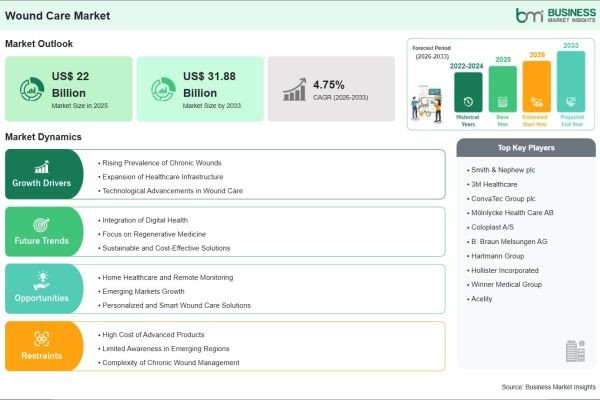
The Wound Care Industry is experiencing steady growth worldwide, driven by the escalating prevalence of chronic wounds, a rising number of surgical procedures globally, and an expanding geriatric population highly susceptible to skin injuries.
According to Business Market Insights, the global Wound Care Market size is expected to reach US$ 31.88 Billion by 2033 from US$ 22 Billion in 2025. The market is estimated to record a CAGR of 4.75% from 2026 to 2033.
Advancements in bioactive therapies and smart dressing technologies, along with the rising adoption of negative pressure wound therapy (NPWT) systems in home care settings, are significantly transforming the market landscape. Manufacturers are increasingly prioritizing moisture-balancing and infection-control solutions to meet shifting clinical preferences for enhanced patient comfort and accelerated healing timelines.
Download Sample Report : https://www.businessmarketinsights.com/sample/BMIPUB00032610
What Is Wound Care?
Wound care encompasses a comprehensive range of medical solutions, dressings, devices, and biological products designed to assess, protect, and manage acute and chronic injuries. Its primary objective is to accelerate the body's natural healing process, restore tissue integrity, and prevent severe secondary complications such as localized or systemic infections.
Because the nature of tissue injuries varies significantly, wound care products are extensively utilized across a multitude of healthcare settings. Traditional wound care relies on standard protective barriers like cotton gauzes and medical tapes. In contrast, advanced wound care integrates specialized polymer dressings, active therapeutic devices, and bioengineered skin substitutes tailored to manage complex, hard-to-heal lesions.
Market Drivers
A primary driver for the Wound Care Industry is the rising global incidence of metabolic and vascular chronic diseases, particularly diabetes and obesity. These conditions frequently impair peripheral circulation and nerve function, leading to a high prevalence of complex, long-term ailments such as diabetic foot ulcers, venous leg ulcers, and pressure sores.
The rapidly expanding volume of surgical procedures performed worldwide also acts as a vital growth factor. Post-operative wound care is a crucial aspect of surgical recovery, creating a steady and continuous demand for high-performance dressings, tissue sealants, and anti-infective products to mitigate the risk of surgical site infections (SSIs).
Furthermore, demographic shifts significantly contribute to market demand. The growing aging population has a natural vulnerability to skin tears and delayed healing cycles, heavily relying on advanced, exudate-managing solutions to avoid prolonged hospitalization and chronic pain.
Additionally, the global shift toward home healthcare and outpatient services is prompting medical equipment manufacturers to design lightweight, automated, and portable wound therapy devices, further propelling sustained market growth.
Market Segmentation
By Product Type
- Advanced Wound Dressings (Foam, Hydrocolloid, Alginate, Hydrogel, Film, Collagen Dressings)
- Surgical Wound Care Products (Sutures, Staples, Tissue Adhesives, and Sealants)
- Traditional Wound Care Products (Bandages, Gauzes, Medical Tapes, Sponges)
- Wound Therapy Devices (Negative Pressure Wound Therapy, Pressure Relief Devices, Oxygen Equipment)
- Wound Care Biologics (Skin Substitutes, Growth Factors, Allografts, Xenografts)
By Wound Type
- Chronic Wounds (Diabetic Foot Ulcers, Pressure Ulcers, Venous Leg Ulcers, Others)
- Acute Wounds (Surgical Wounds, Traumatic Wounds, Burns)
By End User
- Hospitals and Clinics
- Ambulatory Surgical Centers
- Home Care Settings
- Long-Term Care Facilities
The advanced wound dressings segment dominates the market due to the widespread clinical preference for moisture-retaining therapies. The hospitals and clinics segment also accounts for a substantial share, primarily managing severe acute trauma and complex post-surgical cases.
Regional Insights
- North America dominates the Wound Care Industry, supported by an advanced medical infrastructure, favorable insurance reimbursement frameworks, and high clinical adoption of expensive regenerative biological treatments.
- Asia-Pacific is expected to witness the fastest growth, driven by rapid healthcare modernization, expanding investments in clinical access, a massive diabetic patient population, and huge demographic bases in countries like China and India.
- Europe exhibits steady growth, heavily regulated by strict clinical safety directives that encourage the deployment of certified, infection-preventative advanced dressings and automated vacuum devices.
- Middle East & Africa and South & Central America are gradually expanding due to escalating government efforts to improve regional emergency care networks and rising public awareness regarding optimal wound hygiene.
Top Players in the Wound Care Industry
The market is highly competitive, with leading manufacturers focusing on R&D investments, strategic long-term institutional contracts, and obtaining regulatory approvals for innovative antimicrobial material compounds.
- Smith & Nephew plc
- Mölnlycke Health Care AB
- ConvaTec Group PLC
- Coloplast A/S
- Solventum (Formerly 3M Health Care)
- Cardinal Health, Inc.
- B. Braun Melsungen AG
- Integra LifeSciences Holdings Corporation
- Organogenesis Holdings Inc.
- Medline Industries, LP
These companies continue to invest in advanced material engineering to produce tailored wound care solutions that meet the exact fluid absorption, barrier integrity, and antimicrobial requirements of their global medical clientele.
Technological Innovations
Technological advancements in biochemistry and digital health tracking are significantly transforming the Wound Care Market. Manufacturers are optimizing modern dressings by integrating electronic nanosensors capable of monitoring wound microenvironments, tracking variables like pH, temperature, and moisture levels in real time without removing the protective layer.
Furthermore, innovations in active biochemical therapies are gaining traction. Companies are increasingly commercializing controlled nitric oxide-releasing hydrogels and tissue-engineered extracellular matrices, aiming to trigger rapid cell proliferation and vascularization in hard-to-heal, late-stage chronic lesions.
The development of cloud-connected negative pressure wound therapy systems with automated alert features is also opening new frontiers, allowing remote healthcare providers to monitor patient compliance and machine status seamlessly.
Future Market Outlook
The future outlook for the Wound Care Industry remains highly positive. As healthcare practitioners increasingly prioritize value-based care and reduced hospital lengths of stay, the medical sector will continue to shift away from passive cotton gauzes, heavily favoring specialized, fast-healing advanced substrates.
The ongoing expansion of outpatient specialized wound clinics, alongside growing demand for specialized products in home care networks, is expected to create substantial growth opportunities. Manufacturers that prioritize highly cost-effective, bio-absorbable materials and effective infection barriers will be best positioned to capture market share in the coming years.
Frequently Asked Questions (FAQs)
What is the main difference between traditional and advanced wound care?
Traditional wound care provides basic mechanical protection and keeps dry wounds covered. Advanced wound care dynamically regulates the moisture levels of the injury site, promotes cellular growth, and actively prevents bacterial colonization.
Why is foam dressing highly utilized in clinical settings?
Foam dressings offer excellent fluid handling capabilities, absorbing moderate to heavy amounts of exudate while safeguarding the surrounding skin from maceration and cushioning the wound area from external friction.
How does negative pressure wound therapy (NPWT) accelerate healing?
NPWT uses a localized vacuum pump to apply controlled sub-atmospheric pressure to a dressed wound. This process removes excess fluid, pulls wound edges closer together, and actively stimulates granulation tissue formation.
Are bioengineered skin substitutes safe for open wounds?
Yes, approved cellular and tissue-based biologics undergo rigorous sterilization and decellularization processes to ensure biocompatibility, serving as temporary or permanent structural matrices that assist the body's regenerative cells.
Browse More Reports:
https://www.businessmarketinsights.com/reports/asean-implantable-defibrillators-market
https://www.businessmarketinsights.com/reports/nordic-implantable-defibrillators-market
https://www.businessmarketinsights.com/reports/africa-resuscitation-devices-market
About Us
Business Market Insights is a market research platform that provides subscription service for industry and company reports. Our research team has extensive professional expertise in domains such as Electronics & Semiconductor; Aerospace & Defense; Automotive & Transportation; Energy & Power; Healthcare; Manufacturing & Construction; Food & Beverages; Chemicals & Materials; and Technology, Media, & Telecommunications.
Contact Us
If you have any questions about this report or would like further information, please contact us:
Contact person: Ankit Mathur
Email: sales@businessmarketinsights.com
Phone: +16467917070






