
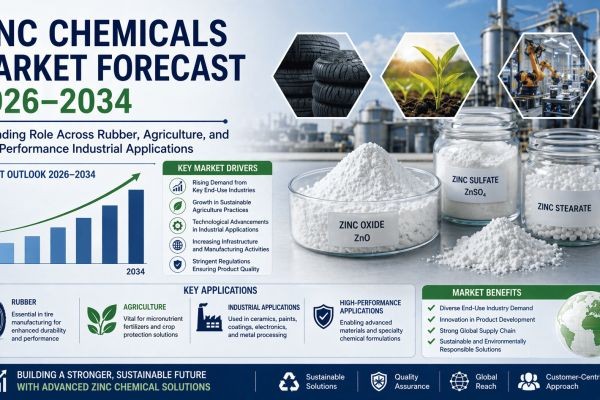
Zinc chemicals, a fundamental category of inorganic compounds derived from zinc metal, are indispensable to a vast array of industrial and consumer sectors. Their unique properties—including corrosion inhibition, UV absorption, catalytic activity, and nutritional value—make them critical components in everything from rubber tires and agricultural fertilizers to pharmaceutical products and architectural paints. Unlike many specialty chemicals, zinc chemicals benefit from well-established, scalable production processes and a mature global supply chain, ensuring their consistent availability for foundational industries worldwide.
Get Full Report Here: https://www.24chemicalresearch.com/reports/262607/global-zinc-chemicals-market-2024-2030-45
Market Dynamics:
The market's trajectory is shaped by a complex interplay of powerful growth drivers, significant restraints that are being actively addressed, and vast, untapped opportunities.
Powerful Market Drivers Propelling Expansion
-
Robust Growth in the Rubber and Tire Industry: The single largest application for zinc chemicals, particularly zinc oxide, remains the rubber industry, where it is a crucial activator in the vulcanization process. This process, which enhances the elasticity and durability of rubber, is essential for tire manufacturing. With the global automotive industry producing over 85 million vehicles annually and the replacement tire market consistently strong, demand for zinc oxide is deeply entrenched. Furthermore, the push for high-performance, fuel-efficient tires with longer lifespans is driving the need for advanced zinc-based additives that improve rubber compound performance by 15-20%.
-
Agricultural Sector's Reliance on Micronutrients: Zinc sulfate and other zinc salts are vital micronutrients in the agricultural sector, addressing zinc deficiency in soils—a problem affecting nearly half of the world's agricultural lands. The intensification of farming and the need to boost crop yields to feed a growing global population are compelling drivers. Zinc-enriched fertilizers have been shown to increase yields of staple crops like wheat and rice by 10-25%, making them a key tool for food security. The global push for sustainable agriculture is also fostering the development of zinc-based bio-stimulants and foliar sprays.
-
Expanding Applications in Construction and Ceramics: The construction industry's insatiable demand for protective coatings and paints fuels consumption of zinc-based compounds like zinc phosphate and zinc chromate (where regulations permit), which are excellent anti-corrosion agents. Additionally, zinc oxide is a key component in the manufacture of ceramics and glass, imparting unique properties such as opacity and UV resistance. The steady global urbanization rate, particularly in Asia-Pacific, with construction output exceeding $13 trillion annually, ensures a durable demand base for these applications.
Download FREE Sample Report: https://www.24chemicalresearch.com/download-sample/262607/global-zinc-chemicals-market-2024-2030-45
Significant Market Restraints Challenging Adoption
Despite its foundational role, the market faces hurdles that require strategic management.
-
Volatility in Raw Material (Zinc Metal) Prices: The production of zinc chemicals is intrinsically linked to the price and availability of refined zinc metal, which is subject to significant volatility. Prices can fluctuate by 20-30% annually due to factors like mining output, geopolitical tensions, and global economic cycles. This price volatility directly impacts production costs, squeezing profit margins for chemical manufacturers and creating budgetary uncertainty for downstream buyers, making long-term planning challenging.
-
Stringent Environmental and Health Regulations: The production and use of certain zinc chemicals, particularly those involving heavy metals or generating effluent, are under increasing regulatory scrutiny. Regulations like REACH in Europe and TSCA in the U.S. impose strict controls on emissions and waste disposal. Compliance often necessitates significant capital investment in cleaner technologies and waste treatment facilities, increasing operational costs by 5-15% and posing a higher barrier to entry for smaller producers.
Critical Market Challenges Requiring Innovation
The industry's evolution is not without its internal challenges. The shift towards more environmentally friendly alternatives, such as non-heavy metal corrosion inhibitors to replace chromates, requires substantial R&D investment to match the performance of established products. This transition can take 5-10 years and consumes a significant portion of R&D budgets. Furthermore, maintaining consistent product quality, especially for high-purity grades required in pharmaceuticals and electronics, is a persistent challenge. Variations in feedstock purity can lead to batch inconsistencies, requiring sophisticated quality control systems that add an additional 3-7% to production costs.
Additionally, the market must contend with logistical complexities. Shipping certain zinc chemicals, especially hydrated or solution-based forms, incurs higher costs due to weight and special handling requirements. These logistical hurdles can add 5-10% to the final delivered cost, particularly for international trade, affecting competitiveness in price-sensitive markets.
Vast Market Opportunities on the Horizon
-
Rising Demand in the Pharmaceutical and Personal Care Sectors: Zinc oxide and zinc pyrithione are experiencing growing demand in sunscreens, ointments, and anti-dandruff shampoos. The global personal care active ingredients market, valued at over $10 billion, is a prime target. Zinc oxide's status as a broad-spectrum, mineral-based UV filter aligns perfectly with the consumer trend towards natural and reef-safe products, with the sunscreen segment alone projected to grow by 4-5% annually.
-
Advancements in Battery Technologies: While lithium-ion dominates, zinc-based battery technologies, such as zinc-air and zinc-bromine flow batteries, are gaining traction for large-scale energy storage due to zinc's abundance, safety, and lower cost. These systems are ideal for grid storage and renewable energy integration. Pilot projects for zinc-air batteries have demonstrated potential for 8-12 hour discharge durations, making them a compelling solution for stabilizing power grids with intermittent renewable sources.
-
Strategic Vertical Integration and Recycling Initiatives: Forward-thinking companies are pursuing vertical integration to secure raw material supplies and stabilize costs. Simultaneously, there is a growing focus on zinc recycling from industrial waste streams and end-of-life products. Developing efficient closed-loop recycling processes can reduce reliance on primary zinc mining, lower carbon footprints by up to 30%, and create a more sustainable and resilient supply chain, appealing to environmentally conscious customers and regulators.
In-Depth Segment Analysis: Where is the Growth Concentrated?
By Type:
The market is segmented into Zinc Oxide, Zinc Sulfate, Zinc Chloride, Zinc Carbonate, and others. Zinc Oxide dominates the market, accounting for the largest share due to its irreplaceable role in rubber vulcanization and its diverse applications in ceramics, chemicals, and personal care. Its versatility and essential function in tire manufacturing cement its leading position.
By Application:
Application segments include Rubber Compounding, Agriculture, Glass & Ceramics, Paints & Coatings, Pharmaceuticals, and others. The Rubber Compounding segment is the historical and current leader, driven by the massive, non-discretionary demand from the global tire industry. However, the Agriculture and Pharmaceuticals segments are exhibiting strong growth rates, reflecting global trends in food security and health consciousness.
By End-User Industry:
The end-user landscape includes Automotive, Agriculture, Construction, Chemicals, Healthcare, and others. The Automotive industry is the predominant consumer, primarily through its consumption of tires and various rubber components. The Agriculture and Construction sectors are also critical end-users, with growth closely tied to global economic development and infrastructure investment.
Download FREE Sample Report: https://www.24chemicalresearch.com/download-sample/262607/global-zinc-chemicals-market-2024-2030-45
Competitive Landscape:
The global Zinc Chemicals market is fragmented and highly competitive, characterized by the presence of both large multinational corporations and regional players. The top three companies—US Zinc, Zochem, and EverZinc—collectively command a significant portion of the market share. Their dominance is underpinned by integrated operations (from mining to chemical production), extensive product portfolios, and long-standing customer relationships across multiple industries.
List of Key Zinc Chemicals Companies Profiled:
-
US Zinc (U.S.)
-
GH Chemicals (Canada)
-
Akrochem (U.S.)
-
Weifang Longda Zinc Industry (China)
-
Bruggemann (Germany)
-
HAKUSUI TECH (Japan)
-
American Chemet (U.S.)
-
Zochem (Canada)
-
Numinor (Israel)
-
Rubamin (India)
-
Pan-Continental Chemical (China)
-
Toho Zinc (Japan)
The competitive strategy is largely focused on cost leadership, product quality differentiation for specialized applications, and geographic expansion to tap into emerging markets. Strategic acquisitions and partnerships are common as companies seek to broaden their technological capabilities and market reach.
Regional Analysis: A Global Footprint with Distinct Leaders
-
Asia-Pacific: Is the dominant force, holding the largest share of the global market. This leadership is fueled by massive manufacturing bases in China and India, particularly in rubber, ceramics, and agriculture. The region's rapid industrialization, urbanization, and government support for agriculture make it both the largest producer and consumer of zinc chemicals.
-
North America and Europe: Together, they form a mature but significant market. These regions are characterized by high-value, specialty applications in pharmaceuticals, advanced ceramics, and high-performance coatings. Demand is driven by stringent quality standards, technological innovation, and a strong focus on environmental regulations, leading to a preference for high-purity and eco-friendly zinc chemical products.
-
South America, and Middle East & Africa: These regions represent emerging growth opportunities. Growth is driven by expanding agricultural activities, infrastructure development, and the gradual establishment of local manufacturing capabilities. While currently smaller in absolute terms, these markets present significant potential for long-term expansion.
Get Full Report Here: https://www.24chemicalresearch.com/reports/262607/global-zinc-chemicals-market-2024-2030-45
Download FREE Sample Report: https://www.24chemicalresearch.com/download-sample/262607/global-zinc-chemicals-market-2024-2030-45
About 24chemicalresearch
Founded in 2015, 24chemicalresearch has rapidly established itself as a leader in chemical market intelligence, serving clients including over 30 Fortune 500 companies. We provide data-driven insights through rigorous research methodologies, addressing key industry factors such as government policy, emerging technologies, and competitive landscapes.
-
Plant-level capacity tracking
-
Real-time price monitoring
-
Techno-economic feasibility studies
International: +1(332) 2424 294 | Asia: +91 9169162030
Website: https://www.24chemicalresearch.com/






