
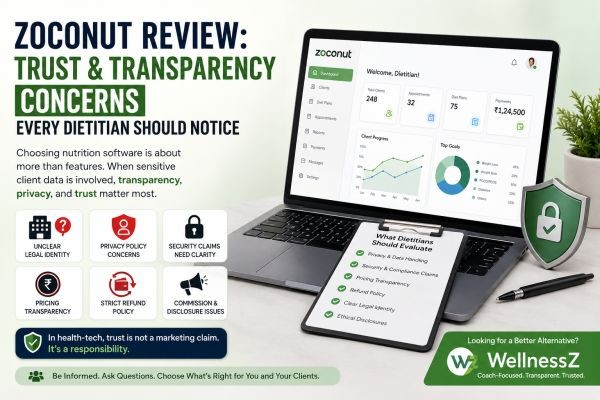
For dietitians and wellness professionals, selecting software is not simply a technology decision. It is also a trust decision.
Nutrition and health platforms frequently handle personal and business-sensitive information, including client records, meal plans, consultations, payment details, progress reports, and health-related communication. Because of this responsibility, professionals increasingly look beyond features and ask deeper questions about transparency, privacy, and accountability.
Zoconut is one of the platforms serving dietitians and nutrition professionals, offering tools for client management, diet planning, appointment handling, and workflow automation. Its feature set positions it as a modern solution for wellness businesses.
However, a closer review of publicly available information highlights several areas where transparency and trust communication may deserve greater attention. These observations are based on information accessible through public policies, app disclosures, pricing communication, and website content.
This article is not designed to deliver legal conclusions or dismiss Zoconut’s usefulness. Instead, it reviews public trust-related concerns that wellness professionals may wish to consider before selecting any health-tech platform.
Why Trust Matters in Health-Tech Software
Unlike generic business software, nutrition platforms manage highly personal information.
Clients often share:
- Body measurements
- Diet history
- Lifestyle information
- Medical and wellness goals
- Appointment history
- Payments and consultations
- Personal progress records
When such information is involved, trust cannot rely on branding alone.
Many health-tech platforms market themselves using phrases such as:
- Secure platform
- Trusted by professionals
- HIPAA compliant
- All-in-one solution
While these statements may sound reassuring, trust is ultimately created through clear policies, transparent communication, and responsible data practices.
Professionals want to know not only what software can do — but also how responsibly it operates.
1. Questions Around Corporate Identity
Consistency in company identity is a basic expectation for professional software businesses.
Public references connected with Zoconut appear to mention different legal names, including Zoconut Private Limited, Medicians Software Solutions Private Limited, and Zoconut Pvt Ltd.
For users, this may create avoidable uncertainty.
Software buyers generally expect clear information regarding:
- Who owns the platform
- Which company processes payments
- Who manages user information
- Which entity is legally accountable
This becomes particularly relevant in healthcare-related software where trust and responsibility are closely linked.
A consistent legal identity helps users feel confident about who they are engaging with.
2. App Privacy Communication May Need More Clarity
Privacy disclosures play an important role in user confidence, especially before app installation.
Zoconut promotes features involving client communication, diet planning, appointments, and wellness tracking — capabilities that typically involve user data processing.
At the same time, publicly visible privacy labels may leave some users wanting clearer explanations regarding how information is handled.
This does not automatically suggest wrongdoing, but it may create questions such as:
- What data is actually collected?
- How is it processed?
- Where is it stored?
- How is it secured?
For wellness platforms, transparency around these questions often matters as much as functionality itself.
Clear privacy communication helps reduce uncertainty and strengthens user confidence.
3. Privacy Policies Should Prioritize Simplicity
Privacy policies exist to inform users, not overwhelm them.
Some sections of Zoconut’s publicly available privacy information may appear difficult for everyday users to follow, particularly when important topics are combined or explained in technical language.
A well-designed privacy policy should answer essential questions quickly and clearly:
- What information is collected?
- Why is it collected?
- Who has access?
- How long is it retained?
- Can users request deletion?
- Where can concerns be raised?
For dietitian software managing sensitive information, clarity is especially valuable.
Simple communication supports stronger trust and reduces misunderstandings.
4. Sign-Up Experience Could Offer Better Privacy Guidance
First impressions matter in SaaS products.
During registration, users often provide personal and business-related information, including contact details, clinic information, and operational data.
While Zoconut directs users toward terms and conditions, the visible privacy explanation during sign-up may feel limited.
Many modern platforms improve onboarding trust by providing concise privacy notices that explain:
- What information is requested
- Why it is needed
- How it will be used
These small additions can create a more transparent onboarding experience and reassure new users from the beginning.
5. Security Messaging Works Best with Supporting Details
Security is one of the most important decision factors in health-tech software.
Zoconut publicly references security and compliance standards such as HIPAA and PCI, which are significant claims in healthcare environments.
When platforms highlight such standards, users often expect supporting context, including:
- Certification information
- Audit references
- Scope of compliance
- Systems covered
- Relevant limitations
Without accessible supporting details, security claims may appear incomplete to some users.
In healthcare technology, trust grows strongest when security communication is both visible and verifiable.
6. Pricing Visibility Matters to Professionals
Pricing transparency influences purchasing confidence.
Although Zoconut describes its pricing approach as transparent, some professionals may still seek additional clarity regarding:
- Subscription costs
- Credits and usage models
- Renewal rules
- Overage pricing
- Refund conditions
- Custom plan boundaries
This information is especially important for:
- Independent dietitians
- Small wellness clinics
- Growing nutrition businesses
- Budget-conscious practitioners
Clear pricing supports better comparisons and reduces friction during purchasing decisions.
7. Refund Policies Shape User Confidence
Refund policies often influence how comfortable users feel trying a platform.
Publicly available refund language connected with Zoconut appears relatively restrictive, with references suggesting limited refund situations and longer processing timelines.
While companies may adopt strict policies for operational reasons, professionals often prefer refund systems that feel straightforward and predictable.
A user-friendly refund framework generally explains:
- Eligibility rules
- Time windows
- Documentation requirements
- Processing expectations
Transparency in this area contributes directly to customer confidence.
8. Referral & Commission Models Need Transparency
Zoconut promotes earning opportunities linked to lab testing and future product-related recommendations.
Commission models themselves are not uncommon. However, in health and wellness environments, they can raise questions if financial incentives are not clearly disclosed.
Clients may expect transparency regarding whether recommendations could involve professional earnings.
This applies to:
- Lab testing
- Product referrals
- Supplement recommendations
- Affiliate-style programs
Clear disclosure helps preserve trust and supports ethical decision-making.
9. Website Quality Influences Brand Credibility
A software company’s website often serves as its digital storefront.
Some publicly visible Zoconut content appears to include:
- Repetitive language
- Typographical inconsistencies
- Older references
- Uneven content presentation
While these issues may seem minor individually, they can influence how professionals perceive reliability and attention to detail.
For health-tech businesses, polished communication reflects professionalism.
Strong public content supports:
- Brand credibility
- User trust
- Search visibility
- Enterprise confidence
Presentation matters because it often shapes first impressions.
Final Perspective
Zoconut may provide useful technology for dietitians and nutrition professionals, and many users may find value in its tools and workflows.
At the same time, professionals evaluating any health-tech platform should look beyond features and examine broader trust indicators.
Important evaluation areas include:
- Legal clarity
- Privacy communication
- Security transparency
- Pricing visibility
- Refund fairness
- Ethical disclosures
- Public professionalism
The concerns discussed here do not necessarily define every user experience. Rather, they encourage thoughtful decision-making when choosing software that manages sensitive health and client information.
For wellness professionals exploring alternatives, WellnessZ positions itself as a platform focused on transparency, coaching workflows, automation, and business growth support.






