
Key Acai Berry Market Projections
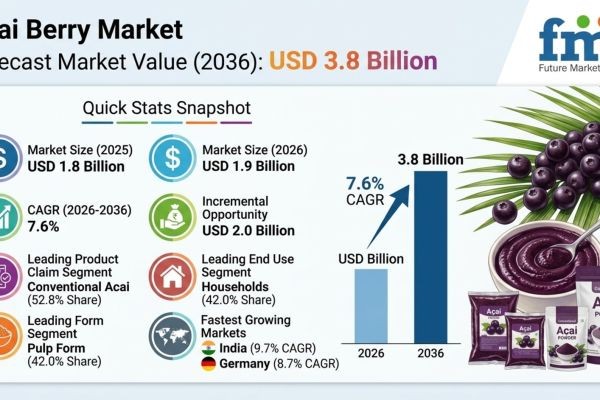
- Market Size (2025): USD 1.8 Billion
- Market Size (2026): USD 1.9 Billion
- Forecast Market Value (2036): USD 3.8 Billion
- CAGR (2026-2036): 7.6%
- Incremental Opportunity: USD 2.0 Billion
- Leading Product Claim Segment: Conventional Acai (52.8% Share)
- Leading End Use Segment: Households (42.0% Share)
- Leading Form Segment: Pulp Form (42.0% Share)
- Fastest Growing Markets: India (9.7% CAGR) and Germany (8.7% CAGR)
- Key Growth Driver: Rising Consumer Preference for Natural Antioxidants and Functional Nutrition
Request a Sample Report: https://www.futuremarketinsights.com/reports/sample/rep-gb-1207
Strategic Market Insights
The acai berry industry continues to evolve from a niche superfruit category into a mainstream functional food and wellness ingredient market. Consumers are increasingly seeking nutrient-dense fruits rich in antioxidants, polyphenols, and natural compounds that support overall health and wellness.
Acai berries have gained widespread popularity due to their association with antioxidant support, energy enhancement, and healthy lifestyle trends. The growing influence of fitness culture, preventive healthcare, and clean-label nutrition is encouraging consumers to incorporate acai products into daily diets through smoothies, bowls, supplements, beverages, and snack applications.
Foodservice operators, particularly smoothie chains and health-focused cafés, are expanding menu offerings featuring acai bowls and blended beverages. At the same time, retail channels continue introducing frozen acai packs, powders, capsules, and ready-to-drink products, making acai more accessible to mainstream consumers.
As demand increases globally, suppliers are focusing on sourcing transparency, quality assurance, and cold-chain management to maintain product integrity and ensure premium positioning.
Analyst Perspective
“Acai berry demand is increasingly becoming a product-format decision for both food and wellness brands. Foodservice operators require frozen pulp with consistent texture and color, while supplement manufacturers prefer shelf-stable powders with verified sourcing and quality standards. Companies that can demonstrate traceable Amazon sourcing and strong cold-chain control will be best positioned to capture premium market opportunities,” said Nandini Roy Choudhury, Principal Consultant at FMI.
Competitive Landscape and Market Share Analysis
The global acai berry market consists of integrated sourcing companies, ingredient processors, wellness brands, foodservice suppliers, and specialty retailers. Competitive differentiation increasingly centers on sourcing credibility, cold-chain infrastructure, processing capabilities, and product innovation.
Manufacturers continue investing in frozen pulp production, freeze-drying technologies, powder processing capabilities, and direct-to-consumer retail strategies. Companies are also strengthening relationships with growers and processors in Brazil to secure reliable access to premium-quality acai berries.
As consumer demand for ethically sourced and sustainable products rises, traceability, fair-trade initiatives, and environmental stewardship are becoming increasingly important competitive advantages.
Leading Market Participants Include
- SAMBAZON, Inc.
- Acai Roots, Inc.
- Nossa! Fruits SAS
- The Berry Company Limited
- OAKBERRY
- Nativo Acai
- AcaiExotic
- Açaí Berry Foods
- Amazon Forest Trading
Competition increasingly focuses on sourcing transparency, product quality, cold-chain management, retail penetration, and foodservice expansion strategies.
Production vs. Consumption Economy Analysis
Production remains highly concentrated in Brazil, which serves as the primary global supplier of acai berries and processed acai ingredients. The Amazon region continues to provide significant harvesting capacity, supporting both domestic consumption and export demand.
Consumption growth is expanding rapidly across North America, Europe, and Asia Pacific as awareness of superfoods and functional nutrition increases. Smoothie bowls, functional beverages, dietary supplements, and health-oriented food products continue driving market demand.
India, Germany, China, and the United Kingdom are emerging as important growth markets due to expanding wellness sectors, increasing disposable incomes, and rising consumer interest in premium nutrition products.
Supply Chain and Value Chain Insights
The acai berry value chain begins with berry harvesting, followed by processing, pulping, freezing, drying, packaging, distribution, and final product formulation across food, beverage, nutraceutical, and personal care applications.
Harvest timing remains a critical factor because acai berries must be processed shortly after harvesting to maintain quality, nutritional value, and color characteristics. As a result, processors continue investing in localized processing facilities and advanced cold-chain logistics.
The growing adoption of digital traceability systems and sourcing verification programs is helping suppliers enhance transparency and strengthen consumer trust.
Strategic Procurement Analysis
Procurement strategies increasingly prioritize reliable sourcing, quality assurance, product consistency, cold-chain capabilities, and regulatory compliance.
Food manufacturers and supplement brands seek suppliers capable of delivering standardized products while maintaining traceable sourcing practices. Procurement teams are also evaluating sustainability certifications, processing capabilities, and supplier scalability when selecting strategic partners.
As demand for premium superfood ingredients rises, procurement decisions are increasingly influenced by sourcing transparency and long-term supply reliability.
Country Opportunity Assessment
India
India is projected to remain the fastest-growing market through 2036, registering a CAGR of 9.7%. Rising urban wellness trends, expanding premium café culture, and growing demand for imported superfoods continue supporting market growth.
Germany
Germany is expected to expand at a CAGR of 8.7% during the forecast period. Strong organic retail channels, increasing health-conscious consumer behavior, and demand for premium nutritional products support continued market expansion.
Brazil
Brazil is forecast to grow at a CAGR of 8.4% through 2036. As the primary production hub for acai berries, the country continues benefiting from expanding domestic demand and export opportunities.
China
China is anticipated to register a CAGR of 8.2%, supported by growing wellness trends, expanding beverage innovation, and increasing consumer awareness of superfood ingredients.
United Kingdom
The United Kingdom is projected to grow at a CAGR of 7.5% through 2036, driven by increasing retail availability of smoothie packs, premium powders, and health-focused food products.
United States
The United States is expected to expand at a CAGR of 6.2% through 2036. Strong demand from smoothie bowl chains, wellness retailers, and organic food consumers continues supporting market growth.
Japan
Japan is forecast to register a CAGR of 5.7%, benefiting from growing adoption of functional beverages and premium health-oriented food products.
Technology and Innovation Outlook
Key innovations shaping the acai berry industry include:
- Advanced freeze-drying technologies
- High-efficiency frozen pulp processing systems
- Functional beverage formulations
- Acai-based nutritional supplements
- Sustainable sourcing verification platforms
- Digital traceability systems
- Clean-label ingredient processing
- Enhanced cold-chain logistics technologies
Manufacturers continue investing in technologies that improve product quality, shelf life, nutritional retention, and supply chain transparency.
Segment Analysis
By Product Type
Raw-whole acai is expected to account for 40.0% of market demand in 2026. Premium sourcing claims, authenticity, and growing consumer preference for minimally processed foods continue supporting segment growth.
Frozen acai, freeze-dried products, powders, juices, and pulp formulations are also expected to contribute significantly to overall market expansion.
By Product Claim
Conventional acai is projected to account for 52.8% of market demand in 2026. Broad availability, competitive pricing, and strong retail presence continue supporting segment dominance.
Organic acai products are expected to gain traction as health-conscious consumers increasingly prioritize certified and sustainably sourced products.
By Application
Pharmaceutical and herbal use is expected to account for 38.0% of total demand in 2026. Acai extracts continue gaining popularity in antioxidant supplements, wellness formulations, and herbal health products.
Food and beverages, nutraceuticals, cosmetics, personal care products, and animal nutrition applications also contribute significantly to market growth.
By End Use
Households are expected to account for 42.0% of total demand in 2026. Growing popularity of home-prepared smoothies, wellness beverages, and functional nutrition products continues driving household consumption.
By Form
Pulp form is projected to account for 42.0% of market demand in 2026 due to its widespread use in smoothie bowls, beverages, and foodservice applications.
Powder, liquid, capsule, and tablet forms continue gaining traction across wellness and nutraceutical sectors.
Exclusive Discounts on Full Report: https://www.futuremarketinsights.com/reports/acai-berry-market
Future Industry Outlook
The Acai Berry Market is expected to benefit from growing demand for superfoods, expanding consumer interest in natural antioxidants, increasing wellness awareness, and rising adoption across food, beverage, nutraceutical, and personal care applications.
Although supply chain complexities, harvest season limitations, and cold-chain requirements remain important challenges, continued investment in sourcing transparency, processing technologies, and product innovation is expected to support long-term market growth.
Companies capable of ensuring sustainable sourcing, maintaining product quality, investing in traceability systems, and developing innovative consumer-friendly formats will be best positioned to capitalize on opportunities through 2036.






