
A consistent operational scale-up is redefining heavy industry and utility infrastructure pipelines, fueled by the commercial necessity to deploy durable, closed-circuit heat transfer systems capable of safely regulating massive thermal loads without a reliance on external water sources.
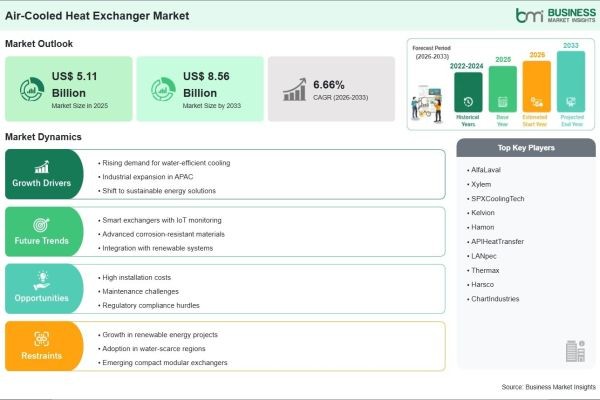
Based on market intelligence from Business Market Insights, the global Air-Cooled Heat Exchanger Market [https://www.businessmarketinsights.com/reports/air-cooled-heat-exchanger-market] is anticipated to reach US$ 8.56 Billion by 2033, mounting from its 2025 value of US$ 5.11 Billion at a projected CAGR of 6.66% from 2026 to 2033.
Technological advancements in fin design, airflow management, corrosion-resistant materials, predictive maintenance, and smart monitoring are reshaping the Air-Cooled Heat Exchanger Market. Manufacturers are improving heat transfer efficiency, durability, and operational reliability to meet the needs of energy-intensive industries that require continuous cooling without excessive water consumption. As industrial facilities seek better energy performance and lower environmental impact, demand for advanced air-cooled systems continues to rise.
Download Sample Report : https://www.businessmarketinsights.com/sample/BMIPUB00035468 [https://www.businessmarketinsights.com/sample/BMIPUB00035468?utm_source=organic&utm_medium=1021]
What Are Air-Cooled Heat Exchangers?
Air-cooled heat exchangers are industrial cooling systems that use ambient air instead of water to reduce the temperature of process fluids. They are designed to transfer heat efficiently in environments where water availability, disposal, or treatment costs create challenges for conventional cooling systems. Because of their ability to deliver reliable thermal management with lower water dependence, they are widely deployed across heavy industry and utility operations.
These systems are commonly used in applications where operational continuity, energy efficiency, and environmental compliance are essential. Their use is especially important in oil & gas, petrochemical, and power generation facilities, where large-scale cooling is required to maintain stable processes and equipment performance. As industries modernize, air-cooled exchangers are becoming a preferred option for sustainable industrial cooling.
Market Drivers
A major driver of the Air-Cooled Heat Exchanger Market is the rising focus on water conservation and sustainable cooling. Industrial operators are under growing pressure to reduce freshwater use and limit wastewater generation, making air-cooled systems a practical alternative to water-intensive equipment. This is especially relevant in regions facing water scarcity and stricter environmental oversight.
Another important growth factor is the expansion of high-efficiency industrial infrastructure. New refineries, petrochemical facilities, power plants, and manufacturing units are being built or upgraded with more energy-efficient thermal management systems. Air-cooled heat exchangers are gaining traction in these projects because they offer flexible installation, compatibility with automation, and reliable performance in demanding conditions.
The market is also benefiting from the adoption of smart monitoring and predictive maintenance technologies. Industrial users want systems that can reduce downtime, optimize airflow, and improve lifecycle performance. This is encouraging manufacturers to integrate digital controls, advanced simulation tools, and improved fan technologies into their product offerings.
Market Segmentation
By Type
- Forced Draft: Uses fans below the tube bundle to push air through the exchanger; widely used in large industrial applications.
- Induced Draft: Uses fans mounted above the bundle to pull air through the exchanger, improving airflow distribution and reducing recirculation risks.
By Fin Type
- L Fin: Cost-efficient exchangers with reliable thermal performance in standard industrial environments.
- Extruded Fins: Durable fin designs suited for corrosive and high-temperature conditions.
By End-Use
- Oil & Gas: Used for hydrocarbon processing, gas compression, and refinery cooling operations.
- Power Generation: Applied in thermal power facilities for condenser cooling and temperature control.
- Chemicals: Supports stable process temperatures and operational safety in chemical plants.
- Petrochemicals: Used in large-scale fluid cooling and heat recovery systems.
- HVAC: Supports efficient air conditioning and refrigeration in commercial and industrial systems.
- Other End Users: Includes food processing, mining, marine, and manufacturing applications.
The report indicates that forced draft systems account for a significant share because of their strong airflow performance and broad adoption in large industrial processing facilities. L fin heat exchangers hold a notable market share due to their cost efficiency and reliable thermal performance. By end use, oil & gas dominates the market because of extensive use in upstream and downstream operations, while power generation, petrochemicals, and HVAC continue to contribute meaningfully to market growth.
Regional Insights
- North America holds a strong position due to advanced industrial infrastructure, high adoption of thermal management systems, and ongoing investment in refining, chemical, and power industries.
- Asia-Pacific is growing significantly, supported by rapid industrialization, infrastructure development, and expansion of manufacturing and petrochemical capacity.
- Europe continues to advance through industrial modernization and sustainability-focused cooling technologies.
- Middle East & Africa is seeing growing demand from oil & gas, power, and industrial projects.
- South & Central America is also expanding as industrial and energy infrastructure develops.
Top Players in the Air-Cooled Heat Exchanger Market
The market is competitive, with leading companies focusing on efficiency, durability, and smart thermal management to strengthen their positions.
- Alfa Laval
- Xylem
- SPX Cooling Tech
- Kelvion
- Hamon
- API Heat Transfer
- LANpec
- Thermax
- Harsco
- Chart Industries
These companies continue to invest in advanced fin technologies, corrosion-resistant materials, digital monitoring, and customized thermal engineering to address the evolving needs of industrial cooling applications.
Technological Innovations
Technological innovation is transforming the Air-Cooled Heat Exchanger Market through improved heat transfer designs, better airflow optimization, and smarter system control. Manufacturers are using advanced simulation tools and computational fluid dynamics to design exchangers that perform more efficiently across different industrial conditions.
Predictive maintenance and remote monitoring are also becoming more important. These tools help operators detect performance issues early, reduce unplanned downtime, and improve overall system reliability. As industrial sites become more connected, this digital layer is becoming a key part of thermal management strategies.
New product launches are also pushing the market forward. Recent developments include larger-capacity systems designed for power generation, carbon capture, and data center applications, as well as advanced rear-door heat exchanger solutions for high-performance computing environments.
Future Market Outlook
The future outlook for the Air-Cooled Heat Exchanger Market remains positive. Rising industrial modernization, sustainability-driven cooling adoption, and continued infrastructure expansion are expected to support steady growth through 2033. As industries look for ways to reduce water use while maintaining thermal efficiency, air-cooled systems will remain highly relevant.
Companies that focus on smart monitoring, energy-efficient fan systems, corrosion resistance, and customized exchanger designs are likely to capture the strongest opportunities. With industrial cooling needs becoming more complex and sustainability goals becoming more urgent, the market is positioned for continued long-term expansion.
Frequently Asked Questions (FAQs)
What is the projected size of the Air-Cooled Heat Exchanger Market by 2033?
The market is projected to reach US$ 8.56 Billion by 2033, rising from US$ 5.11 Billion in 2025.
What is the CAGR for the Air-Cooled Heat Exchanger Market?
The market is expected to grow at a CAGR of 6.66% from 2026 to 2033.
Which type segment dominates the market?
Forced draft systems account for a significant share of the market.
Which fin type holds a notable share?
L fin heat exchangers hold a notable market share.
Which end-use sector dominates the market?
Oil & gas dominates the market.
Browse More Reports:
https://www.businessmarketinsights.com/reports/brics-veterinary-x-ray-market
https://www.businessmarketinsights.com/reports/north-america-veterinary-x-ray-market
https://www.businessmarketinsights.com/reports/europe-laser-ablation-market
About Us
Business Market Insights is a market research platform that provides subscription service for industry and company reports. Our research team has extensive professional expertise in domains such as Electronics & Semiconductor; Aerospace & Defense; Automotive & Transportation; Energy & Power; Healthcare; Manufacturing & Construction; Food & Beverages; Chemicals & Materials; and Technology, Media, & Telecommunications.
Contact Us
If you have any questions about this report or would like further information, please contact us:
Contact person: Ankit Mathur
Email: sales@businessmarketinsights.com
Phone: +16467917070






