
Market Overview and Growth Outlook
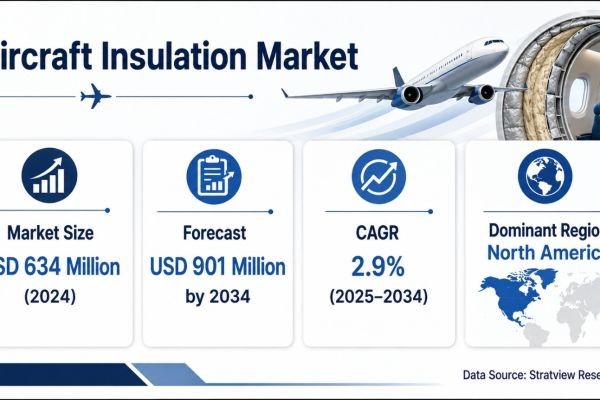
The Aircraft Insulation Market was valued at USD 634 million in 2024 and is expected to reach USD 697 million in 2025, reflecting 9.9% annual growth. By 2034, the market is projected to reach USD 901 million.
“The Aircraft Insulation Market is expected to grow at a CAGR of 2.9% during 2025-2034.”
Aircraft insulation demand is increasing because insulation supports thermal management, soundproofing, fire resistance, and vibration dampening. These functions improve passenger comfort, crew safety, and aircraft operating efficiency. The industry outlook remains linked to air travel demand, aircraft production rates, lightweight insulation development, and regulatory standards for fire resistance and safety.
Request a free sample report:
https://www.stratviewresearch.com/Request-Sample/Aircraft-Insulation-Market#form
The Aircraft Insulation Market trends show a market shaped by aircraft modernization, fleet expansion, and material innovation. As aircraft manufacturers pursue safer and lighter systems, insulation becomes a structural contributor to comfort, thermal control, acoustic performance, and energy efficiency across commercial and regional aircraft platforms.
Market Segmentation Analysis
Aircraft Insulation Market, by Aircraft Type includes Commercial Aircraft, Regional Aircraft, General Aviation, Military Aircraft, and Helicopter. Commercial Aircraft will dominate the market throughout the forecast period. This dominance reflects the importance of insulation in high-volume aircraft platforms where cabin comfort, noise control, thermal stability, and safety compliance remain essential to aircraft design.
Aircraft Insulation Market, by Insulation Type includes Thermal Insulation, Acoustic & Vibration Insulation, and Electric Insulation. Thermal Insulation is anticipated to account for the largest market share in the Aircraft Insulation Market. Its role is central because aircraft require insulation systems that support fire barriers, thermal control, acoustical protection, and weight reduction versus metal alternatives.
Aircraft Insulation Market, by Material Type includes Foamed Plastic Insulation, Fiberglass Insulation, Ceramic Insulation, and Other Material Types. Fiberglass Insulation is expected to maintain its dominance in the Aircraft Insulation Market. Foamed Plastic Insulation is expected to witness the highest growth during the forecast period due to sound-absorbing and thermal insulation properties.
Aircraft Insulation Market, by Application Type includes Airframe and Engine. Airframe includes Aerostructure, Cabin Interior, Landing Gear, and Others. Airframe is expected to be the leading application category in the Aircraft Insulation Market in the coming years because aircraft structures require insulation across cabin, fuselage, landing gear, and aerostructure applications.
Aircraft Insulation Market, by Region includes North America, Europe, Asia-Pacific, and Rest of the World. The segmentation provides regional analysis across North America, Europe, Asia-Pacific, and Rest of the World, allowing market intelligence users to assess demand distribution across established aerospace hubs and high-growth regional aircraft ecosystems.
Regional Market Insights
North America is expected to hold the largest share over the forecast period. The region is described as the aircraft industry’s hub, with raw material suppliers, aircraft insulation manufacturers, tier players, aircraft OEMs, airlines, aircraft leasing companies, and MRO companies supporting demand across the insulation value chain.
Asia-Pacific is estimated to witness the highest growth during the forecast period. The source attributes this growth to increasing air travel demand, rising aircraft production, expanding airline fleets, aerospace infrastructure investments, government support for indigenous aircraft manufacturing, and regional focus on fuel efficiency, noise reduction, and passenger comfort.
Emerging Trends Shaping the Aircraft Insulation Market
Lightweight and eco-friendly insulation solutions are shaping industry trends as aircraft manufacturers seek fuel efficiency and reduced emissions. Thermal insulation blankets also support fire barriers, thermal performance, acoustic insulation, corrosion resistance, water repellency, environmental performance, and electrical insulation, making material performance a central theme in market analysis.
Aircraft modernization and retrofitting programs are also influencing the Aircraft Insulation Market. Aging fleets require insulation upgrades that improve safety, passenger comfort, noise attenuation, and thermal performance. This creates growth trends beyond new aircraft production and supports a broader strategic insights view of aftermarket-linked insulation demand.
Key Growth Drivers of the Market
- Rising air travel demand increases aircraft utilization and supports aircraft production, creating proportional demand for insulation materials across new aircraft programs.
- Passenger comfort requirements increase the need for advanced thermal and acoustic insulation, improving cabin experience and supporting airline operating standards.
- Stringent safety, fire resistance, and energy-efficiency regulations encourage aircraft manufacturers to use high-performance insulation materials across aircraft structures.
- Lightweight and eco-friendly insulation solutions contribute to fuel efficiency and reduced emissions, strengthening material adoption across aerospace programs.
- Aircraft modernization and retrofitting programs, particularly in aging fleets, expand demand for insulation systems beyond new-build aircraft production.
Competitive Landscape
Top Companies in the Market
Daher
Triumph Group Inc.
Hi-Temp Insulation, Inc.
Darchem Engineering Ltd.
BASF SE
Hutchinson SA
DuPont de Nemours, Inc.
3M
Boyd Corporation
Tecnologie Industriali e Aeronautiche Srl
Isolite GmbH
G-Force Manufacturing
Geven SpA.
Conclusion and Strategic Outlook
The Aircraft Insulation Market is set for measured expansion, rising from USD 634 million in 2024 to USD 901 million by 2034 at a CAGR of 2.9% during 2025-2034. Growth is supported by aircraft production, modernization, lightweight materials, safety standards, and passenger comfort requirements.
The market forecast points to stable long-term demand rather than short-term volatility. Commercial aircraft, thermal insulation, fiberglass insulation, airframe applications, North America’s leading position, and Asia-Pacific’s high-growth trajectory define the industry intelligence outlook for stakeholders tracking insulation demand across aircraft platforms.
FAQs – Aircraft Insulation Market
1. What is the Aircraft Insulation Market size and forecast?
The Aircraft Insulation Market was valued at USD 634 million in 2024. It is expected to reach USD 697 million in 2025 and USD 901 million by 2034.
2. What is the CAGR of the Aircraft Insulation Market?
The Aircraft Insulation Market is expected to grow at a CAGR of 2.9% during 2025-2034. This reflects steady demand across aircraft production, modernization, and insulation material adoption.
3. What are the main growth drivers of the Aircraft Insulation Market?
Growth is driven by rising air travel demand, aircraft production rates, safety regulations, lightweight insulation materials, and modernization programs. These factors increase the need for thermal, acoustic, fire-resistant, and vibration-dampening insulation systems.
4. Which region leads the Aircraft Insulation Market?
North America is expected to hold the largest share over the forecast period. The region benefits from a broad aerospace ecosystem that includes suppliers, OEMs, airlines, leasing companies, and MRO companies.
5. What is the investment outlook for the Aircraft Insulation Market?
The investment outlook remains linked to aircraft production, retrofitting, material innovation, and regulatory compliance. The Aircraft Insulation Market offers steady growth opportunities, with Asia-Pacific expected to witness the highest growth during the forecast period.






