
The global animal feed organic trace minerals market is undergoing a decisive shift from conventional inorganic salts toward chelated, proteinated, and complexed mineral forms, according to latest insights by Future Market Insights. Driven by rapid genetic advancements in commercial livestock, stringent environmental caps on manure mineral excretion, and the economic benefits of precision nutrition, livestock producers are replacing high-dose inorganic mineral premixes with lower, highly bioavailable organic mineral inclusion rates that improve feed conversion efficiency and gut health.
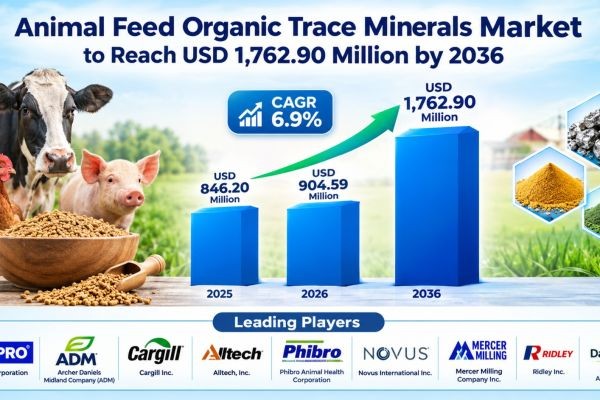
The global market, valued at USD 846.20 million in 2025, is projected to reach USD 904.59 million in 2026. Advancing at a Compound Annual Growth Rate (CAGR) of 6.9% over the ten-year forecast period, total market valuation is anticipated to achieve USD 1,762.90 million by 2036, delivering an absolute incremental opportunity of USD 858.31 million.
Request a Sample Report: https://www.futuremarketinsights.com/reports/sample/rep-gb-23352
Market Performance Overview (2026–2036)
To map out the leading trace mineral elements, target livestock categories, and regional growth vectors guiding this USD 858.31 million market expansion, key segment allocations highlight where global commercial demand is concentrated:
- Zinc Minerals Segment (36.2% share): Commands mineral type revenue in 2026, driven by zinc's essential role in enzymatic catalysis, epithelial tissue integrity, immune defense, and hoof/claw health across poultry, swine, dairy, and beef cattle.
- Iron, Manganese, Copper, & Selenium (63.8% combined share): Form secondary essential mineral pillars, targeting metabolic pathways, reproductive performance, and antioxidant protection (e.g., selenium yeast and manganese glycinates).
- Poultry Livestock Segment (41.8% share): Dominates target livestock applications in 2026, as fast-growing modern broiler and high-output layer genetics create metabolic mineral demands that inorganic sources cannot efficiently fulfill.
- Dairy, Beef, & Pork Sectors: Represent high-value secondary livestock pillars where organic trace minerals reduce somatic cell counts in milk, improve reproductive conception rates, and enhance carcass yield.
- China & India Regional Leadership: Lead national expansion rates at 3% CAGR and 8.6% CAGR respectively through 2036, driven by livestock farming intensification, compound feed modernization, and environmental soil-loading regulations.
Technical Drivers and Precision Nutrition Shifts
The commercial substitution of inorganic minerals with organic trace minerals across commercial feed mills is propelled by three primary industry catalysts:
Bioavailability-Driven Feed Conversion Improvements
Chelated and amino acid-complexed minerals protect trace elements from dietary antagonists (such as phytates and fibers) in the gastrointestinal tract, delivering 30% to 50% higher bioavailability than inorganic sulfates or oxides. In broiler diets, chelated zinc and manganese improve feed conversion ratios (FCR) by 2% to 4%, providing a clear return on investment (ROI).
Environmental Regulations Limiting Mineral Excretion
Strict agricultural nutrient management regulations (such as EU environmental directives and Chinese livestock waste standards) enforce legal limits on heavy metal concentrations (zinc and copper) in manure spread on agricultural land. Organic trace minerals allow feed formulators to lower total dietary inclusion rates while reducing fecal mineral excretion by 20% to 40%.
Modern Genetics Demanding Higher Cellular Mineral Density
Decades of genetic selection have produced broilers, pigs, and dairy cows with rapid growth velocities and higher metabolic turnover. Inorganic mineral salts fail to absorb at rates sufficient to sustain modern skeletal integrity and immune competence, creating a biological demand pull for organic chelates.
Industrial Constraints & Formulation Challenges
Feed compounders and trace mineral manufacturers navigate specific operational hurdles:
- Higher Unit Price Premium: Chelated and proteinated minerals carry a $2\times$ to $4\times$ price premium over generic inorganic salts, creating adoption resistance in price-sensitive farming clusters that evaluate feed on upfront input cost rather than full-cycle performance.
- Fragmented Regulatory Registration Frameworks: Differing definitions and registration requirements for mineral chelates across regulatory bodies (US FDA/AAFCO, European EFSA, and regional Asian authorities) require multiple technical dossiers and localized compliance testing.
Regional Growth Profile
Regional demand reflects intensive industrial livestock scaling in Asia alongside regulatory-driven nutrient management compliance in Europe and North America:
- China (9.3% CAGR): The global growth frontrunner, driven by intensive poultry and swine farm scaling, rapid compound feed industrialization, and strict regulatory inspections on livestock waste runoff.
- India (8.6% CAGR): Spurring rapid volume growth through commercial poultry integration, dairy cooperative modernization, and rising adoption of chelated mineral feed blocks.
- Germany (7.9% CAGR) & France (7.2% CAGR): Lead European demand, supported by stringent EU environmental soil-loading limits, antibiotic-reduction feed initiatives, and advanced lifecycle precision dosing software.
- United Kingdom (6.6% CAGR): Expanding through retailer-mandated high-welfare meat standards and low-excretion mineral formulations in free-range and compound feeds.
- United States (5.9% CAGR) & Brazil (5.2% CAGR): Represent mature, high-volume production hubs driven by large-scale feedlot and dairy hoof-health programs in the US and export-focused poultry integration in Brazil.
Competitive Landscape
The global animal feed organic trace minerals landscape features specialized performance mineral innovators, multinational agricultural corporations, and regional feed premix blenders.
Key market participants profiled in the report include Zinpro Corporation, Archer Daniels Midland Company (ADM), Cargill Inc., Alltech, Inc., Phibro Animal Health Corporation, Novus International Inc., Mercer Milling Company Inc., Ridley Inc., and Davidsons Animal Feeds. Leading players differentiate through patented amino acid complexation chemistry, species-specific clinical trial data, and integrated digital precision-formulation support.
Exclusive Discounts on Full Report: https://www.futuremarketinsights.com/reports/animal-feed-organic-trace-minerals-market
Frequently Asked Questions
What is the projected valuation of the global animal feed organic trace minerals market by 2036?
The global animal feed organic trace minerals market is projected to reach USD 1,762.90 million by 2036, expanding from an estimated baseline valuation of USD 904.59 million in 2026 at a CAGR of 6.9%.
Why does Zinc lead the Mineral Type category?
Zinc accounts for a 36.2% market share in 2026 because organic zinc chelates are universally supplemented across all livestock species to support vital immune responses, skin and feather integrity, hoof health, and reproductive efficiency.
What livestock segment holds the largest share of organic trace mineral consumption?
Poultry leads the livestock category with a 41.8% market share in 2026, as high-density broiler and layer operations require highly bioavailable minerals to support fast skeletal development and disease resistance under intensive production schedules.
FMI Custom Research: Strategic Intelligence for Confident Decision-Making
In today's rapidly evolving business environment, leadership teams need clear, actionable intelligence tailored to their strategic objectives. FMI's Custom Research solutions are designed around specific business questions, enabling executives to evaluate growth opportunities, validate investments, assess competitive dynamics, and reduce uncertainty before making critical decisions.
Key Executive Benefits
- Decision-Ready Insights: Research tailored to your specific business challenges, growth plans, and investment priorities.
- Reduced Strategic Risk: Validate market opportunities, customer demand, and competitive positioning before committing resources.
- Market Entry Confidence: Assess opportunity size, regulatory barriers, channel dynamics, and competitive landscapes with precision.
- Competitive Advantage: Gain proprietary intelligence unavailable through syndicated reports or internal datasets.
- Faster Growth Decisions: Accelerate expansion, product development, portfolio optimization, and investment planning.
- Primary Market Validation: Access real-world customer, buyer, and stakeholder insights that support high-confidence decision-making.
Business Impact
FMI helps organizations transform market complexity into strategic clarity, enabling leadership teams to identify growth opportunities faster, optimize resource allocation, strengthen competitive positioning, and make high-stakes business decisions with confidence.
To explore how FMI Custom Research can support your strategic priorities, connect with our team at - sales@futuremarketinsights.com
About Future Market Insights (FMI)
Future Market Insights (FMI) delivers actionable, decision-focused market intelligence that goes beyond traditional research reports. The company provides:
- In-depth pricing and cost benchmarking analysis
- Demand forecasting based on real industry inputs
- Procurement and buyer behavior insights
- Supply chain and trade flow intelligence
- Technology and application trend analysis across industries
FMI follows a robust bottom-up research methodology, combining insights from industry experts, procurement leaders, manufacturers, and technical professionals to ensure accurate and practical market intelligence.






