
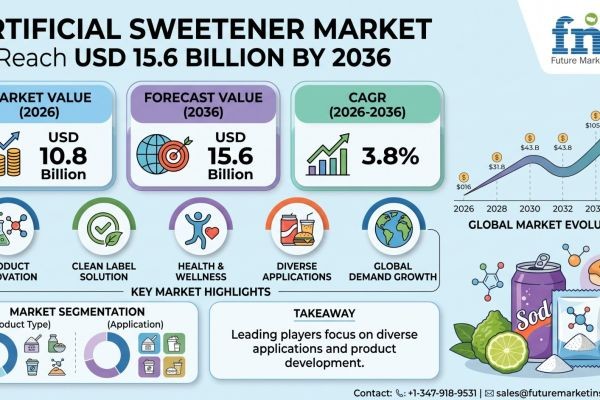
The global artificial sweetener market is undergoing steady, value-driven expansion as food and beverage manufacturers execute large-scale product reformulations to meet consumer demand for zero-calorie and low-sugar alternatives, according to latest insights by Future Market Insights. Spurred by rising global diabetes and obesity prevalence, government public health guidelines, and advanced flavor-masking technologies that eliminate lingering aftertastes, high-intensity sugar substitutes are securing high-volume integration across industrial food processing systems.
The global market, valued at USD 10.8 billion in 2026, is projected to advance at a Compound Annual Growth Rate (CAGR) of 3.8% over the ten-year forecast period, reaching a total market valuation of USD 15.6 billion by 2036.
Get detailed market forecasts, competitive benchmarking, and pricing trends:
https://www.futuremarketinsights.com/reports/sample/rep-gb-95
Market Performance Overview (2026–2036)
To map out the key product types, primary end-user applications, and regional growth vectors guiding this USD 4.8 billion market expansion, key segment allocations highlight where global commercial demand is concentrated:
- Aspartame Product Type (48.0% share): Dominates the active ingredient category in 2026 due to its clean, sugar-like taste profile, cost-effective high-intensity sweetness ratio, and long-standing regulatory clearance across global food safety authorities.
- Sucralose, Acesulfame-Potassium (Ace-K), Saccharin, & Cyclamate: Form secondary product pillars, frequently used in synergy blends to improve temporal sweetness decay and heat stability during processing.
- Food and Beverages Application Segment (42.0% share): Commands the primary end-user market share, driven by carbonated diet soft drinks, ready-to-drink (RTD) teas, low-sugar dairy products, bakery items, and confectionery.
- India & China Regional Leadership: Lead national growth rates at 8% CAGR and 4.2% CAGR respectively through 2036, driven by rapid urbanization, expanding food processing infrastructure, and government diabetes management policies.
Technical Drivers and Formulation Shifts
The integration of artificial sweeteners across industrial CPG processing is propelled by three primary industry catalysts:
Multi-Sweetener Blending and Flavor Masking
Single-component artificial sweeteners often face limitations regarding heat degradation or lingering metallic aftertastes. CPG formulators are increasingly deploying multi-sweetener system blends (e.g., combining Aspartame with Ace-K or Sucralose) alongside advanced encapsulation and flavor-masking technologies to replicate the exact temporal mouthfeel and sweetness kinetics of sucrose.
Public Health Mandates and Institutional Sugar Reduction
Rising healthcare costs linked to diabetes and metabolic syndrome are compelling governments to enact sugar taxes and front-of-pack warning labels. Industrial food manufacturers utilize artificial sweeteners to lower sugar content without increasing caloric density or unit production costs.
Cost Efficiency in Mass-Market Food Processing
High-intensity artificial sweeteners operate at micro-dosing levels (often 200x to 600x sweeter than sucrose per unit weight). This high potency drastically reduces bulk raw material storage, logistics weight, and ingredient costs compared to nutritive bulk sugars.
Industrial Infrastructure & Regulatory Constraints
Sweetener manufacturers and food technologists navigate specific operational and market hurdles:
- Thermal Stability & pH Sensitivity Limits: Aspartame degrades under prolonged high-temperature baking or highly acidic liquid storage, requiring formulators to blend heat-stable compounds like Sucralose or Ace-K for baked goods and shelf-stable beverages.
- Scientific and Public Scrutiny on Additive Safety: Re-evaluations by international health bodies necessitate ongoing investment in clinical safety research and transparent consumer communications to preserve brand trust.
Regional Growth Profile
Regional demand reflects rapid food processing industrialization across Asian consumer markets alongside compliance-driven reformulation in Western economies:
- India (4.8% CAGR): The global growth frontrunner, driven by rising middle-class demand for low-sugar health products, government diabetes awareness initiatives, and expanding local food processing capacity.
- China (4.2% CAGR): Spurring rapid volume growth through state dietary guidelines emphasizing calorie control, large-scale domestic ingredient manufacturing, and expanding beverage production.
- Brazil (3.9% CAGR): Driven by public health initiatives addressing lifestyle diseases, partnership investments with international CPG brands, and growing urban health consciousness.
- United Kingdom (3.5% CAGR) & United States (3.1% CAGR): Represent mature, highly regulated markets supported by sugar tax compliance, established diet beverage sales, and continuous innovation in low-calorie CPG reformulations.
Competitive Landscape
The global artificial sweetener landscape features multinational specialty chemical processors, agricultural ingredient refiners, and high-intensity sweetener distributors.
Key market participants profiled in the report include DuPont, Tate & Lyle PLC, Cargill, Incorporated, Archer Daniels Midland Company (ADM), Ajinomoto Co., Inc., Nestlé S.A., Ingredion Incorporated, Wilmar International Limited, JK Sucralose, and Roquette Frères. Leading suppliers differentiate through R&D in hybrid natural-artificial sweetener blends, advanced crystallization purity standards, and technical application support for CPG brand partners.
Full Report for Detailed Insights: https://www.futuremarketinsights.com/reports/global-artificial-sweeteners-market
Frequently Asked Questions
What is the projected valuation of the global artificial sweetener market by 2036?
The global artificial sweetener market is projected to reach USD 15.6 billion by 2036, expanding from an estimated baseline valuation of USD 10.8 billion in 2026 at a CAGR of 3.8%.
Why does Aspartame hold a 48% market share?
Aspartame leads the product category in 2026 because it delivers a clean, sugar-like taste profile at minimal usage levels, possesses decades of global regulatory approvals, and remains the primary sweetener choice for carbonated diet soft drinks.
What application segment leads commercial artificial sweetener sales?
Food and Beverages leads with a 42% market share in 2026, as carbonated diet drinks, low-sugar dairy, snacks, and confectionery represent the primary mass-market delivery channels for high-intensity sugar substitutes.
FMI Custom Research: Strategic Intelligence for Confident Decision-Making
In today's rapidly evolving business environment, leadership teams need clear, actionable intelligence tailored to their strategic objectives. FMI's Custom Research solutions are designed around specific business questions, enabling executives to evaluate growth opportunities, validate investments, assess competitive dynamics, and reduce uncertainty before making critical decisions.
Key Executive Benefits
- Decision-Ready Insights: Research tailored to your specific business challenges, growth plans, and investment priorities.
- Reduced Strategic Risk: Validate market opportunities, customer demand, and competitive positioning before committing resources.
- Market Entry Confidence: Assess opportunity size, regulatory barriers, channel dynamics, and competitive landscapes with precision.
- Competitive Advantage: Gain proprietary intelligence unavailable through syndicated reports or internal datasets.
- Faster Growth Decisions: Accelerate expansion, product development, portfolio optimization, and investment planning.
- Primary Market Validation: Access real-world customer, buyer, and stakeholder insights that support high-confidence decision-making.
Business Impact
FMI helps organizations transform market complexity into strategic clarity, enabling leadership teams to identify growth opportunities faster, optimize resource allocation, strengthen competitive positioning, and make high-stakes business decisions with confidence.
To explore how FMI Custom Research can support your strategic priorities, connect with our team at - sales@futuremarketinsights.com
About Future Market Insights (FMI)
Future Market Insights (FMI) delivers actionable, decision-focused market intelligence that goes beyond traditional research reports. The company provides:
- In-depth pricing and cost benchmarking analysis
- Demand forecasting based on real industry inputs
- Procurement and buyer behavior insights
- Supply chain and trade flow intelligence
- Technology and application trend analysis across industries
FMI follows a robust bottom-up research methodology, combining insights from industry experts, procurement leaders, manufacturers, and technical professionals to ensure accurate and practical market intelligence.






