
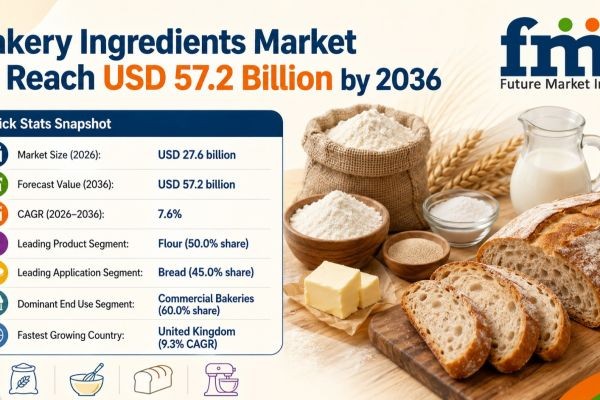
The global bakery ingredients market is transitioning from a traditional input supply model into an engineered, production-control framework for industrial bakeries, according to latest insights by Future Market Insights. As high-volume commercial bakeries standardize processes to eliminate recipe variation and batch losses, demand for specialized flour systems, enzyme improvers, and clean-label dough conditioners has surged. The global industry, valued at USD 23.7 billion in 2025, is projected to reach USD 25.4 billion in 2026. Advancing at a Compound Annual Growth Rate (CAGR) of 7.5% over the ten-year forecast period, total market valuation is expected to reach USD 52.4 billion by 2036, opening an absolute incremental opportunity of USD 27.0 billion.
Request a Sample Report: https://www.futuremarketinsights.com/reports/sample/rep-gb-416
Market Performance Overview (2026–2036)
To understand the core product types, application uses, and sales channels driving this market scale-up, an analysis of leading segment allocations highlights where global demand is concentrated:
- Flour Product Type (50.0% share): Commands half of the overall product category in 2026, serving as the core structural base for breads, pizza doughs, and pastries requiring stable gluten strength and hydration predictability.
- Bread Application (45.0% share): Represents the primary end-use application, driven by packaged loaf and sandwich bread production where repeat baking cycles require tight flour and dough performance.
- Commercial Bakeries End-User (60.0% share): Dominates end-use demand, as automated industrial plants plan large-volume ingredient purchases to prevent line stoppage and rework.
- Direct Sales Distribution Channel (55.0% share): Leads distribution, as large-scale bakeries negotiate direct bulk supply contracts to secure delivery timelines and technical application support.
- Conventional Ingredients Formulation (65.0% share): Holds the majority share due to cost efficiency and steady bulk availability of refined flours, standard sugars, and conventional fats.
Technical Drivers and Formulation Innovation
The integration of advanced bakery ingredients across high-speed commercial production lines is driven by three primary market catalysts:
Line Standardization and Process Control
Industrial bakeries are using standardized ingredient systems earlier in the mixing phase to minimize recipe shifts. High-speed automated lines require consistent flour hydration and gluten behavior to maintain uniform crumb structure and loaf volume without needing continuous mechanical corrections.
Enzyme Systems for Softness and Shelf-Life Extension
To combat quality loss during extended retail distribution, producers are increasingly adopting targeted enzyme solutions. Advanced fungal and bacterial enzymes (such as alpha-amylases and xylanases) maintain crumb softness, resilience, and foldability in breads, rolls, and wraps over multi-day shelf cycles.
Allergen Segregation and Clean-Label Demands
Regulatory shifts such as the US FDA confirming sesame as a major allergen are forcing bakeries to tighten ingredient segregation and line sanitation protocols. Simultaneously, consumer preference for simpler ingredient lists is accelerating the adoption of clean-label emulsifier alternatives, enzymes, and natural sourdough starters.
Industrial Infrastructure & Raw Material Volatility
Bakery processors and procurement directors face distinct operational constraints:
- Divergent Raw Material Pricing: Flour, egg, and dairy input costs do not move in tandem. Fluctuations in wheat crop yields alongside shifting sweetener and fat tariffs force procurement teams to structure flexible, long-term supply contracts to maintain profit margins.
- Enzyme Dosing Accuracy: Inaccurate manual weighing of micro-ingredients in high-throughput facilities leads to batch inconsistencies. Ingredient suppliers are addressing this by delivering pre-dosed, concentrated improver formats that simplify automated dosing.
Regional Growth Outlook
The geographic analysis reflects rapid market expansion across urbanizing Asian economies alongside steady, value-focused growth in Western markets:
- India (8.5% CAGR): The global growth frontrunner, supported by expanding domestic wheat milling capacity, rising urban consumption of packaged bread and biscuits, and modern retail chain penetration.
- France (8.0% CAGR): Spurring strong European growth, underpinned by a rich artisanal and industrial bread culture, soft wheat production recovery, and demand for specialized baguette flour systems.
- China (7.8% CAGR): Driven by expanding industrial bakery output, multi-city production standardization, and increasing consumer adoption of Western-style packaged bakery goods.
- Brazil (7.2% CAGR): Supported by steady bakery flour usage across commercial baking networks and technical formulation support to manage wheat quality variations.
- Japan (6.5% CAGR): Focused on high-quality, controlled flour sourcing to support delicate textures in soft breads and convenience store bakery replenishment cycles.
- Germany (5.9% CAGR): Driven by large-scale private-label bread production, retail discount networks, and strict dough performance standards.
- United States (4.8% CAGR): Sourcing a large baseline volume footprint, anchored by massive flour milling infrastructure and steady demand for bakery mix systems and improvers.
Competitive Landscape
The global bakery ingredients landscape is shaped by a combination of bulk commodity suppliers, global flavor and texture conglomerates, and specialized biosolutions providers. Companies compete on bulk distribution reach, milling scale, proprietary enzyme portfolios, and hands-on technical application support.
Leading market participants include Cargill Inc., Archer Daniels Midland (ADM), Ingredion Inc., DuPont de Nemours and Company, Tate & Lyle PLC, dsm-firmenich, Associated British Foods, Corbion N.V., Novonesis A/S, and Puratos Group N.V.. To secure repeat B2B accounts, key players are heavily investing in localized application labs, enzyme research, and bake-stable filling technologies.
Exclusive Discounts on Full Report: https://www.futuremarketinsights.com/reports/bakery-ingredients-market
Frequently Asked Questions
What is the projected valuation of the global market by 2036?
The global bakery ingredients market is projected to reach USD 52.4 billion by 2036, expanding from an estimated baseline valuation of USD 25.4 billion in 2026 at a CAGR of 7.5%.
Why does Flour lead the Product segment?
Flour holds a 50.0% market share because it is the fundamental structural ingredient across nearly all bakery categories, providing the protein and starch matrix required for dough strength and crumb formation.
What exclusions govern the boundaries of this market report?
The scope strictly covers commercial bakery input ingredients (flour, sweeteners, fats, leavening agents, enzymes, and improvers), explicitly excluding finished consumer baked goods, restaurant bakery sales, commercial baking machinery, café services, and non-bakery food additives.






