
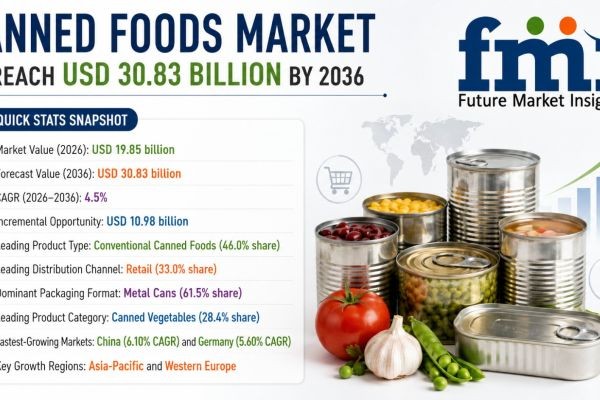
The global canned foods market is undergoing a structural expansion, according to latest insights by future market insights. Moving beyond its traditional role as a basic pantry staple, this shelf-stable grocery sector is entering a major premiumization and diversification phase. The global market, which is valued at USD 19.85 billion in 2026, is projected to expand steadily at a Compound Annual Growth Rate (CAGR) of 4.5% over the ten-year forecast period. By 2036, total industry valuation is anticipated to reach USD 30.83 billion, creating a substantial absolute incremental dollar opportunity of USD 10.98 billion for food processors, agricultural networks, and retail brands worldwide.
Request a Sample Report: https://www.futuremarketinsights.com/reports/sample/rep-gb-15971
Market Performance Overview (2026–2036)
To capture the underlying product configurations and distribution channels driving this USD 10.98 billion market scale-up, a detailed segment share analysis highlights where global consumption volume is concentrated:
- Metal Cans Format (61.5% share): Continues to command the packaging architecture in 2026, benefiting from an incredibly well-established industrial supply chain and unmatched barrier properties that keep products fresh.
- Household / Retail End Use (58.2% share): Represents the dominant volume sink, driven by sustained grocery pantry-stocking habits and high demand for cost-efficient household meal bases.
- Conventional Product Type (46.0% share): Leads the product segment in 2026, sustained by deep buyer familiarity, broad market availability, and baseline affordability.
- Retail Distribution Channel (33.0% share): Anchors the transactional framework, utilizing hypermarkets, supermarkets, and expanding digital channels to capture core consumer procurement volumes.
- Canned Vegetables Category (28.4% share): Functions as the top-performing product category, reflecting high repeat purchasing patterns due to low unit costs and culinary versatility.
Technical Drivers and Packaging Shifts
The continuous expansion of the global canned foods market is propelled by a combination of changing consumer habits and advanced packaging engineering:
Pantry-Stocking Resilience and Food Security
Durable shifts in consumer buying habits have left households in North America and Europe maintaining higher baseline pantry inventories. Furthermore, geopolitical friction points impacting agricultural exports and extreme-weather crop losses have reinforced the positioning of long-lasting, shelf-stable foods as crucial pillars of household food security.
Premiumization and Clean-Label Reassurance
The aggressive growth of the organic and clean-label premium tier has triggered extensive formulation adjustment cycles. Specialized lines command a 40% to 80% pricing premium over conventional mass-market canned items. This growth is strongly supported by expanding shelf space allocations in specialized natural food chains and strict regional organic compliance standards.
Flexible Formats and Material Innovation
Industrial lines are actively augmenting traditional metal cans with alternative, lightweight solutions including retort pouches, composite cans, and aseptic cartons. Microwave-ready pouches are capturing meaningful share from canned pasta and soups, while aseptic cartons dominate liquid categories like broths. Can manufacturers are successfully responding by rolling out high-performance, BPA-free liners and ultra-lightweight structural configurations.
Industrial Infrastructure Challenges
Global manufacturing plants and corporate supply chain directors must successfully balance operational hurdles against changing margins:
- Raw Material and Crop Volatility: Food processing chains remain highly vulnerable to volatile agricultural input costs driven by unpredictable crop yields and regional weather changes. Scaled operators must deploy long-term pre-season purchasing agreements to protect margin stability.
- Capital-Intensive Line Conversions: Shifting production infrastructure from traditional metal lines to modern flexible pouches or aseptic formats requires significant tooling and capital expenditures, placing a heavier cost burden on smaller regional manufacturers.
Regional Growth Outlook
The geographic analysis highlights rapid urbanization and organized retail penetration across emerging Asian economies outpacing mature Western consumption zones:
- China (6.10% CAGR): The global growth frontrunner, propelled by rapid organized retail scale-ups, expanding middle-class consumption of branded packaged goods, and massive direct consumer reach via leading e-commerce marketplaces.
- Germany (5.60% CAGR): Leading European expansion, driven by strong retail discounter market shares, steady cross-border trade in canned vegetables, and a robust consumer culture surrounding certified organic lines.
- Japan (5.50% CAGR): Showcasing robust growth through tight alignment with convenience store ecosystems and an aging demographic that heavily relies on high-quality canned ready meals and soups.
- United Kingdom (4.10% CAGR): Supported by strong retailer private label dominance across major supermarket groups and post-Brexit focus on local production chains.
- United States (3.50% CAGR): Maintaining a steady demand baseline, anchored by high private label integration across multi-channel digital apps and major big-box clubs.
Competitive Landscape
The global canned foods landscape features a highly consolidated upper tier of multi-national food processors alongside agile regional specialists. Industry-leading production capacity, extensive brand portfolios, and dominant distribution networks are led by global giants including Conagra Brands Inc, Campbell Soup Company, Kraft Heinz Company, Del Monte Foods Inc, Bonduelle SA, Dole Food Company Inc, Hormel Foods Corporation, and Thai Union Group PCL.
To expand margin pools, top-tier competitors are actively shifting their strategic positioning away from low-margin bulk commodities toward high-margin functional ready meals, specialized sustainable single-origin seafood tracing, and cleaner clean-label ingredient decks.
Exclusive Discounts on Full Report: https://www.futuremarketinsights.com/reports/canned-foods-market
Frequently Asked Questions
What is the projected size of the global market by 2036?
The global canned foods market is projected to reach USD 30.83 billion by 2036, expanding from an estimated baseline valuation of USD 19.85 billion in 2026 at a CAGR of 4.5%.
Why do metal cans maintain a dominant 61.5% share?
Metal cans remain the industrial standard because they provide maximum structural shelf life, cost-effective cross-border freight handling, and seamless compatibility with established mass-production cooking lines.
What exclusions define the operational boundaries of this report?
The commercial scope strictly limits its focus to shelf-stable canned products, explicitly excluding fresh, frozen, or refrigerated items, dehydrated or freeze-dried foods, non-food bottled beverages, and pet food/animal nutrition products.
FMI Custom Research: Strategic Intelligence for Confident Decision-Making
In today's rapidly evolving business environment, leadership teams need more than market data they need clear, actionable intelligence tailored to their strategic objectives. FMI's Custom Research solutions are designed around the specific business questions organizations need answered, enabling executives to evaluate growth opportunities, validate investments, assess competitive dynamics, and reduce uncertainty before making critical decisions.
Key Executive Benefits
- Decision-Ready Insights tailored to business priorities
• Reduced Strategic Risk through validated market intelligence
• Market Entry Confidence with detailed competitive analysis
• Competitive Advantage supported by proprietary research
• Faster Growth Decisions through customized strategic insights
• Primary Market Validation from industry stakeholders
• Global Industry Expertise across diverse sectors
• Proven Track Record with thousands of consulting engagements
Business Impact
FMI helps organizations transform market complexity into strategic clarity, enabling leadership teams to identify growth opportunities faster, optimize resource allocation, strengthen competitive positioning, and make high-stakes business decisions with confidence.
To explore how FMI Custom Research can support your strategic priorities, please connect with our team at - sales@futuremarketinsights.com






