
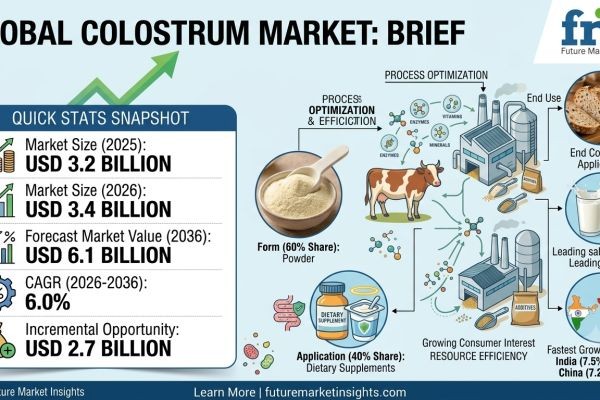
The global Colostrum Market is poised for sustained expansion, according to latest insights by Future Market Insights. The market was valued at USD 3.2 billion in 2025 and is estimated to reach USD 3.4 billion in 2026.
Key Colostrum Market Projections
- Market Size (2025): USD 3.2 Billion
• Market Size (2026): USD 3.4 Billion
• Forecast Market Value (2036): USD 6.1 Billion
• CAGR (2026-2036): 6.0%
• Incremental Opportunity: USD 2.7 Billion
• Leading Source Segment: Bovine Colostrum (90.0% Share)
• Leading Form Segment: Powder (60.0% Share)
• Leading Application: Dietary Supplements (40.0% Share)
• Fastest Growing Markets: India (7.5% CAGR) and China (7.2% CAGR)
• Key Growth Driver: Growing Consumer Interest in Immune and Gut Health
Request a Sample Report: https://www.futuremarketinsights.com/reports/sample/rep-gb-897
Strategic Market Insights
The colostrum industry continues to gain momentum as consumers increasingly seek natural solutions that support immune function, digestive health, and overall wellness. Colostrum contains immunoglobulins, growth factors, lactoferrin, and other bioactive compounds that make it an attractive ingredient across dietary supplements, infant nutrition, pharmaceuticals, animal nutrition, and personal care applications.
Growing awareness surrounding preventive healthcare and functional nutrition is encouraging manufacturers to introduce innovative colostrum-based products in convenient formats such as powders, capsules, gummies, sachets, and ready-to-drink beverages. These developments are expanding consumer access while supporting repeat purchase behavior.
As wellness consumers become more educated, demand is shifting toward products that provide documented bioactivity, verified sourcing, and transparent ingredient claims. Companies capable of demonstrating IgG content, collection quality, and processing integrity are increasingly positioned for competitive advantage.
Analyst Perspective
“The colostrum market is being built around proof of origin and proof of bioactivity. I see the main shift in how brands are using colostrum beyond capsules. Powder sticks, gummies, liposomal liquids and beauty nutrition formats are changing the buying route,” said Nandini Roy Choudhury, Principal Analyst at FMI.
Competitive Landscape and Market Share Analysis
The global colostrum market is characterized by a mix of consumer wellness brands, dairy bioactive ingredient suppliers, and specialized animal nutrition companies. Competition is increasingly focused on source verification, bioactive retention, product innovation, and scientific substantiation.
Consumer-facing brands continue investing heavily in education, direct-to-consumer channels, and premium wellness positioning. At the same time, ingredient suppliers are strengthening dairy sourcing networks and improving processing technologies to preserve immunoglobulin activity and maximize ingredient efficacy.
Market participants are also differentiating themselves through low-heat drying technologies, standardized IgG testing, traceability programs, and specialized formulations designed for immune health, digestive wellness, beauty nutrition, and sports recovery applications.
Leading Market Participants Include
- ARMRA
• Vital Proteins
• PanTheryx
• FrieslandCampina Ingredients
• Royal FrieslandCampina
• Fonterra
• Biochem
• Lemme
• Vivici
• Triplebar
Competition increasingly centers on ingredient quality, bioactive documentation, retail visibility, sourcing transparency, and innovation in delivery formats.
Production vs. Consumption Economy Analysis
Production remains highly dependent on dairy farming infrastructure and controlled collection practices. Although global dairy output continues to grow, usable colostrum remains limited because collection occurs only during early lactation periods and must prioritize calf nutrition requirements.
From a consumption perspective, North America, Europe, China, India, and Japan remain major demand centers. Rising wellness awareness, increasing supplement adoption, and growing demand for premium nutritional ingredients continue to drive consumption across both developed and emerging markets.
India and China are expected to generate particularly attractive growth opportunities due to expanding supplement industries, rising disposable incomes, and growing consumer interest in preventive healthcare solutions.
Supply Chain and Value Chain Insights
The colostrum value chain begins with dairy farm collection, quality testing, IgG verification, processing, drying, formulation, packaging, distribution, and final application across wellness, nutrition, pharmaceutical, and animal health sectors.
Farm-level handling remains a critical factor because bioactive quality depends on collection timing, storage conditions, and immunoglobulin preservation. Manufacturers continue investing in standardized collection protocols and advanced testing systems to ensure product consistency.
The growing use of digital traceability systems and quality monitoring platforms is helping suppliers improve transparency and maintain compliance with increasingly stringent market requirements.
Strategic Procurement Analysis
Procurement decisions increasingly prioritize verified source documentation, IgG concentration levels, product stability, shelf life, regulatory compliance, and supply reliability.
Nutraceutical manufacturers and wellness brands are seeking suppliers capable of delivering consistent bioactive content while maintaining traceable sourcing practices. Procurement teams are also evaluating processing methods, drying technologies, and third-party certifications when selecting ingredient partners.
As regulatory scrutiny around immune and health claims intensifies, suppliers with robust scientific documentation and quality assurance capabilities are expected to gain a stronger competitive position.
Country Opportunity Assessment
India
India is projected to remain the fastest-growing market through 2036, registering a CAGR of 7.5%. The country's extensive dairy production infrastructure, growing nutraceutical manufacturing sector, and rising consumer awareness of immune health continue to support market growth.
China
China is expected to expand at a CAGR of 7.2% during the forecast period. Growing demand for premium nutrition products, increasing acceptance of functional ingredients, and large-scale dairy production capacity continue to create favorable market conditions.
Brazil
Brazil is forecast to grow at a CAGR of 6.6% through 2036. Expanding dairy production, rising animal nutrition demand, and increasing consumer interest in wellness supplements are expected to support sustained growth.
United Kingdom
The United Kingdom is anticipated to register a CAGR of 5.8%, supported by strong supplement retail infrastructure, premium wellness consumption trends, and established dairy processing capabilities.
Germany
Germany is projected to grow at a CAGR of 5.7% through 2036, benefiting from advanced dairy processing expertise, strict quality standards, and growing demand for scientifically supported wellness products.
Japan
Japan is expected to expand at a CAGR of 5.4% through 2036 as functional nutrition, premium supplementation, and convenient daily wellness formats gain traction among consumers.
United States
The United States is forecast to register a CAGR of 4.2%, supported by mature supplement channels, premium wellness product innovation, and increasing interest in digestive and immune health.
Technology and Innovation Outlook
Key innovations shaping the colostrum industry include:
- Low-heat drying technologies
• Advanced IgG testing and verification systems
• Liposomal liquid delivery formats
• Functional gummies and chewables
• Ready-to-drink wellness beverages
• Encapsulation technologies for bioactive protection
• Digital traceability and sourcing verification systems
• Beauty nutrition formulations incorporating bovine colostrum
Manufacturers continue investing in technologies that preserve bioactive compounds while improving product convenience, stability, and consumer appeal.
Segment Analysis
By Source
Bovine colostrum is expected to dominate the market with a 90.0% share in 2026. Widespread dairy farm access, scalable collection capabilities, and established processing infrastructure support its leadership position.
Human colostrum-derived products and synthetic-replicated alternatives remain niche segments due to regulatory complexities and supply limitations.
By Form
Powder is projected to account for 60.0% of market demand in 2026. Superior shelf stability, convenient handling, ease of formulation, and compatibility with supplement formats make powder the preferred choice among manufacturers.
Capsules, tablets, and liquid products continue to gain popularity as consumers seek more convenient methods of daily supplementation.
By Application
Dietary supplements are expected to account for 40.0% of total demand in 2026. Growing interest in immune health, digestive wellness, and daily nutritional support continues driving product adoption across wellness-focused consumers.
Infant nutrition, animal feed, pharmaceuticals, and personal care applications also contribute significantly to market expansion.
Future Industry Outlook
The Colostrum Market is expected to benefit from growing demand for functional nutrition, rising wellness awareness, increasing innovation in delivery formats, and expanding use across dietary supplements, infant nutrition, pharmaceuticals, and animal health applications.
Although sourcing limitations, regulatory scrutiny, and claim substantiation requirements remain important challenges, continued investment in quality control, bioactive preservation technologies, and scientific validation is expected to support long-term market growth.
Companies capable of demonstrating source transparency, maintaining high IgG content, investing in product innovation, and supporting evidence-based health positioning will be best positioned to capitalize on opportunities through 2036.
Exclusive Discounts on Full Report: https://www.futuremarketinsights.com/reports/colostrum-market






