
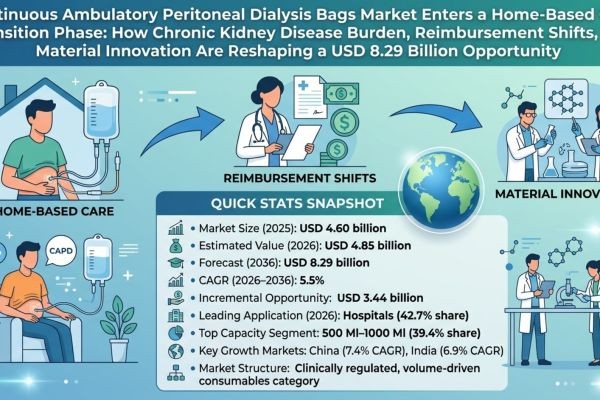
The global continuous ambulatory peritoneal dialysis (CAPD) bags market is undergoing a structural transition as renal care models shift from hospital-centric treatment toward patient-managed home therapies. What was once a stable, procedure-driven consumables segment is now evolving into a strategically regulated category shaped by reimbursement policies, infection control standards, and material compliance requirements. As chronic kidney disease (CKD) prevalence rises globally and healthcare systems prioritize cost-effective, outpatient care, CAPD bags are becoming central to scalable dialysis delivery.
Quick Stats Snapshot
• Market Size (2025): USD 4.60 billion
• Estimated Value (2026): USD 4.85 billion
• Forecast (2036): USD 8.29 billion
• CAGR (2026–2036): 5.5%
• Incremental Opportunity: USD 3.44 billion
• Leading Application (2026): Hospitals (42.7% share)
• Top Capacity Segment: 500 Ml–1000 Ml (39.4% share)
• Key Growth Markets: China (7.4% CAGR), India (6.9% CAGR)
• Market Structure: Clinically regulated, volume-driven consumables category
Market Size and Forecast
The CAPD bags market is projected to grow from USD 4.85 billion in 2026 to USD 8.29 billion by 2036, expanding at a CAGR of 5.5%. This growth reflects a steady increase in end-stage renal disease (ESRD) patient populations and a parallel shift toward home-based dialysis therapies.
Unlike high-volatility medical device markets, CAPD bags represent a recurring-demand category tied directly to treatment frequency. Growth is therefore driven less by episodic innovation and more by patient volumes, reimbursement structures, and clinical protocol adoption. As healthcare systems aim to reduce hospital burden and costs, CAPD is gaining traction as a preferred modality, sustaining long-term demand for dialysis consumables.
Growth Drivers: Why CAPD Bags Are Becoming Central to Renal Care Delivery
- Rising Prevalence of Chronic Kidney Disease (CKD)
Increasing incidence of CKD and ESRD globally is expanding the patient base requiring long-term dialysis support, directly driving consumables demand. - Shift Toward Home-Based Dialysis
Healthcare systems are incentivizing peritoneal dialysis over in-center hemodialysis due to lower infrastructure costs and improved patient quality of life. - Reimbursement Policy Support
Developed markets are introducing favorable reimbursement frameworks for home dialysis programs, accelerating adoption rates. - Material Innovation and Regulatory Compliance
Transition from PVC to non-PVC biocompatible materials is gaining momentum as regulators tighten plasticizer exposure limits.
Key Challenges: Clinical and Operational Constraints
- Regulatory Pressure on Materials: Accelerated transition to non-PVC materials increases production complexity and costs.
• Infection Risk Sensitivity: CAPD procedures are highly sensitive to contamination, requiring stringent quality and design standards.
• Procurement Standardization: Public healthcare systems impose strict qualification criteria, limiting supplier flexibility.
• Distribution Complexity: Home-based dialysis models require robust last-mile delivery and sterile logistics capabilities.
Emerging Opportunities: Where Strategic Differentiation Is Developing
Non-PVC and Biocompatible Material Transition
Manufacturers investing early in compliant materials are likely to secure long-term procurement contracts in regulated markets.
Twin-Bag and Closed-System Innovations
Advanced disconnect systems reduce peritonitis risk and improve patient safety, making them increasingly preferred in clinical protocols.
Expansion of Home Dialysis Programs
Emerging markets are scaling government-funded renal care programs, creating new demand channels for CAPD consumables.
Lightweight and Field-Deployable Solutions
Innovations in portable and fillable dialysis bags are expanding use cases in emergency and low-resource environments.
Segmentation Insights
By Application
• Hospitals (42.7%) lead due to structured treatment protocols and access to trained professionals.
• Dialysis centers and home care settings are gaining traction as outpatient models expand.
• Clinical research remains a niche but specialized segment.
By Capacity
• 500 Ml–1000 Ml (39.4%) dominates due to optimal balance between fluid exchange efficiency and patient comfort.
• Larger volumes (1000–3000 Ml) are used for specific treatment regimens but involve handling complexity.
Regional Analysis: Diverging Growth Paths Across Healthcare Systems
Asia-Pacific: Volume Expansion and Access Growth
• China (7.4% CAGR) leads global growth, driven by expanding dialysis infrastructure.
• India (6.9% CAGR) benefits from rising CKD awareness and government-backed healthcare programs.
Europe: Regulation and Material Transition
• Germany (6.3%) leads regional growth with strong compliance frameworks and advanced healthcare systems.
• The UK (4.7%) reflects steady demand supported by public healthcare programs.
North America: Stable Demand with Policy Influence
• The United States grows at 5.2%, driven by reimbursement reforms and increasing home dialysis adoption.
Latin America: Emerging Healthcare Investment
• Brazil (5.8%) shows growth through expansion of renal care access and infrastructure.
Japan: Mature Market Dynamics
• Japan (4.1%) reflects stable demand with slower growth due to established dialysis systems and aging population dynamics.
Competitive Landscape: Concentration and Compliance Define Market Structure
The CAPD bags market is moderately concentrated, with key players including Baxter, Kawasumi Laboratories, Coloplast, Mitra Industries, and Maco Pharma. Baxter holds approximately 31% market share, positioning it as the global leader.
Competitive differentiation is based on:
• Compliance with evolving material regulations
• Proven product safety and infection control performance
• Integration with standardized dialysis systems
• Global distribution and supply chain reliability
High entry barriers persist due to strict regulatory approval processes and the clinical risks associated with product failure.
Strategic Implications for Industry Stakeholders
- For Manufacturers: Accelerating non-PVC material adoption is critical to maintaining market access.
• For Healthcare Providers: Standardization of twin-bag systems can reduce infection rates and improve outcomes.
• For Procurement Leaders: Supplier selection must prioritize compliance, reliability, and long-term availability.
• For Investors: The market offers stable, recurring revenue tied to chronic disease management trends.
Future Outlook: Compliance and Patient-Centric Care Will Shape Growth
The next decade will be defined by the convergence of regulatory compliance and patient-centric care models. As home dialysis adoption accelerates, CAPD bags will need to deliver not only clinical reliability but also ease of use, safety, and material sustainability.
The transition toward non-PVC materials represents a structural shift that will redefine supplier competitiveness. At the same time, innovations in infection control and system integration will continue to shape clinical preferences.
Executive-Level Takeaways
- The CAPD bags market is projected to reach USD 8.29 billion by 2036, driven by CKD prevalence and home dialysis adoption.
• Regulatory-driven material transition from PVC to non-PVC is a defining competitive factor.
• Hospitals remain the dominant application, but home-based care is accelerating demand growth.
• Asia-Pacific leads expansion, while developed markets emphasize compliance and quality.
• Infection control and system reliability remain non-negotiable in product selection.
• The market offers stable, long-term growth linked to chronic disease management.
Full Report View: https://www.futuremarketinsights.com/reports/continuous-ambulatory-peritoneal-dialysis-bags-market






