
The global cosmetic jars market is undergoing a structural transformation as beauty brands reposition packaging from a functional container to a critical element of product performance, sustainability compliance, and brand identity. Increasing demand for skincare products, coupled with rising expectations around recyclability, refillability, and premium aesthetics, is reshaping how cosmetic jars are designed, manufactured, and sourced. As regulatory frameworks tighten around packaging waste and consumers gravitate toward clean beauty and luxury experiences, cosmetic jars are emerging as a strategic interface between formulation integrity and consumer perception.
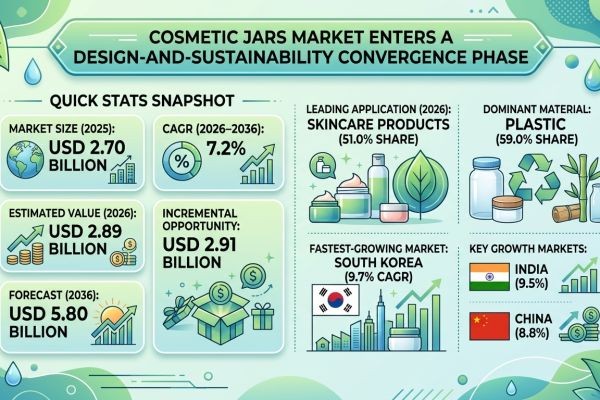
Quick Stats Snapshot
- Market Size (2025): USD 2.70 billion
• Estimated Value (2026): USD 2.89 billion
• Forecast (2036): USD 5.80 billion
• CAGR (2026–2036): 7.2%
• Incremental Opportunity: USD 2.91 billion
• Leading Application (2026): Skincare Products (51.0% share)
• Dominant Material: Plastic (59.0% share)
• Fastest-Growing Market: South Korea (9.7% CAGR)
• Key Growth Markets: India (9.5%), China (8.8%)
Market Size and Forecast
The cosmetic jars market is projected to grow from USD 2.89 billion in 2026 to USD 5.80 billion by 2036, registering a CAGR of 7.2%. This growth trajectory reflects the expanding global skincare market and the increasing importance of packaging differentiation in competitive beauty segments.
Unlike commoditized packaging formats, cosmetic jars operate at the intersection of function and branding. Growth is driven not only by product volume but also by packaging redesign cycles, material upgrades, and premiumization strategies. As brands refresh portfolios to align with sustainability mandates and evolving consumer expectations, jar replacement cycles are accelerating, contributing to steady market expansion.
Growth Drivers: Why Cosmetic Jars Are Becoming Strategic Packaging Assets
- Expansion of Skincare and Premium Beauty Segments
Skincare accounts for 51% of demand, driven by the global rise in moisturizers, anti-aging products, and treatment-based formulations requiring jar packaging.
- Sustainability and Regulatory Pressure
Extended Producer Responsibility (EPR) regulations and recycled content mandates are pushing brands toward recyclable and refillable jar systems.
- Premiumization and Brand Differentiation
Luxury and prestige beauty brands increasingly rely on heavy-wall glass and decorated jars to create high-end consumer experiences.
- Growth of E-Commerce Beauty Distribution
Durable, lightweight, and shatter-resistant plastic jars are essential for direct-to-consumer shipping models.
Key Challenges: Balancing Sustainability, Cost, and Performance
- Material Trade-Offs: Transitioning to sustainable materials can increase costs and impact barrier performance.
• Raw Material Price Volatility: Fluctuations in plastic resins, glass, and metal affect manufacturing economics.
• Counterfeiting Risks: Luxury segments require authentication features to protect brand integrity.
• Recycling Complexity: Multi-material and decorated jars can complicate recycling processes.
Emerging Opportunities: Where Innovation Is Driving Value
Refillable and Modular Jar Systems
Refillable packaging is gaining traction, particularly in luxury beauty, as brands seek to reduce waste and improve customer retention.
Airless and Preservation-Enhanced Technologies
Airless jar systems are increasingly used for oxygen-sensitive formulations, improving shelf life and product efficacy.
Post-Consumer Recycled (PCR) Integration
Adoption of PCR plastics is accelerating, with brands targeting minimum recycled content thresholds by 2030.
Smart and Connected Packaging
Integration of NFC chips and QR codes is enabling authentication, consumer engagement, and anti-counterfeiting measures.
Segmentation Insights
By Material Type
- Plastic (59%) dominates due to cost efficiency, design flexibility, and durability in e-commerce logistics.
• Glass is preferred in premium segments for aesthetics and recyclability.
• Metal serves niche applications requiring durability and distinctive branding.
By Application
Skincare (51%) leads due to high-volume consumption of creams, masks, and moisturizers.
• Facial care and body care segments follow, supported by product diversification.
• Color cosmetics and hair care represent smaller but growing applications.
Regional Analysis: Growth Fueled by Beauty Innovation and Consumption Trends
Asia-Pacific: Innovation and Volume Growth Hub
South Korea (9.7% CAGR) leads global growth, driven by K-beauty innovation and packaging design excellence.
• China (8.3% CAGR) benefits from expanding luxury beauty consumption and manufacturing scale.
• India (9.5% CAGR) is driven by rapid growth in domestic skincare markets and organized retail expansion.
North America: Clean Beauty and Personalization
The United States (6.8%) focuses on sustainable packaging and refillable systems aligned with clean beauty trends.
Europe: Luxury Heritage and Regulatory Influence
France (7.1%) leads with strong luxury cosmetics heritage and premium packaging demand.
• Germany (6.2%) emphasizes technical packaging and dermo-cosmetics applications.
Latin America: Natural Beauty Expansion
Brazil (7.9%) benefits from rising middle-class consumption and demand for natural ingredient-based products.
Japan: Precision and Minimalist Design
Japan (6.4%) focuses on high-quality manufacturing and refined packaging aesthetics.
Competitive Landscape: Innovation, Customization, and Scale Define Leadership
The cosmetic jars market is highly competitive, with key players including Aptar Group, Gerresheimer AG, Albéa Group, HCP Packaging, Quadpack Industries, Silgan Holdings, Berry Global, and Cosmopak.
Competitive advantage is defined by:
- Advanced decoration and customization capabilities
• Material innovation and sustainability alignment
• Integration of airless and refillable technologies
• Ability to serve both mass and luxury segments
Strategic Implications for Industry Stakeholders
- For Beauty Brands: Packaging is a core component of product positioning, influencing both perception and sustainability compliance.
• For Packaging Manufacturers: Investment in refillable systems and PCR materials is critical for long-term competitiveness.
• For Procurement Leaders: Supplier selection must balance cost, innovation capability, and regulatory alignment.
• For Investors: The market offers growth driven by premiumization and sustainability-led innovation.
Future Outlook: Sustainability and Experience Will Define Competitive Advantage
The next decade will see cosmetic jars evolve beyond static containers into multifunctional systems that combine preservation, sustainability, and digital engagement. Refillable models, smart packaging, and advanced material science will play a central role in shaping market dynamics.
Success will depend on the industry’s ability to deliver environmentally compliant solutions without compromising aesthetics, durability, or product protection. As clean beauty and luxury converge, cosmetic jars will remain a critical touchpoint in the consumer experience.
Executive-Level Takeaways
- The cosmetic jars market is projected to reach USD 5.80 billion by 2036, driven by skincare growth and premium packaging demand.
• Plastic remains dominant, but sustainability pressures are accelerating material innovation.
• Skincare applications account for over half of total demand, shaping product design and packaging requirements.
• Asia-Pacific leads growth, while Europe and North America drive regulatory and premiumization trends. - Refillable systems and airless technologies are emerging as key competitive differentiators.
• Packaging is evolving into a strategic asset influencing brand value, compliance, and consumer engagement.
Full Report View: https://www.futuremarketinsights.com/reports/cosmetic-jars-market






