
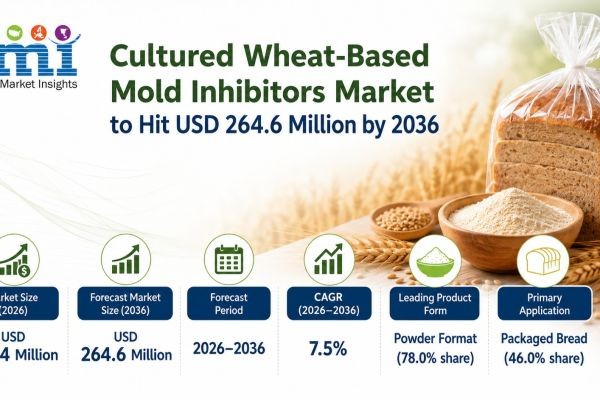
The global cultured wheat-based mold inhibitors for bakery market is entering a crucial scale-up phase. As commercial food brands face tightening retail compliance screens and deep consumer pushback against synthetic salts, standard preservatives like calcium propionate are increasingly being dropped in favor of fermentation-derived, flour-native solutions. According to comprehensive industry insights by Future Market Insights, the global market is projected to reach USD 128.4 million in 2026 and expand to USD 264.6 million by 2036, progressing at a strong Compound Annual Growth Rate (CAGR) of 7.5% over the ten-year forecast period. This transition represents an absolute dollar opportunity of USD 136.2 million.
Request a Sample Report: https://www.futuremarketinsights.com/reports/sample/rep-gb-33402
Key Market Highlights at a Glance
- Market Size (2026): USD 128.4 Million
- Forecast Market Size (2036): USD 264.6 Million
- Forecast Period: 2026–2036
- CAGR (2026–2036): 7.5%
- Leading Product Form: Powder Format (78.0% share)
- Primary Application: Packaged Bread (46.0% share)
- Core Label Claim Category: Clean Label (52.0% share)
- Dominant Function Segment: Mold Control (68.0% share)
- Primary Sales Channel: Direct Enterprise Sales (52.0% share)
- Fastest-Growing Country: India (9.2% CAGR)
Why Is the Cultured Wheat-Based Mold Inhibitors Market Growing?
The persistent commercial adoption of cultured wheat structures is driven by complex ingredient-deck management, supply chain familiarity, and cost-in-use optimization.
Key Growth Drivers
- Native Label Alignment: Fermented wheat flour or cultured wheat wordings allow bakeries to satisfy clean-label initiatives using an ingredient derived from the identical agricultural source as the primary substrate (flour).
- Mitigating Spoilage and Financial Returns: Sliced commercial loaves carry high moisture profiles and immense surface-area exposure, making visible mold the leading cause of retail product rejections and costly route returns.
- Operational Drop-in Stability: Advanced processing ensures that fermented wheat yields consistent concentrations of natural propionic, acetic, and lactic acids, matching the shelf-life longevity of synthetic preservation without requiring complex plant re-tooling.
“Cultured wheat-based mold inhibitors are becoming a bakery process decision rather than a simple label swap. Buyers want mold-free days without losing bread volume or crumb color. Suppliers that prove acid profile consistency and help bakers adjust dough pH should gain stronger trial conversion.” Nandini Roy Choudhury, Principal Consultant at FMI
Powder Formats Rule Mainstream Industrial Milling Infrastructure
Powder configurations represent the leading commercial form, projected to capture a commanding 78.0% share of global demand in 2026. Industrial plants heavily favor dry formats because they integrate seamlessly into massive flour silos, automated scaling setups, and existing dry-premix workflows. However, plant engineers closely scrutinize powder anti-caking properties and flowability indices; any localized clumping or variation in acid concentration can trigger uneven product distribution, resulting in localized mold failures across a single baking run.
Packaged Bread Commands Close to Half of Total Category Shipments
Packaged bread lines serve as the primary commercial destination for cultured wheat, controlling an estimated 46.0% of the total application matrix in 2026. Sliced white sandwich breads, sandwich buns, and high-volume commercial rolls require prolonged ambient route stability across long-distance retail networks. To protect brand reputation, bakery plant managers rigorously test crumb consistency, loaf volume, and elasticity, ensuring the natural acidity of fermented inhibitors does not weaken yeast activity or extend proofing tolerances.
Market Dynamics
- Market Drivers: Intense retailer monitoring of chemical-sounding consumer labels, high-volume baking innovations, and the capability of combining cultured wheat with texturizers in multi-functional flour systems.
- Market Restraints: The higher relative cost-in-use compared to cheap commodity salts. Because cultured wheat typically requires higher dosage rates (often 1.0% to 5.0% of flour weight depending on base parameters), its application is currently concentrated in premium and private-label tiers, demanding proven reductions in return rates to justify bulk procurement.
Custom Research Available: https://www.futuremarketinsights.com/customization-available/rep-gb-33402
Regional and Country Outlook
Country Growth Rates (CAGR through 2036)
- India — 9.2% CAGR
- China — 8.6% CAGR
- South Korea — 7.0% CAGR
- United Kingdom — 6.7% CAGR
- United States — 6.4% CAGR
- Germany — 5.9% CAGR
- France — 5.8% CAGR
- Japan — 5.2% CAGR
India is emerging as the global frontrunner, projected to clock a blistering 9.2% CAGR through 2036. This performance is powered by a massive local wheat supply base, expanding food processing logistics, and an explosion in quick-commerce packaged bread demand extending well outside primary tier-one metros. China follows at an 8.6% CAGR, supported by immense chain-bakery density and a major production scale-up for premium toast bread lines. The United States charts a reliable 6.4% CAGR, driven by vast commercial baking infrastructure and the widespread integration of advanced micro-testing application labs.
Competitive Landscape
The global competitive paradigm features a mixture of specialized life-sciences fermenters and sprawling multi-line bakery ingredient distributors.
Key Companies:
Upstream biochemical development and validated product evidence are led by global giants Corbion (with its established Verdad Essence lines) and BDF Natural Ingredients (featuring its PRESACTIVE BAKE series). Broad channel distribution, premix blending, and onsite technical plant support are heavily driven by ingredient heavyweights Lallemand Baking, AB Mauri, Cain Food Industries, J&K Ingredients, Vaishnavi Bio Tech, Kemin Industries, and IFF.
Exclusive Discounts on Full Report: https://www.futuremarketinsights.com/reports/cultured-wheat-based-mold-inhibitors-for-bakery-market
Frequently Asked Questions
How big is the cultured wheat-based mold inhibitors market in 2026?
The global market is estimated to be valued at USD 128.4 million in 2026.
What will be the size of the cultured wheat-based mold inhibitors market in 2036?
The industry revenue is predicted to reach USD 264.6 million by 2036, expanding at a CAGR of 7.5%.
Which form format dominates commercial production?
Powder formats dominate the structural landscape, commanding a 78.0% share in 2026 due to direct drop-in alignment with dry flour dosing infrastructure.
What is the primary function driving consumer brand adoption?
Mold control is the primary application function, making up 68.0% of the market share in 2026 as visible product spoilage is the most significant cause of retail rejections.
Who are the core manufacturers operating in this clean-label market?
The market is led by industry suppliers Corbion, BDF Natural Ingredients, Lallemand Baking, and AB Mauri.
FMI Custom Research: Strategic Intelligence for Confident Decision-Making
In today's rapidly evolving business environment, leadership teams need more than market data they need clear, actionable intelligence tailored to their strategic objectives. FMI's Custom Research solutions are designed around the specific business questions organizations need answered, enabling executives to evaluate growth opportunities, validate investments, assess competitive dynamics, and reduce uncertainty before making critical decisions.
Key Executive Benefits
- Decision-Ready Insights tailored to business priorities
• Reduced Strategic Risk through validated market intelligence
• Market Entry Confidence with detailed competitive analysis
• Competitive Advantage supported by proprietary research
• Faster Growth Decisions through customized strategic insights
• Primary Market Validation from industry stakeholders
• Global Industry Expertise across diverse sectors
• Proven Track Record with thousands of consulting engagements
Business Impact
FMI helps organizations transform market complexity into strategic clarity, enabling leadership teams to identify growth opportunities faster, optimize resource allocation, strengthen competitive positioning, and make high-stakes business decisions with confidence.
To explore how FMI Custom Research can support your strategic priorities, please connect with our team at - sales@futuremarketinsights.com
Why Choose FMI: https://www.futuremarketinsights.com/why-fmi
Explore More Related Studies Published by FMI Research
Butter Coffee Market : https://www.futuremarketinsights.com/reports/butter-coffee-market
Gellan Gum Market : https://www.futuremarketinsights.com/reports/gellan-gum-market
Explore In-Depth Food & Beverage Market Insights : https://www.futuremarketinsights.com/industry-analysis/food-and-beverage
About Future Market Insights (FMI)
Future Market Insights, Inc. is an ESOMAR-certified, ISO 9001:2015 market research and consulting organization trusted by Fortune 500 companies. With a global presence across the U.S., UK, India, and Dubai, FMI delivers data-driven insights across 30+ industries and 1200 markets worldwide.
Contact Us
Future Market Insights Inc.
Christiana Corporate, 200 Continental Drive,
Suite 401, Newark, Delaware – 19713, USA
T: +1-347-918-3531
For Sales Enquiries: sales@futuremarketinsights.com
Website: https://www.futuremarketinsights.com






