
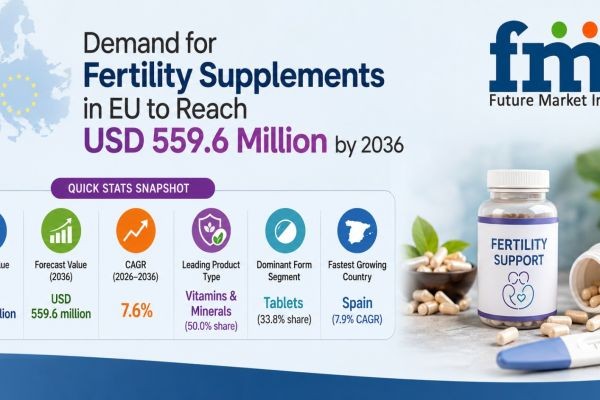
The European Union fertility supplements market is undergoing a highly disciplined, clinically driven transformation, according to latest insights by future market insights. As the average age at first childbirth continuously increases across European member states and delayed parenthood trends persist, what was once a discretionary health choice is now a structured, medically motivated regimen. The global market inside the EU, valued at USD 250.0 million in 2025, is projected to reach USD 269.0 million in 2026. Expanding at a strong Compound Annual Growth Rate (CAGR) of 7.6% over the ten-year forecast period, the total industry valuation within the bloc is anticipated to cross USD 559.6 million by 2036, opening an absolute incremental opportunity of USD 290.6 million.
Request a Sample Report: https://www.futuremarketinsights.com/reports/sample/rep-gb-27169
Market Performance Overview (2026–2036)
To map out the key product configurations, therapeutic form factors, and primary distribution networks guiding this USD 290.6 million European expansion, a detailed segment share analysis highlights where commercial value is concentrated:
- Vitamins & Minerals Product Type (50.0% share): Dominates the market in 2026, functioning as the foundational standard for preconception care due to strict guidelines from reproductive medicine societies endorsing folic acid, zinc, and selenium.
- Tablets Delivery Form (33.8% share): Holds the leading position in the form segment due to its established clinical consumption patterns and manufacturing cost efficiencies, though capsules are capturing market share through a higher perceived bioavailability.
- Pharmacies Sales Channel: Serves as the primary distribution anchor for recommendation-led buying, leveraging community and hospital pharmacy settings to build credibility and command premium pricing.
Technical Drivers and Sourcing Monopolies
The rapid integration of specialized fertility supplements into European clinical protocols is propelled by distinct structural and regulatory catalysts:
Multi-Nutrient Clinical Protocol Integration
A primary driver of market growth is the active incorporation of specific nutritional supplementation matrices into official preconception and IVF preparation protocols. Leading entities such as the European Society of Human Reproduction and Embryology (ESHRE) increasingly recommend multi-supplement protocols combining folic acid, CoQ10, folate, and antioxidant blends to boost clinical outcomes, extending consumer usage routines to a steady 6 to 24 months.
Strict Regulatory Control Under Directive 2002/46/EC
The marketing landscape within the EU is heavily governed by Directive 2002/46/EC and Regulation 1924/2006. EFSA restricts structural fertility claims to highly precise, validated wording (e.g., zinc contributes to normal fertility and reproduction, and folate contributes to maternal tissue growth during pregnancy). This strict framework protects the market from misleading, unverified medicinal claims while creating an immense structural hurdle that favors established, well-documented converters.
Rising Male Fertility Sourcing Dynamics
Beyond traditional female prenatal matrices, the market is experiencing a profound volume expansion driven by a rise in male fertility awareness. Growing clinical evidence directly links zinc, selenium, L-carnitine, and targeted antioxidant blends to improved semen parameters (sperm count, motility, and morphology). This expanding clinical validation allows brands to successfully launch male-specific combination products at pharmacy level.
Industrial Infrastructure Challenges
Brand development teams and contract manufacturing organizations must coordinate to navigate intense technical limits:
- Complex Bioavailability and Formulation Hurdles: Suspending sensitive active ingredients like CoQ10 alongside volatile herbal extracts (such as maca, vitex, or ashwagandha) within a single compressed tablet requires sophisticated stabilizers and precise manufacturing to prevent premature oxidation or textural degradation over the product's shelf life.
- Commoditization via Private-Label Lines: High-margin multi-nutrient blends face rising shelf competition from low-cost, private-label prenatal vitamins. To maintain higher pharmacy price positions, premium brands must continuously invest in direct healthcare professional partnership networks and rigorous clinical data validation.
Regional Growth Outlook
The geographic analysis reflects monumental growth velocity across modernizing Mediterranean healthcare lifecycles alongside highly mature Western European distribution networks:
- Spain (7.9% CAGR): The global growth frontrunner within the EU, driven by a rapidly expanding reproductive health awareness culture, intense clinic investments, and a strong regional alignment with Mediterranean wellness traditions.
- Netherlands (7.4% CAGR): Leading clinical innovation, where advanced reproductive healthcare practices, major fertility research centers, and a deep consumer preference for clean-label, traceable organic ingredients dictate procurement strategies.
- Italy (7.2% CAGR): Propelled by a progressive integration of specialty supplements into traditional family-oriented medical networks and a high cultural trust in natural, verified healthcare formulations.
- Germany (6.8% CAGR): Holding the largest overall market footprint at 28.5% market share in 2026, driven by a robust medical infrastructure, established pharmacy networks, and strict guidelines enforced by the German Society for Reproductive Medicine.
- France (6.5% CAGR): Maintaining a steady trajectory, supported by a growing healthcare preference for premium, clinically validated reproductive solutions and specialized nutrition placements across major medical groups.
Competitive Landscape
The European fertility supplements environment features an established upper echelon of global pharmaceutical corporations, specialized reproductive nutrition labels, and highly certified contract processors. Global market equity, advanced therapeutic technology investments, and dominant multi-jurisdictional professional access are led by heavyweights including Garden of Life, Thorne Research, Fertility Nutraceuticals, Nature's Way, New Chapter, Vitafusion, Zahler, MediNatura, and Carlyle.
To defend structural margins against private-label copycats, leading global manufacturers are aggressively prioritizing investments in expanding multi-origin facilities, automated high-speed tablet compression machinery, and certified non-GMO botanical sourcing loops.
Full Report for Detailed Insights: https://www.futuremarketinsights.com/reports/demand-for-fertility-supplements-in-eu
Frequently Asked Questions
What is the projected valuation of the global market by 2036?
The demand for fertility supplements in the EU is projected to reach USD 559.6 million by 2036, expanding upward from an estimated baseline valuation of USD 269.0 million in 2026 at a CAGR of 7.6%.
Why does the Vitamins & Minerals segment command a 50.0% market share?
Essential micronutrients like folic acid, selenium, and zinc function as the core biochemical building blocks required for healthy cellular reproduction, ovulation optimization, and sperm morphology, securing them as mandatory inclusions under international preconception guidelines.
What exclusions govern the boundaries of this market report?
The analytical scope strictly focuses on over-the-counter dietary fertility supplements, explicitly excluding prescription fertility medications (such as gonadotropins or clomiphene citrate), standard prenatal vitamins marketed solely for confirmed pregnancy, and medical IVF/IUI hospital treatment services.
FMI Custom Research: Strategic Intelligence for Confident Decision-Making
In today's rapidly evolving business environment, leadership teams need more than market data they need clear, actionable intelligence tailored to their strategic objectives. FMI's Custom Research solutions are designed around the specific business questions organizations need answered, enabling executives to evaluate growth opportunities, validate investments, assess competitive dynamics.
Key Executive Benefits
- Decision-Ready Insights tailored to business priorities
- Reduced Strategic Risk through validated market intelligence
- Market Entry Confidence with detailed competitive analysis
- Competitive Advantage supported by proprietary research
- Faster Growth Decisions through customized strategic insights
- Primary Market Validation from industry stakeholders
- Global Industry Expertise across diverse sectors
- Proven Track Record with thousands of consulting engagements
Business Impact
FMI helps organizations transform market complexity into strategic clarity, enabling leadership teams to identify growth opportunities faster, optimize resource allocation, strengthen competitive positioning, and make high-stakes business decisions with confidence.
To explore how FMI Custom Research can support your strategic priorities, please connect with our team at - sales@futuremarketinsights.com






