
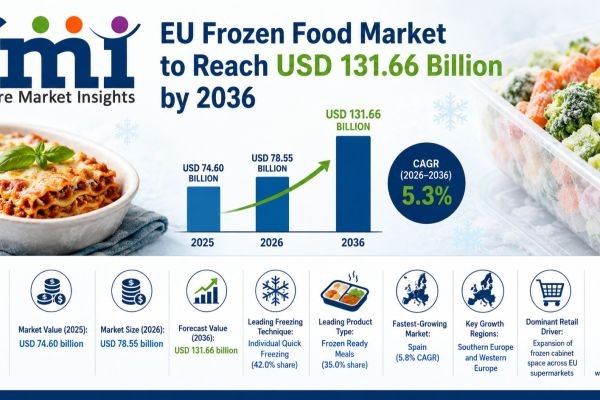
The European Union frozen food market is undergoing a major structural expansion and perception reset, according to latest insights by future market insights. Moving firmly past the historical "low-quality" stigma, the category is transitioning into a core pillar of premium, sustainable, and anti-food-waste lifestyle routines across European households. The market, which is valued at USD 78.55 billion in 2026, is projected to expand at a steady Compound Annual Growth Rate (CAGR) of 5.3% over the ten-year forecast period. By 2036, total industry valuation is anticipated to achieve USD 131.66 billion, creating an absolute incremental dollar opportunity of over USD 53 billion.
Request a Sample Report: https://www.futuremarketinsights.com/reports/sample/rep-gb-27184
Market Performance Overview (2026–2036)
To map out the key application configurations and distribution channels driving this multi-billion dollar market scale-up, an analysis of leading segment allocations highlights where commercial volume is concentrated:
- Individual Quick Freezing Freezing Technique (42.0% share): Outpaces alternative preservation techniques in 2026, functioning as the premier industrial standard because it maintains piece separation, cellular structure, and texture integrity that consumers associate with fresh-food quality.
- Frozen Ready Meals Product Type (35.0% share): Commands the product category segment, sustained by time-constrained, working professional households seeking complete, nutritious, on-demand meal solutions with minimal preparation.
- Supermarkets & Hypermarkets Distribution Channel: Anchors the physical transaction framework, driving category volume as major grocery operators continuously expand freezer aisle footprints by 3% to 5% annually to capitalize on higher profit margins per linear meter compared to ambient shelving.
Technical Drivers and Sourcing Monopolies
The rapid integration of advanced frozen formats into European grocery distribution is propelled by distinct industrial and sustainability catalysts:
Quality Parity and IQF Technology Sophistication
Modern European consumers are increasingly recognizing that flash-freezing technologies lock in nutrients, flavor profiles, and textures at the absolute peak of freshness. Advanced IQF machinery ensures that vegetables, seafood, and meat cuts retain an exceptional organic structure, effectively dissolving the historical trade-off between preservation convenience and raw food quality.
Alignment with Green Deal Anti-Food-Waste Targets
A primary catalyst driving retail portfolio updates is the inherent sustainability positioning of frozen logistics. Long, stable shelf lives, precise portion control, and minimized ambient spoilage align perfectly with the EU's strict Farm to Fork food waste reduction mandates, transforming frozen cabinets into environmentally responsible destination points for eco-conscious shoppers.
Premium Private-Label Proliferation and Margin Squeezes
The competitive ecosystem is being heavily reshaped by major retail networks launching premium and organic private-label frozen lines (such as gourmet selections at Carrefour, REWE, and Tesco). While these high-quality retailer own-brand solutions deliver restaurant-quality meals at home and accelerate category trial, they are simultaneously compressing the profit margins of legacy, pure-play branded names.
Industrial Infrastructure Challenges
European processing lines and cold-chain supply chain directors must coordinate to navigate inherent structural constraints:
- Fluctuating Energy and Cold-Chain Overhead Costs: Maintaining an unbroken, certified cold-chain environment at minus 18 degrees Celsius or below across expansive multi-country transit routes demands intense energy utilization, exposing processors to volatile localized utility tariffs.
- Rigid EFSA Food Safety and Labeling Mandates: Evolving European Food Safety Authority (EFSA) regulations require deep trace-element tracking and comprehensive labeling frameworks, meaning suppliers lacking advanced digital tracking systems face immediate channel delisting.
Regional Growth Outlook
The geographic analysis reflects monumental growth velocity across modernizing Mediterranean lifecycles alongside highly mature Western European distribution networks:
- Spain (5.8% CAGR): The global growth frontrunner, driven by rapid urbanization, an explosion in dual-income household convenience adoption, and heavy category retail innovation integrating localized Mediterranean ingredients.
- Italy (5.0% CAGR): Moving at a powerful pace as northern urban segments successfully integrate premium frozen components and traditional regional specialties into rigid family meal traditions.
- France (4.9% CAGR): Sourcing a dominant volume baseline, anchored by an exceptional premium footprint from specialized frozen operators like Picard Surgelés and a high consumer willingness to spend on gourmet ready meals.
- Germany (4.6% CAGR): Leading volume scaling via highly disciplined discount retail private-label lines (Aldi, Lidl) and an intense industrial focus on Industry 4.0 automation and quality certification.
- BENELUX (4.3% CAGR): Characterized by premium quality leadership and strict regional consumer commitment to sustainable packaging and energy-efficient cold chain processing.
Competitive Landscape
The European frozen food environment features an established tier of massive multinational food corporations alongside dominant regional contract manufacturers and automated retail private labels. Nomad Foods (operating Findus, Iglo, and Birds Eye EU lines) holds the leading branded market position, driven by a deep multi-country product portfolio and established retail channel integrations.
Comprehensive volume distribution pipelines, state-of-the-art cold logistics, and large-scale blending infrastructure are driven by global market titans including Nestlé, Unilever, Conagra, General Mills, McCain Foods, Dr. Oetker, Frosta AG, and Picard Surgelés. To maximize customer acquisition costs and retain digital-first demographics, leading players are actively prioritizing investments in recyclable mono-material packaging, bio-based trays, and advanced cryogenic quick-freezing arrays.
Full Report for Detailed Insights: https://www.futuremarketinsights.com/reports/demand-for-frozen-food-in-eu
Frequently Asked Questions
What is the projected valuation of the global market by 2036?
The demand for frozen food in the EU is projected to reach USD 131.66 billion by 2036, expanding upward from an estimated baseline valuation of USD 78.55 billion in 2026 at a CAGR of 5.3%.
Why does Individual Quick Freezing (IQF) dominate the freezing technique segment?
IQF mechanisms flash-freeze items rapidly and independently, preventing the formation of large ice crystals inside food cells. This preserves natural textures, eliminates clumped freezing, and delivers excellent freshness retention.
What exclusions govern the boundaries of this market report?
The analytical scope strictly focuses on food items preserved at or below minus 18 degrees Celsius, explicitly excluding water ice/dry ice intended for non-food cooling functions, frozen pet food lines, and standalone cold-chain logistics machinery.
FMI Custom Research: Strategic Intelligence for Confident Decision-Making
In today's rapidly evolving business environment, leadership teams need more than market data they need clear, actionable intelligence tailored to their strategic objectives. FMI's Custom Research solutions are designed around the specific business questions organizations need answered, enabling executives to evaluate growth opportunities, validate investments, assess competitive dynamics.
Key Executive Benefits
- Decision-Ready Insights tailored to business priorities
- Reduced Strategic Risk through validated market intelligence
- Market Entry Confidence with detailed competitive analysis
- Competitive Advantage supported by proprietary research
- Faster Growth Decisions through customized strategic insights
- Primary Market Validation from industry stakeholders
- Global Industry Expertise across diverse sectors
- Proven Track Record with thousands of consulting engagements
Business Impact
FMI helps organizations transform market complexity into strategic clarity, enabling leadership teams to identify growth opportunities faster, optimize resource allocation, strengthen competitive positioning, and make high-stakes business decisions with confidence.
To explore how FMI Custom Research can support your strategic priorities, please connect with our team at - sales@futuremarketinsights.com






