
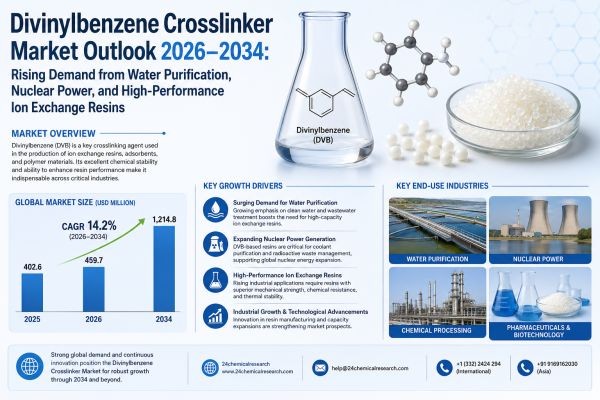
Divinylbenzene (DVB) is a critical crosslinking monomer at the very heart of modern ion exchange resin manufacturing, where it forms a robust three-dimensional polymer network that imparts mechanical strength, chemical resistance, and long-term structural stability to the resin matrix. Commercially available in varying purity grades — most notably 55% and 80% DVB content — DVB is copolymerized with styrene to produce the crosslinked bead architecture that forms the operational backbone of both cation and anion exchange resins. These resins serve as indispensable separation and purification tools across water treatment, food processing, pharmaceutical manufacturing, and chemical processing industries worldwide. What makes DVB particularly valuable is its direct influence over resin performance parameters: crosslink density, porosity, osmotic shock resistance, and service life are all fundamentally governed by the quality and loading of DVB used during polymerization, making it a genuinely mission-critical specialty chemical rather than a commodity input.
Get Full Report Here: https://www.24chemicalresearch.com/reports/308789/divinylbenzene-crosslinker-for-ion-exchange-resin-market
Market Dynamics:
The market's trajectory is shaped by a complex interplay of powerful growth drivers, significant restraints that are being actively addressed, and vast, untapped opportunities that are only beginning to attract serious commercial attention.
Powerful Market Drivers Propelling Expansion
- Rising Global Demand for Water Treatment Infrastructure: The single most consistent growth driver for DVB crosslinker demand is the accelerating global buildout of water purification infrastructure. Ion exchange resins, which depend on DVB as their structural and functional foundation, are deployed at massive scale in municipal demineralization systems, industrial process water circuits, and effluent treatment facilities. As freshwater scarcity intensifies across South Asia, the Middle East, and sub-Saharan Africa, and as regulatory standards for treated water quality continue to tighten across North America and Europe, utilities and industrial operators are committing substantial capital to advanced ion exchange systems. This creates a direct and durable pull-through for high-crosslink-density DVB-based resins. Furthermore, the growing infrastructure investment tied to PFAS remediation — a significant water quality challenge that has gained regulatory urgency since 2023 — has opened an incremental and technically demanding demand channel for specialty ion exchange resins that require elevated DVB crosslink density to perform reliably under challenging contaminant profiles.
- Expansion of Nuclear Power and High-Purity Industrial Applications: Nuclear power generation represents one of the most technically exacting end-use environments for DVB-crosslinked ion exchange resins. These resins are employed in reactor coolant purification circuits and radioactive waste processing streams, where structural integrity under sustained radiation exposure and elevated thermal stress is genuinely non-negotiable. The global low-carbon energy transition has reinvigorated nuclear capacity additions across Asia-Pacific, Eastern Europe, and the Middle East, translating directly into long-term procurement commitments for specialty-grade DVB crosslinkers. The crosslink density of DVB in these resins — typically ranging from 4% to 12% — directly governs selectivity, swelling behavior, and operational lifespan, making DVB purity and compositional consistency a critical quality parameter. Similarly, semiconductor fabrication facilities require ultra-high-purity process water achievable only through mixed-bed ion exchange systems, driving further demand for premium-grade DVB resin formulations as chip complexity and purity requirements continue to escalate.
- Pharmaceutical Manufacturing Growth and Stringent Water Purity Standards: Growth in pharmaceutical water purification, driven by stringent USP and EP compendial standards for water-for-injection (WFI) and purified water systems, is reinforcing sustained procurement of high-grade DVB crosslinkers. As pharmaceutical and biotechnology manufacturing capacity expands rapidly across India, Southeast Asia, and China, resin manufacturers are scaling output of both gel-type and macroporous ion exchange resins — both of which depend fundamentally on DVB to achieve their specified crosslink architectures. The food and beverage sector provides an additional layer of demand stability, with DVB-crosslinked resins used extensively in sucrose decolorization, whey demineralization, juice clarification, and high-fructose corn syrup production processes that require consistent, specification-driven resin performance over extended service cycles.
Download FREE Sample Report: https://www.24chemicalresearch.com/download-sample/308789/divinylbenzene-crosslinker-for-ion-exchange-resin-market
Significant Market Restraints Challenging Adoption
Despite its structural advantages and multi-sector demand profile, the DVB crosslinker market faces meaningful headwinds that participants must navigate carefully.
- Feedstock Price Volatility and Supply Chain Concentration: Divinylbenzene is synthesized through the catalytic dehydrogenation of diethylbenzene, a derivative of the broader petrochemical value chain. This positions DVB crosslinker pricing in direct correlation with crude oil and benzene price movements, introducing significant cost unpredictability for downstream resin manufacturers. Periods of crude oil price spikes compress resin producer margins and can delay capital investment decisions that would otherwise stimulate DVB demand. Furthermore, commercial-scale DVB production is concentrated among a relatively small number of manufacturers globally, which means supply disruptions at any major facility can create cascading shortages across the ion exchange resin supply chain. This supply concentration dynamic represents a structural vulnerability that large resin manufacturers have sought to address through long-term supply agreements and, in certain cases, backward integration strategies.
- Regulatory Compliance Costs and Handling Constraints: DVB is classified as a hazardous chemical under various national and regional regulatory frameworks and is subject to occupational exposure limits, emissions controls, and transportation regulations across major markets including the European Union, the United States, and increasingly stringent Asia-Pacific jurisdictions. Compliance with REACH regulations in Europe, OSHA standards in the United States, and evolving Chinese hazardous chemical management rules adds meaningful cost burdens to both DVB producers and their downstream customers. Compounding this challenge, DVB is a reactive monomer with a tendency toward premature polymerization during storage and transportation, necessitating strict temperature controls, precise inhibitor management, and specialized logistics infrastructure. These handling requirements elevate supply chain costs and create compliance burdens for distributors operating in regions with less-developed chemical logistics networks.
Critical Market Challenges Requiring Innovation
The high capital intensity of ion exchange resin manufacturing presents a structural challenge that periodically decouples DVB crosslinker demand growth from actual end-market pull. Producing ion exchange resins requires highly specialized suspension polymerization reactors, precise process control capabilities, and extensive quality testing infrastructure — all of which represent significant capital investments that restrict the pace at which new resin manufacturing capacity can come online. For DVB producers, this translates into lumpy and sometimes unpredictable demand patterns that complicate production planning and capacity utilization optimization.
Additionally, competition from alternative crosslinking technologies, while not yet a material threat, merits monitoring. Ongoing research into acrylic-based and fluoropolymer ion exchange systems poses a long-term substitution risk in specific niche applications where regulators or end-users are evaluating resin platforms that minimize aromatic hydrocarbon content. In certain pharmaceutical and food-grade contexts, this trend could gradually erode DVB's addressable share in those high-value segments over the coming decade, encouraging DVB producers to invest in product quality improvements and application-specific technical service capabilities to defend their position.
Vast Market Opportunities on the Horizon
- Lithium and Critical Mineral Recovery Driving Specialty Resin Demand: The accelerating global transition toward electrification and battery energy storage is creating significant new demand vectors for DVB-crosslinked ion exchange resins in lithium, cobalt, nickel, and rare earth element recovery and purification processes. Hydrometallurgical processing of battery-grade lithium from brines and spodumene concentrates depends critically on selective ion exchange resins, many of which utilize DVB-crosslinked polymer matrices tuned to specific ion selectivity profiles. As lithium refining capacity expands across Australia, Chile, China, and emerging producers in North America and Europe, the downstream pull for specialty DVB-based resins represents a high-growth, above-average-margin opportunity for DVB crosslinker producers with the technical capability to serve this demanding segment.
- Emerging Market Urbanization and Industrial Water Infrastructure Investment: Rapid urbanization across Southeast Asia, South Asia, Africa, and Latin America is generating large-scale investment in municipal water treatment and industrial effluent management infrastructure. Governments and multilateral development institutions are channeling substantial capital into water purification projects, desalination post-treatment demineralization systems, and zero-liquid-discharge industrial facilities — all of which rely on ion exchange technology at their core. This infrastructure build-out cycle is expected to sustain above-trend growth in ion exchange resin demand throughout the forecast period to 2034, providing DVB crosslinker producers with a geographically diversifying customer base that reduces over-reliance on mature Western market demand patterns.
- Advanced Ion Exchange Process Technologies Creating Next-Generation Resin Requirements: The advancement of continuous ion exchange (CIX) and simulated moving bed (SMB) technologies in pharmaceutical purification and sugar processing applications is extending resin service life requirements and performance specifications beyond what conventional DVB formulations were originally designed to meet. These process technologies demand next-generation DVB crosslinker grades with tighter purity profiles, more consistent particle size distributions, and controlled isomer ratios between para-DVB and meta-DVB. DVB producers that invest in product development aligned with these evolving technical requirements will be well-positioned to command meaningful price premiums and build durable, long-term supply relationships with high-value resin manufacturers operating at the forefront of separation science.
In-Depth Segment Analysis: Where is the Growth Concentrated?
By Type:
The market is segmented into DVB 55 (55% Purity Grade), DVB 63 (63% Purity Grade), DVB 80 (80% Purity Grade), and High-Purity DVB (Above 80%). High-Purity DVB (Above 80%) is the leading and most sought-after segment, owing to its superior crosslinking efficiency and its ability to produce ion exchange resins with tightly controlled porosity and mechanical robustness demanded by pharmaceutical-grade water purification, nuclear-grade condensate polishing, and specialty separation applications. DVB 55 and DVB 63 grades continue to serve cost-sensitive industrial applications where moderate crosslink density is entirely acceptable, making these grades an enduring choice for general-purpose cation and anion exchange resin manufacturing across water softening and industrial demineralization. The clear trend toward stricter environmental and quality standards is progressively shifting the demand mix toward higher-grade DVB formulations.
By Application:
Application segments include Strong Acid Cation Exchange Resins, Strong Base Anion Exchange Resins, Weak Acid Cation Exchange Resins, Weak Base Anion Exchange Resins, Mixed Bed Ion Exchange Resins, and others. The Strong Acid Cation Exchange Resin segment currently dominates, driven by its extensive deployment in water softening, demineralization, and industrial process streams where divalent cation removal is critical. Strong Base Anion Exchange Resins follow closely, with growing utilization in power generation cycles and ultrapure water production for semiconductor manufacturing. Mixed bed resins, combining both cation and anion functionalities, are gaining traction in high-purity applications and benefit significantly from precise DVB crosslinking to ensure uniform bead structure and long operational life.
By End-User Industry:
The end-user landscape spans the Water Treatment Industry, Pharmaceutical & Biotechnology Industry, Power Generation Industry, Food & Beverage Industry, Chemical & Petrochemical Industry, and Semiconductor & Electronics Industry. The Water Treatment Industry stands as the foremost end-user segment, consuming the largest share of DVB crosslinker-based resins due to escalating global demand for clean water and stringent effluent regulations. The pharmaceutical and biotechnology sector represents one of the fastest-growing end-user categories, driven by the need for ultra-high-purity process water and selective biomolecule purification. The semiconductor and electronics industry is emerging as a critical growth frontier as the miniaturization of chips demands increasingly pure process chemicals and water across every stage of fabrication.
Download FREE Sample Report: https://www.24chemicalresearch.com/download-sample/308789/divinylbenzene-crosslinker-for-ion-exchange-resin-market
Competitive Landscape:
The global Divinylbenzene (DVB) Crosslinker for Ion Exchange Resin market is characterized by a moderately consolidated structure, with a small number of large-scale chemical manufacturers commanding significant production capacity and global distribution reach. Dow Inc. (United States), Deltech Corporation (United States), and Nippon Steel Chemical & Material Co., Ltd. (Japan) represent the most established players in the space, with long-standing production infrastructure, proven product quality across multiple DVB purity grades, and deep technical relationships with leading ion exchange resin manufacturers globally. Their competitive positions are reinforced by advanced distillation and purification capabilities that allow consistent delivery of narrow isomer ratios and low ethylvinylbenzene (EVB) impurity levels — parameters that are critical for controlled crosslink density in high-performance ion exchange resin applications.
The competitive landscape has evolved meaningfully over the past several years as a growing cohort of Chinese specialty chemical manufacturers — including Jiangsu Evergreen New Material Technology Co., Ltd., Shanxi Sanwei Group Co., Ltd., and Jiangsu Danhua Group — have expanded DVB production capacity to serve both domestic and international markets, leveraging cost-competitive production infrastructure. Meanwhile, smaller and emerging producers in India and South Korea are beginning to establish regional presence, particularly targeting local ion exchange resin manufacturers seeking localized supply chains with shorter lead times. The competitive strategy across the market is overwhelmingly focused on product quality differentiation, supply reliability, technical service capability, and the development of application-specific DVB grades that meet the increasingly demanding specifications of pharmaceutical, nuclear, and semiconductor-grade resin producers.
List of Key Divinylbenzene (DVB) Crosslinker Companies Profiled:
- Dow Inc. (United States)
- Deltech Corporation (United States)
- Nippon Steel Chemical & Material Co., Ltd. (Japan)
- Jiangsu Evergreen New Material Technology Co., Ltd. (China)
- Shanxi Sanwei Group Co., Ltd. (China)
- Jiangsu Danhua Group (China)
- TCI Chemicals (Japan)
The competitive strategy across leading participants is overwhelmingly focused on advancing DVB purity and crosslinking efficiency through continuous investment in fractional distillation technology and batch polymerization process know-how, alongside forming long-term supply partnerships with tier-one ion exchange resin manufacturers to co-develop and validate next-generation resin formulations. Technical capability in producing both para-DVB and meta-DVB isomer blends at controlled ratios is increasingly a key differentiator that separates qualified specialty suppliers from commodity-grade producers in this market.
Regional Analysis: A Global Footprint with Distinct Leaders
- Asia-Pacific: Is the dominant and fastest-growing region in the global DVB crosslinker market, driven by its expansive industrial base, rapidly expanding water treatment infrastructure, and surging demand from chemical processing, power generation, and pharmaceutical manufacturing sectors. China serves as both a major producer and consumer of DVB-based resins, while India, Japan, and South Korea contribute significant and growing demand. Government-led environmental compliance mandates and large-scale industrial modernization programs continue to stimulate market activity throughout the region, and the well-established petrochemical supply chain supports competitive local DVB production that reduces import dependency for downstream resin manufacturers.
- North America: Represents a mature yet consistently active market, supported by a long-established base of ion exchange resin manufacturers serving power generation, food and beverage processing, semiconductor fabrication, and municipal water treatment industries. Stringent federal and state-level regulations governing drinking water quality — including accelerating PFAS remediation mandates — continue to sustain demand for high-performance ion exchange systems and the DVB crosslinkers that underpin them. Canada contributes through its mining and resource extraction sectors, where ion exchange processes play a vital role in metal recovery and effluent management.
- Europe: Maintains a significant and quality-focused presence in the global DVB crosslinker market, underpinned by the region's strong emphasis on environmental sustainability, advanced industrial processes, and stringent regulatory frameworks. Germany, France, and the United Kingdom are among the key contributing countries, with robust demand from chemical, pharmaceutical, and food processing industries. European manufacturers are known for prioritizing high-purity and specialty-grade DVB crosslinkers that meet the demanding requirements of pharmaceutical-grade water systems and fine chemical synthesis, and R&D investment in the region continues to advance DVB crosslinked resin performance characteristics.
- South America, Middle East & Africa: These regions collectively represent the emerging frontier of the DVB crosslinker market. Brazil leads South American demand through its substantial agricultural, mining, and industrial chemical sectors, while Middle Eastern nations such as Saudi Arabia and the UAE have invested heavily in desalination and water recycling infrastructure where ion exchange resins serve critical roles. Growth in these regions is tempered by economic volatility, limited local DVB production capacity, and infrastructure constraints, but long-term industrialization trends and expanding environmental compliance requirements are building a durable foundation for market development through 2034.
Get Full Report Here: https://www.24chemicalresearch.com/reports/308789/divinylbenzene-crosslinker-for-ion-exchange-resin-market
Download FREE Sample Report: https://www.24chemicalresearch.com/download-sample/308789/divinylbenzene-crosslinker-for-ion-exchange-resin-market
About 24chemicalresearch
Founded in 2015, 24chemicalresearch has rapidly established itself as a leader in chemical market intelligence, serving clients including over 30 Fortune 500 companies. We provide data-driven insights through rigorous research methodologies, addressing key industry factors such as government policy, emerging technologies, and competitive landscapes.
- Plant-level capacity tracking
- Real-time price monitoring
- Techno-economic feasibility studies
International: +1(332) 2424 294 | Asia: +91 9169162030
Website: https://www.24chemicalresearch.com/






