
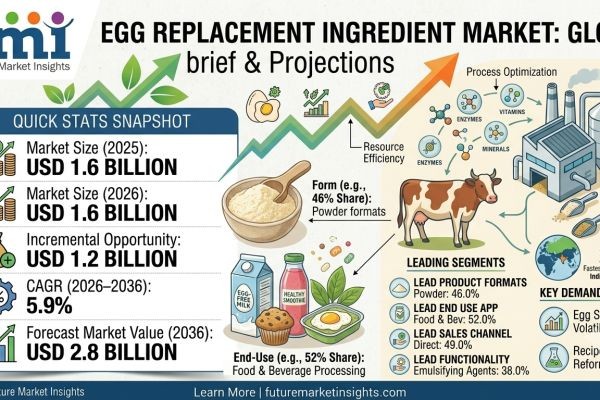
The global Egg Replacement Ingredient Market is poised for steady expansion, according to latest insights by Future Market Insights. The market was valued at USD 1.6 billion in 2025 and is estimated to remain at USD 1.6 billion in 2026. Over the forecast period from 2026 to 2036, the market is projected to expand at a CAGR of 5.9%, reaching approximately USD 2.8 billion by 2036. Growth is being fueled by increasing egg price volatility, rising demand for clean-label food products, expanding bakery and processed food production, and growing adoption of plant-based ingredient systems across food manufacturing.
Key Egg Replacement Ingredient Market Projections
- Market Size (2025): USD 1.6 Billion
• Market Size (2026): USD 1.6 Billion
• Forecast Market Value (2036): USD 2.8 Billion
• CAGR (2026-2036): 5.9%
• Incremental Opportunity: USD 1.2 Billion
• Leading Product Segment: Powder Formats (46.0% Share)
• Leading End Use Application: Food & Beverage Processing (52.0% Share)
• Leading Sales Channel: Direct Sales (49.0% Share)
• Leading Functionality Segment: Emulsifying Agents (38.0% Share)
• Fastest Growing Market: India (6.8% CAGR)
• Key Demand Driver: Egg Supply Volatility and Recipe Reformulation
Request a Sample Report: https://www.futuremarketinsights.com/reports/sample/rep-gb-908
Strategic Market Insights
The egg replacement ingredient industry is evolving from a niche vegan-focused category into a strategic formulation segment for large-scale food manufacturers. Rising fluctuations in egg prices, recurring avian influenza outbreaks, and supply chain disruptions are encouraging processors to explore alternative ingredient systems that deliver consistent performance without compromising texture, taste, or functionality.
Bakery manufacturers, sauce producers, and food service operators increasingly seek ingredient solutions that maintain product quality while reducing dependency on traditional egg inputs. Powder-based systems, starch blends, proteins, enzymes, and emulsifiers are becoming integral components of modern food formulation strategies.
As food manufacturers prioritize operational resilience, ingredient suppliers offering validated recipe systems, application support, and clean-label solutions are gaining competitive advantages across global markets.
Analyst Perspective
“Egg replacement ingredients are moving from a cost-saving tool into a recipe assurance decision. Food manufacturers want powders and liquids able to keep texture steady if egg prices shift. Suppliers with test kitchens and application data are expected to be preferred in bakery and sauce programs,” said Nandini Roy Choudhury, Principal Consultant at FMI.
Competitive Landscape and Market Share Analysis
The global egg replacement ingredient market is characterized by competition among multinational ingredient manufacturers, bakery solution providers, and specialty formulation companies. Market leadership increasingly depends on technical application expertise rather than simple ingredient availability.
Companies are investing heavily in research and development to improve emulsification, moisture retention, texture stabilization, and clean-label functionality. Suppliers that can demonstrate recipe performance under real-world manufacturing conditions continue to gain stronger customer relationships and long-term supply contracts.
Competition is also intensifying around bakery reformulation, allergen-free ingredients, sustainability claims, and plant-based protein integration.
Leading Market Participants Include
- Ingredion Incorporated
• ADM
• Cargill
• Kerry Group
• Tate & Lyle
• Puratos
• Corbion N.V.
• BENEO
• MGP Ingredients
• Fiberstar Inc.
Market competition increasingly revolves around formulation support, application testing, ingredient functionality, and the ability to deliver scalable replacement solutions across industrial food production environments.
Production vs. Consumption Economy Analysis
Demand remains strongest in developed food manufacturing economies where large-scale processors seek alternatives to volatile egg supply chains. North America and Europe continue to represent mature markets with widespread adoption of reformulation strategies.
From a consumption perspective, India, China, the United States, Germany, and the United Kingdom remain major growth centers. Expanding packaged food production, bakery manufacturing, and convenience food consumption continue driving demand for egg replacement systems.
India is expected to emerge as one of the fastest-growing opportunities globally due to rapid expansion of bakery production, food processing infrastructure, and organized food service operations.
Supply Chain and Value Chain Insights
The egg replacement ingredient value chain begins with sourcing proteins, starches, fibers, enzymes, and emulsifiers, followed by ingredient formulation, testing, blending, packaging, distribution, and integration into food manufacturing operations.
Suppliers continue strengthening relationships with bakery manufacturers, sauce producers, food service operators, and packaged food companies to improve adoption rates and support successful reformulation programs.
Application laboratories, pilot-scale testing facilities, and technical support teams play increasingly important roles in accelerating commercial deployment.
Strategic Procurement Analysis
Procurement strategies are increasingly focused on supply reliability, ingredient functionality, clean-label compliance, and cost predictability. Food manufacturers seek suppliers capable of demonstrating proven performance in commercial production environments before approving formulation changes.
Long-term sourcing agreements, technical support services, and validated application data have become critical purchasing criteria.
As food companies seek greater resilience against egg supply disruptions, procurement decisions are increasingly influenced by supplier innovation capabilities and recipe optimization expertise.
Country Opportunity Assessment
India
India is projected to be the fastest-growing market, expanding at a CAGR of 6.8% through 2036. Growth is supported by rising bakery production, increasing packaged food consumption, and growing demand for cost-effective ingredient solutions.
China
China is expected to register a CAGR of 5.7% during the forecast period. Large-scale food manufacturing operations and expanding demand for plant-based and functional food products continue supporting market growth.
Germany
Germany is forecast to expand at a CAGR of 5.6% through 2036. Strong quality standards, food industry innovation, and demand for documented formulation performance continue creating opportunities for ingredient suppliers.
United States
The United States is expected to grow at a CAGR of 4.1% through 2036. Demand remains supported by large bakery operations, processed food manufacturing, and ongoing efforts to reduce exposure to egg price fluctuations.
Technology and Innovation Outlook
Key innovations shaping the egg replacement ingredient industry include:
- Advanced starch and protein-based replacement systems
• Plant protein-powered egg reduction technologies
• Clean-label enzyme solutions
• High-performance emulsification systems
• Shelf-life optimization technologies
• Texture stabilization platforms
• Allergen-friendly ingredient formulations
• Digital formulation and recipe optimization tools
Manufacturers continue investing in ingredient functionality improvements to deliver performance parity with conventional eggs across a wide range of food applications.
Future Industry Outlook
The Egg Replacement Ingredient Market is expected to benefit from increasing food industry reformulation efforts, growing clean-label demand, and continued pressure on global egg supply chains. Food manufacturers are likely to accelerate investments in alternative ingredient systems capable of delivering consistent performance while reducing operational risks.
Although formulation complexity and ingredient approval timelines remain challenges, technological advancements and growing supplier support capabilities are expected to strengthen market growth prospects through 2036.
Companies capable of combining technical expertise, application support, ingredient innovation, and supply chain reliability will be best positioned to capitalize on emerging growth opportunities.
Exclusive Discounts on Full Report: https://www.futuremarketinsights.com/reports/egg-replacement-ingredient-market






