
Market Overview and Growth Outlook
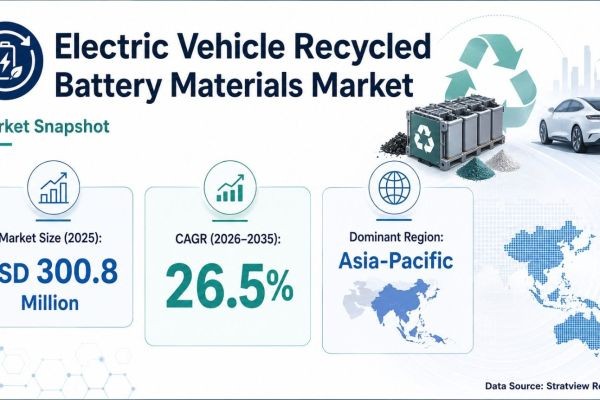
The Electric Vehicle Recycled Battery Materials Market is entering a period of substantial expansion. Market value increased from USD 250.2 million in 2024 to USD 300.8 million in 2025. It is forecast to reach USD 385.6 million in 2026 before rising to USD 3,198.0 million by 2035.
“The Electric Vehicle Recycled Battery Materials Market is expected to grow at a CAGR of 26.5% during 2026–2035.” Demand is increasing as electric vehicle adoption and lithium-ion battery production create more end-of-life batteries and manufacturing scrap containing recoverable metals and components.
Recycled battery materials support a circular manufacturing model. Lithium, nickel, cobalt, manganese, copper, aluminium, graphite, and other materials can be extracted, refined to battery-grade quality, and reused in lithium-ion battery cells, battery packs, and energy storage systems.
The Electric Vehicle Recycled Battery Materials Market outlook is increasingly defined by material security as well as recycling volume. Reusing critical minerals reduces dependence on primary mining activities and strengthens the long-term availability of materials required by the expanding electric vehicle battery manufacturing ecosystem.
Request a free sample report:
https://www.stratviewresearch.com/Request-Sample/electric-vehicle-recycled-battery-materials-market#form
Market Segmentation Analysis
By Source Type, the market is categorized as Hybrid Electric Vehicle, Plug-in Hybrid Electric Vehicle, and Battery Electric Vehicle. Battery Electric Vehicles are expected to remain the primary growth engine because they use large lithium-ion battery packs and are experiencing rapid global adoption, increasing future end-of-life battery volumes.
By Battery Type, the market is categorized as Lithium-ion Battery and Nickel Metal Hydride Battery. Lithium-ion Battery is expected to remain the most dominant and fastest-growing segment. Its widespread use and valuable metal content make it the central battery category for recovery, refining, and material reuse.
By Material Type, the market is categorized as Aluminium, Copper, Nickel, Iron, Lithium, Cobalt, and Others. These material categories represent key outputs of electric vehicle battery recycling. Their recovery provides inputs for new battery cells, battery packs, and other energy storage applications after battery-grade refining.
By Recycling Process Type, the market is categorized as Pyrometallurgy, Hydrometallurgy, and Others. These processing routes enable recyclers to recover valuable battery materials from production scrap and end-of-life batteries. Technology advancements and investment are accelerating material recovery and reuse.
By Region, the market is categorized as North America, Europe, Asia-Pacific, and Rest of the World. Asia-Pacific is expected to be the dominant and fastest-growing region because of its EV manufacturing base, battery production capacity, recycling infrastructure, supportive policies, recycling investment, and major battery manufacturers.
Regional Market Insights
Asia-Pacific is projected to remain the largest market during the forecast period. Its regional strength reflects high electric vehicle manufacturing activity, extensive battery production capacity, and expanding recycling infrastructure. China, Japan, and South Korea have prominent positions in lithium-ion battery manufacturing and electric vehicle adoption.
Government support and investment in recycling technologies are also reinforcing demand. The presence of major battery manufacturers provides a strong industrial base for recovering materials from manufacturing scrap and retired batteries and returning refined materials to the battery supply chain.
Emerging Trends Shaping the Electric Vehicle Recycled Battery Materials Market
Resource security is emerging as a major strategic theme. Recycling enables critical minerals to remain within the battery ecosystem, lowering dependence on primary mining activities and supporting the long-term material requirements of electric vehicle and energy storage production.
The growing scale of lithium-ion battery manufacturing is creating two sources of recycling feedstock: production scrap and future end-of-life batteries. This broadens the addressable recycling base and supports higher material recovery volumes over the forecast period.
Recycling technology development is strengthening the market’s processing capabilities. Pyrometallurgical processing, hydrometallurgical extraction, and emerging direct recycling methods provide pathways for extracting high-value components and returning them to battery manufacturing after refining.
Key Growth Drivers of the Market
- Need for sustainable raw-material supply: Recycling recovers critical battery materials and provides an additional supply source for lithium-ion battery manufacturing.
- Rapid adoption of Battery Electric Vehicles: Higher BEV deployment expands the number of large-capacity batteries entering service and increases future recycling volumes.
- Strong government incentives: Policies supporting EV adoption and battery recycling stimulate vehicle demand, infrastructure development, technology investment, and recycling activity.
- Growing circular battery investment: Investment in closed-loop supply chains strengthens collection, processing, recovery, refining, and material reuse across the ecosystem.
- Expansion of energy storage applications: Recovered battery-grade materials can be reused in lithium-ion battery cells, battery packs, and other energy storage systems.
Competitive Landscape
Top Companies in the Market
Accurec Recycling Gmbh
Umicore N.V.
Retriev Technologies
Battery Solutions
G & P Batteries
Conclusion and Strategic Outlook
The Electric Vehicle Recycled Battery Materials Market is forecast to increase from USD 300.8 million in 2025 to USD 3,198.0 million by 2035. Its projected CAGR of 26.5% during 2026–2035 reflects the expanding scale of electric vehicle batteries, recycling feedstock, and material recovery requirements.
The outlook is supported by larger BEV fleets, widespread lithium-ion battery use, recycling technology advancement, circular supply-chain investment, and demand for greater resource security. Asia-Pacific is expected to remain the leading regional market as its battery and EV manufacturing base supports recycling infrastructure and recovered material demand.
FAQs – Electric Vehicle Recycled Battery Materials Market
1. What is the current size and long-term forecast?
The Electric Vehicle Recycled Battery Materials Market was valued at USD 300.8 million in 2025. It is expected to reach USD 3,198.0 million by 2035.
2. What growth rate is projected?
The market is expected to grow at a CAGR of 26.5% during the 2026–2035 forecast period. This projection follows 20.2% year-over-year growth in 2025.
3. What is creating demand for recycled materials?
EV adoption, lithium-ion battery production, end-of-life batteries, manufacturing scrap, and circular supply-chain investments are increasing demand. Recycling enables valuable materials to return to battery manufacturing.
4. Where is regional demand expected to be strongest?
Asia-Pacific is expected to remain the dominant and fastest-growing market. Its position is supported by EV manufacturing, battery production, recycling infrastructure, government policies, investments, and major manufacturers.
5. What should stakeholders consider before investing?
Stakeholders should consider recycling feedstock, processing technologies, material recovery, battery-grade refining, and integration with battery manufacturers. These factors shape participation in the circular battery value chain.






