
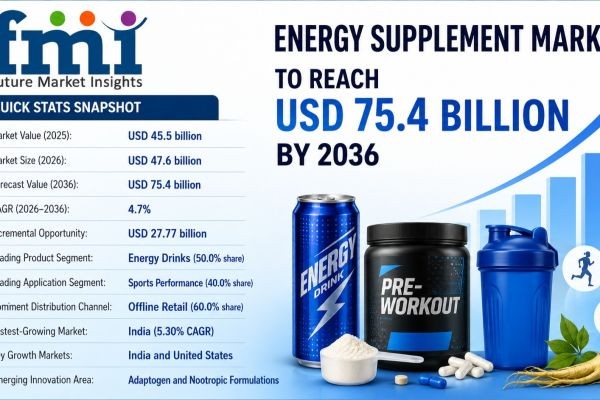
The global energy supplement market is evolving from a niche fitness and gym sub-category into a comprehensive daily wellness and performance-support framework, according to latest insights by future market insights. As consumers increasingly prioritize sustained focus, physical endurance, and clean-label alertness over high-caffeine crashes, the demand for highly targeted functional formulations has accelerated. The global industry, valued at USD 45.50 billion in 2025, is projected to reach USD 47.64 billion in 2026. Expanding at a steady Compound Annual Growth Rate (CAGR) of 4.7% over the ten-year forecast period, the market is anticipated to cross a total valuation of USD 75.41 billion by 2036, yielding a massive absolute incremental opportunity of USD 27.77 billion.
Request a Sample Report: https://www.futuremarketinsights.com/reports/sample/rep-gb-19626
Market Performance Overview (2026–2036)
To understand the core delivery formats and transactional pathways guiding this USD 27.77 billion market scale-up, a detailed segment share analysis highlights where global consumption volume is concentrated:
- Energy Drinks Product Type (50.0% share): Outpaces alternative delivery forms in 2026, anchoring category volume due to deep consumer familiarity with ready-to-drink formats and powerful distribution penetration.
- Sports Performance Application (40.0% share): Commands the application sector, driven heavily by rising gym participation, automated pre-workout programs, and multi-season endurance training protocols.
- Adults End Use Consumer Group (42.0% share): Represents the dominant volume sink, supported by working professionals and fitness enthusiasts who maintain high repeat purchase frequencies.
- Offline Retail Distribution Channel (60.0% share): Functions as the primary physical volume driver via supermarkets and convenience stores, while digital marketplaces and automated D2C subscription models grow at double-digit rates.
Technical Drivers and Sourcing Catalysts
The rapid alignment of the global energy supplement sector into mainstream lifestyle routines is propelled by distinct industrial catalysts:
Sports Nutrition Mainstreaming and Mass Retail Expansion
A primary engine of market growth is the large-scale migration of pre-workout, endurance, and recovery supplements out of specialty fitness outlets into mainstream mass retail lines. Ghost, Optimum Nutrition, and Gainful have successfully doubled their SKU footprint across big-box supermarkets, establishing a stable mass market alongside iconic energy drink leaders.
Premiumization via Caffeine-Alternative Innovations
Widespread clean-label preferences are shifting formulation strategies toward natural, stimulant-free alertness alternatives. Blending active bases with L-theanine, green tea extracts, yerba mate, and adaptogenic botanicals such as rhodiola, ashwagandha, and cordyceps helps smooth out the jittery spike-and-crash curves of standard synthetics. These advanced formulations command strong 25% to 45% pricing premiums over conventional products.
Digital-Native DTC Subscription Scaling
A central mechanism behind brand expansion is the scaling of digital-native direct-to-consumer (DTC) auto-replenishment loops. Leading providers (including AG1, Ritual, and Create) have collectively secured substantial venture capital, building massive recurring revenue bases that bypass high brick-and-mortar shelf costs and enable fast formulation iterations.
Industrial Infrastructure Challenges
Brand development teams and contract manufacturing lines face complex regulatory and sensory limitations:
- Rigid Regulatory and Age Restrictions: Evolving regional enforcement actions and state-level guidelines (such as legislative frameworks in California, New York, and Washington) are tightening young adults' access to products containing more than 100 mg of caffeine per serving, introducing immediate distribution roadblocks in convenience retail channels.
- Ingredient Cost Pass-Through Friction: Incorporating pure, standardized adaptogens and premium plant extracts significantly raises baseline manufacturing costs compared to utilizing cheap anhydrous caffeine, forcing brand managers to carefully balance ingredient premiums against mass-market accessibility.
Custom Research Available: https://www.futuremarketinsights.com/customization-available/rep-gb-19626
Regional Growth Outlook
The geographic analysis reflects monumental growth velocity across expanding Asian fitness networks alongside deeply established North American direct-to-consumer corridors:
- India (5.30% CAGR): The global growth frontrunner, propelled by rapid urbanization, an explosion in urban sports nutrition brands, and accelerating gym memberships across both tier-1 and tier-2 city corridors.
- United States (5.10% CAGR): Sourcing the highest absolute category volume globally, shaped by mature sports nutrition models, Celsius's dominant clean-label thermogenic penetration, and robust FDA DSHEA regulatory guidelines.
- Germany (4.80% CAGR): Leading Western European expansion, driven by deep drugstore private-label integrations across DM and Rossmann, alongside premium sports nutrition scaling at FoodSpring.
- China (4.50% CAGR): Expanding rapidly via fitness cultures in tier-1 hubs and dominant digital supplement commerce on Tmall and JD.com platforms, despite strict caffeine limits for teens.
- Japan (4.30% CAGR): Powered by an exceptionally dense convenience store and vending machine network, backed by long-standing consumer familiarity with functional anti-fatigue tonics under the national Food with Function Claims (FFC) registry.
Competitive Landscape
The global energy supplement landscape features a highly consolidated beverage tier balanced against an agile, highly fragmented group of clean-label capsule and powder innovators. Global volume distribution, multi-jurisdictional brand equity, and massive channel reach are led by market titans including Red Bull GmbH, Monster Beverage Corporation, PepsiCo Inc. (owning Rockstar), and CELSIUS Holdings Inc.
Specialized supplement distribution, multi-strain powder formulations, and structured MLM network management are driven by industry giants such as Amway Corporation, Herbalife Nutrition Ltd., Glanbia Nutritionals Inc., and GNC Holdings LLC. Furthermore, specialized players like Nestle S.A. (owning Vital Proteins and Garden of Life) and Herbaland Naturals Inc. are capturing high-margin cross-over niches by combining clean-label collagen matrices and portable gummy form factors to build deep trust with lifestyle consumers.
Exclusive Discounts on Full Report: https://www.futuremarketinsights.com/reports/energy-supplement-market
Frequently Asked Questions
What is the projected valuation of the global market by 2036?
The global energy supplement market is projected to reach USD 75.41 billion by 2036, expanding upward from an estimated baseline valuation of USD 47.64 billion in 2026 at a CAGR of 4.7%.
Why do ready-to-drink energy drinks command a 50.0% share?
Energy drinks function as the industry standard because their ready-to-drink portability satisfies immediate, on-the-go convenience needs across working professional and athlete demographics.
What exclusions govern the boundaries of this market report?
The commercial scope strictly limits its focus to specialized energy supplement formats, explicitly excluding conventional coffee, tea, or cocoa drinks lacking supplemental energy claims, weight loss lines devoid of primary energy positioning, and prescription alertness stimulants.
FMI Custom Research: Strategic Intelligence for Confident Decision-Making
In today's rapidly evolving business environment, leadership teams need more than market data they need clear, actionable intelligence tailored to their strategic objectives. FMI's Custom Research solutions are designed around the specific business questions organizations need answered, enabling executives to evaluate growth opportunities, validate investments, assess competitive dynamics, and reduce uncertainty before making critical decisions.
Key Executive Benefits
- Decision-Ready Insights tailored to business priorities
• Reduced Strategic Risk through validated market intelligence
• Market Entry Confidence with detailed competitive analysis
• Competitive Advantage supported by proprietary research
• Faster Growth Decisions through customized strategic insights
• Primary Market Validation from industry stakeholders
• Global Industry Expertise across diverse sectors
• Proven Track Record with thousands of consulting engagements
Business Impact
FMI helps organizations transform market complexity into strategic clarity, enabling leadership teams to identify growth opportunities faster, optimize resource allocation, strengthen competitive positioning, and make high-stakes business decisions with confidence.
To explore how FMI Custom Research can support your strategic priorities, please connect with our team at - sales@futuremarketinsights.com






