
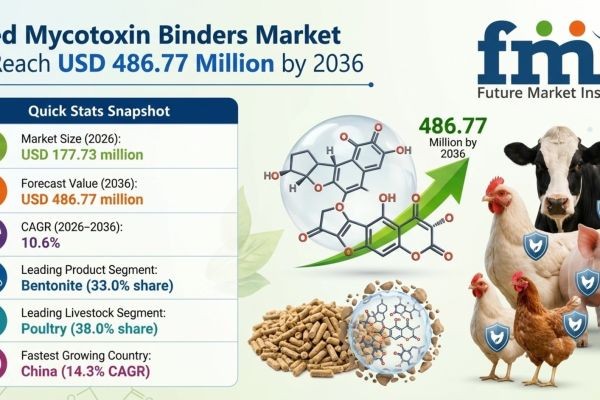
The global feed mycotoxin binders market is experiencing high-velocity expansion as climate variability increases fungal contamination rates in feed grains and regulatory bodies tighten maximum residue limits for aflatoxins, deoxynivalenol (DON), and zearalenone, according to latest insights by Future Market Insights. Formulating animal diets with mineral and organic adsorbent compounds prevents systemic mycotoxin absorption, protecting livestock from immunosuppression, poor feed conversion, and sudden drops in egg or meat production.
The global market, valued at USD 160.70 million in 2025, is projected to reach USD 177.73 million in 2026. Advancing at a double-digit Compound Annual Growth Rate (CAGR) of 10.6% over the ten-year forecast period, total market valuation is anticipated to achieve USD 486.77 million by 2036, delivering an absolute incremental opportunity of USD 309.04 million.
Get detailed market forecasts, competitive benchmarking, and pricing trends:
https://www.futuremarketinsights.com/reports/sample/rep-gb-23320
Market Performance Overview (2026–2036)
To map out the key adsorbent product classes, targeted livestock species, and geographical growth vectors guiding this USD 309.04 million market scale-up, an analysis of leading segment allocations highlights where global commercial demand is concentrated:
- Bentonite Product Segment (33.0% share): Commands the primary product category in 2026, serving as the cost-effective first-line adsorbent for aflatoxin control in large-scale commercial feed mills.
- Poultry Livestock Segment (38.0% share): Represents the largest livestock application, driven by poultry's extreme biological sensitivity to subclinical mycotoxin exposure and high stocking density economics.
- LSCAS & Polysaccharide Binders: Gaining rapid market share due to their ability to bind multiple toxin classes simultaneously during complex grain co-contamination events (e.g., aflatoxin + DON + zearalenone).
Technical Drivers and Feed Safety Dynamics
The integration of mycotoxin binders across commercial feed milling operations is propelled by three primary industry catalysts:
Climate-Driven Grain Contamination Events
Rising temperatures and erratic precipitation patterns during grain flowering and harvest expand fungal infection ranges (Aspergillus, Fusarium). Drought stress followed by humid storage condition creates peak contamination spikes, making binder inclusion a non-discretionary risk management input for feed formulators.
Enforcement of Maximum Residue Limits (MRLs)
Regulatory bodies across the European Union, China, Brazil, and the US FDA enforce strict advisory limits and legal MRLs for mycotoxins in commercial feed. Exceeding these limits triggers costly product recalls and export bans, turning mycotoxin binder procurement into a mandatory compliance protocol.
High-Density Livestock Sensitivity & Economic Impact
In commercial poultry houses holding 20,000+ birds, even minor subclinical toxicosis causes measurable drops in feed conversion efficiency (FCR), flock uniformity, and egg shell quality. Because binder inclusion costs a fraction of potential livestock losses, producers treat binders as indispensable feed safety insurance.
Supply Chain & Formulation Challenges
Feed additive manufacturers and livestock integrators face specific operational constraints:
- Co-Contamination Complexity: Single-ingredient clays often fail to adsorb non-polar mycotoxins like DON or zearalenone, forcing formulators to develop complex multi-component blends (combining clays, yeast cell wall glucomannans, and enzymatic detoxifiers).
- Nutrient Sequestration Risks: Lower-grade mineral binders can non-selectively bind essential vitamins, minerals, or amino acids in the feed matrix, requiring careful GC-MS and in vivo validation to verify binder selectivity.
Regional Growth Outlook
The geographic analysis reflects rapid, climate-and-volume-driven growth in Asian and South American agricultural corridors alongside regulatory-mandated adoption in Western markets:
- China (14.3% CAGR): The global growth frontrunner, driven by massive swine and poultry herd consolidation, high climate risk in corn belts, and strict Ministry of Agriculture feed safety enforcement.
- India (13.3% CAGR): Spurring rapid volume expansion as commercial poultry and dairy sectors scale up in humid tropical climates prone to heavy aflatoxin contamination.
- Germany (12.2% CAGR) & France (11.1% CAGR): Leading European market demand under strict EU feed safety compliance, where multi-functional and eco-compliant binders are standard in compound feeds.
- United Kingdom (10.1% CAGR): Driven by post-Brexit feed quality standards and digital tracking in compound feed mills.
- United States (9.0% CAGR): Anchored by corn-belt aflatoxin management, FDA compliance, and precision livestock farming integrations.
- Brazil (8.0% CAGR): Supported by large-scale export-oriented poultry and swine operations (e.g., JBS, Seara) requiring certified low-residue feeds.
Competitive Landscape
The global feed mycotoxin binders landscape features a combination of multinational chemical corporations, specialized animal health houses, and biosecurity providers. Companies compete on broad-spectrum adsorption efficacy, in vivo trial documentation, and integrated feed testing services.
Key market participants profiled in the report include BASF SE, BIOMIN Holding GmbH (dsm-firmenich), Alltech Inc., Kemin Industries Inc., Adisseo, Selko B.V., Vetline, Novus International Inc., Chr. Hansen, Vibrac, Huvepharma, Perstorp, and Trouw Nutrition. Major players are actively introducing digital contamination mapping tools alongside multi-component yeast-clay-enzyme formulations.
Full Report for Detailed Insights: https://www.futuremarketinsights.com/reports/feed-mycotoxin-binders-market
Frequently Asked Questions
What is the projected valuation of the global market by 2036?
The global feed mycotoxin binders market is projected to reach USD 486.77 million by 2036, expanding from an estimated baseline valuation of USD 177.73 million in 2026 at a CAGR of 10.6%.
Why does Bentonite lead the Product segment?
Bentonite holds a 33.0% share in 2026 because it is a cost-effective, naturally occurring clay that offers exceptional surface area for binding aflatoxins, making it the default first-line option for cost-conscious feed mills.
What exclusions govern the physical boundaries of this market report?
The scope strictly covers active mycotoxin binder products (clays, LSCAS, polysaccharides, blends). It explicitly excludes standalone analytical laboratory testing services, pre-harvest crop fungicides/fumigants, and general feed enzymes lacking specific mycotoxin deactivation claims.
Explore More Related Studies Published by FMI Research:
ASEAN Yeast Extract Market : https://www.futuremarketinsights.com/reports/asean-yeast-extract-market
Europe Canned Tuna Market : https://www.futuremarketinsights.com/reports/europe-canned-tuna-market
Latin America Food Testing Services Market : https://www.futuremarketinsights.com/reports/latin-america-food-testing-services-market
About Future Market Insights (FMI)
Future Market Insights, Inc. is an ESOMAR-certified, ISO 9001:2015 market research and consulting organization trusted by Fortune 500 companies. With a global presence across the U.S., UK, India, and Dubai, FMI delivers data-driven insights across 30+ industries and 1200 markets worldwide.
Contact Us
Future Market Insights Inc.
Christiana Corporate, 200 Continental Drive,
Suite 401, Newark, Delaware – 19713, USA
T: +1-347-918-3531
For Sales Enquiries: sales@futuremarketinsights.com
Website: https://www.futuremarketinsights.com






