
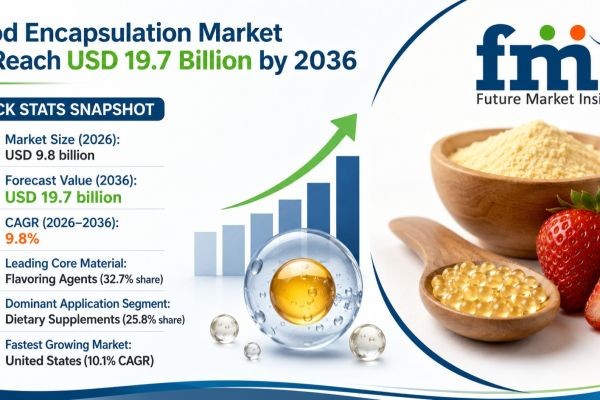
The global food encapsulation market is experiencing a major technological transition, according to latest insights by future market insights. As functional food formulators and supplement manufacturers move away from free-form active ingredients, the demand for microscopic protective delivery systems is accelerating rapidly. The global industry, which was valued at USD 8.9 billion in 2025, is projected to reach USD 9.8 billion in 2026. Advancing at a fast Compound Annual Growth Rate (CAGR) of 9.8% over the ten-year forecast period, total market valuation is anticipated to hit USD 19.7 billion by 2036, creating an absolute incremental opportunity of USD 9.9 billion.
Request a Sample Report: https://www.futuremarketinsights.com/reports/sample/rep-gb-380
Market Performance Overview (2026–2036)
To understand the core matrix materials and primary end-use sectors driving this USD 9.9 billion market expansion, an analysis of leading segment allocations highlights where commercial demand is concentrated:
- Flavoring Agents Core Material (32.7% share): Commands the core material category in 2026, driven by the absolute physical necessity to entrap volatile aromatic compounds and prevent flash-off during high-heat commercial baking cycles (up to 180°C).
- Dietary Supplements Application (25.8% share): Represents the top-performing application segment, forced by the requirement to physically mask intense bitterness and sensory off-notes from concentrated botanical extracts and bioactive ingredients.
- Fluid-Bed and Coacervation Technologies: Represent key operational drivers enabling high-throughput continuous particle coating without fracturing fragile microscopic shells.
Technical Drivers and Matrix Innovation
The continuous adoption of microencapsulation and targeted delivery systems across complex food formulations is propelled by three primary industry catalysts:
Clean-Label Transition and Natural Ingredient Entrapment
Escalating commercial pressure to achieve clean-label certifications is pushing R&D directors to replace easily stabilized synthetic additives with volatile plant-derived extracts. Because natural antioxidants and botanical oils degrade quickly when exposed to light, oxygen, and moisture, physical entrapment via carbohydrate, lipid, or protein-based matrices has become mandatory to ensure acceptable product shelf life.
Prevention of Thermal Flash-Off and Flavor Retention
Commercial food processing especially high-heat baking and extrusion causes massive evaporation of un-encapsulated flavor oils. Utilizing cross-linked polymer shells physically locks in aromatic payloads until moisture or mechanical triggers occur during consumption, eliminating the need for expensive flavor overages to compensate for thermal loss.
Targeted Bioavailability and Bitterness Masking
Concentrated botanical extracts and reactive minerals (such as iron and vitamin C) present severe formulation challenges, including bitter taste profiles and internal oxidation. Multi-layered lipid coatings and enteric shells bypass palate taste receptors and gastric acid, releasing active nutrients directly within the intestinal tract to optimize metabolic absorption.
Industrial Infrastructure Challenges
Manufacturing heads and contract processing operations must carefully navigate significant technical and financial constraints:
- High-Shear Mechanical Fracturing: Legacy food processing facilities rely heavily on high-shear mixing and pumping loops. Advanced coacervate shells can easily shatter under these mechanical stresses, releasing bitter active payloads prematurely and ruining entire production batches.
- Capital Expenditure for Retrofits: Upgrading established manufacturing lines to low-shear environments or installing specialized fluid-bed coating towers requires heavy upfront capital, constraining immediate adoption among mid-tier food processors.
Regional Growth Outlook
The geographic analysis highlights rapid expansion across high-density sports nutrition corridors in the West alongside state-mandated fortification programs in emerging Asian markets:
- United States (10.1% CAGR): The global growth frontrunner, driven by a dense concentration of premium sports nutrition brands demanding patented, delayed-release ingredient profiles and precision fluid-bed coating capabilities.
- United Kingdom (10.0% CAGR): Experiencing rapid acceleration spurred by a surging vegan functional food market, where advanced flavor entrapment is required to mask the earthy off-notes of pea and soy proteins.
- Germany (9.8% CAGR): Underpinned by strict European Food Safety Authority (EFSA) regulations regarding clean labels and rigorous supply chain validation protocols requiring documented post-processing payload survival.
- India (9.6% CAGR): Driven by government-backed population fortification mandates that obligate flour and dairy processors to incorporate stable, tasteless micronutrient matrices at scale.
- Brazil (9.2% CAGR): Propelled by the need to extend the ambient shelf life of fortified baked goods across vast distribution networks with un-refrigerated supply chains.
- Japan (5.9% CAGR): A highly specialized market focused on geriatric clinical nutrition under the FOSHU (Foods for Specified Health Uses) framework, prioritizing nano-scale, texture-neutral delivery matrices.
Competitive Landscape
The global food encapsulation landscape is defined by a mix of specialized microencapsulation technology providers and multi-national flavor and ingredient leaders. Direct release-system innovation, controlled-release technology portfolios, and custom matrix engineering are led by key industry participants including TasteTech Ltd., Balchem Corporation, International Flavors & Fragrances Inc. (IFF), Sensient Technologies Corporation, and Givaudan SA.
To capture high-margin toll-manufacturing contracts, market leaders are actively prioritizing investments in continuous fluid-bed coating systems, bio-polymer wall material development, and plant-based lipid matrices tailored for precision fermentation and alternative protein applications.
Exclusive Discounts on Full Report: https://www.futuremarketinsights.com/reports/food-encapsulation-market
Frequently Asked Questions
What is the projected valuation of the global market by 2036?
The global food encapsulation market is projected to reach USD 19.9 billion by 2036, expanding from an estimated baseline valuation of USD 9.8 billion in 2026 at a CAGR of 9.8%.
Why do Flavoring Agents lead the Core Material segment?
Flavoring agents command a 32.7% share because un-encapsulated aromatic oils evaporate rapidly during high-temperature baking and extrusion, making physical matrix protection essential for sensory consistency.
What exclusions govern the physical boundaries of this report?
The scope strictly excludes active food ingredients sold in their unprotected free-flowing state, consumer-facing secondary packaging (such as bottles or blister packs), and pharmaceutical-grade drug delivery systems.
FMI Custom Research: Strategic Intelligence for Confident Decision-Making
In today's rapidly evolving business environment, leadership teams need more than market data they need clear, actionable intelligence tailored to their strategic objectives. FMI's Custom Research solutions are designed around the specific business questions organizations need answered, enabling executives to evaluate growth opportunities, validate investments, assess competitive dynamics.
Key Executive Benefits
- Decision-Ready Insights tailored to business priorities
- Reduced Strategic Risk through validated market intelligence
- Market Entry Confidence with detailed competitive analysis
- Competitive Advantage supported by proprietary research
- Faster Growth Decisions through customized strategic insights
- Primary Market Validation from industry stakeholders
- Global Industry Expertise across diverse sectors
- Proven Track Record with thousands of consulting engagements
Business Impact
FMI helps organizations transform market complexity into strategic clarity, enabling leadership teams to identify growth opportunities faster, optimize resource allocation, strengthen competitive positioning, and make high-stakes business decisions with confidence.
To explore how FMI Custom Research can support your strategic priorities, please connect with our team at - sales@futuremarketinsights.com






