
The global fractionated lecithin market is undergoing sustained multi-sector expansion, according to comprehensive market analysis by Future Market Insights. Driven by clean-label food reformulations replacing synthetic emulsifiers (such as DATEM, mono- and diglycerides, and sorbitan monostearate) in commercial bakery and confectionery, alongside escalating pharmaceutical demand for high-purity phosphatidylcholine (PC) in liposomal drug delivery systems and cognitive health nutraceuticals, fractionated lecithin is cementing its position as an essential precision phospholipid category globally.
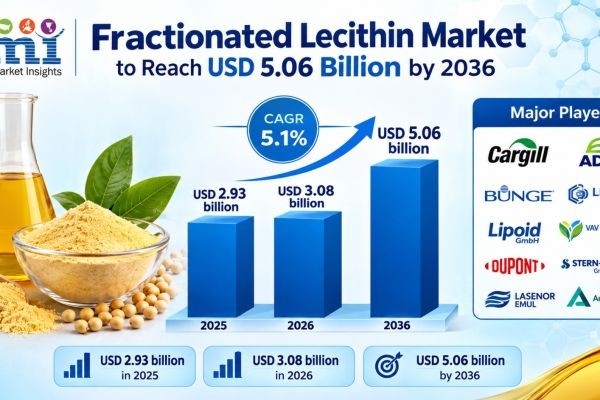
The global market, valued at USD 2.93 billion in 2025, is estimated to reach USD 3.08 billion in 2026. Advancing at a Compound Annual Growth Rate (CAGR) of 5.1% over the ten-year forecast period, total market valuation is projected to achieve USD 5.06 billion by 2036, delivering an absolute dollar expansion of USD 1.98 billion.
Request a Sample Report: https://www.futuremarketinsights.com/reports/sample/rep-gb-9342
Market Performance Overview (2026–2036)
To map out key phospholipid product types, raw material sources, physical delivery formats, and regional growth vectors guiding this USD 1.98 billion market scale-up, key segment allocations highlight where commercial volume and revenue are concentrated:
- Phosphatidylcholine (PC) Enriched Product Type (58.4% share): Commands the leading product category in 2026, driven by high-value procurement for pharmaceutical liposomal encapsulation, brain and liver health nutraceutical supplements, and high-performance food emulsification.
- Soy Raw Material Source Segment (64.7% share): Dominates raw material inputs, supported by established global crushing infrastructure, extensive availability, and cost-efficiency relative to alternative oilseeds.
- Sunflower-Derived Source Segment (Fastest-Growing Raw Material): Experiencing the fastest growth trajectory as food and nutraceutical brand owners seek Non-GMO Project Verified, allergen-free alternatives to bypass soy allergen labeling mandates in North America and the EU.
- Liquid Form Segment (55.9% share): Leads format preference over powders, favored for ease of handling, continuous-line pumpability, and seamless integration into bakery doughs, chocolate confections, and cosmetic emulsions.
- Food Processing End-Use Industry (41.3% share): Represents the dominant application channel, driven by bakery, confectionery, dairy, and beverage formulators utilizing precision phospholipid ratios to improve crumb texture, viscosity, and shelf stability.
- China & Japan Regional Growth Leadership: China leads national expansion at 3% CAGR, followed by Japan at 5.9% CAGR, driven by pharmaceutical manufacturing, cosmetic active ingredient procurement, and expanding functional food processing.
Technical Drivers and Formulation Shifts
The commercial scaling of fractionated lecithin across food processing, pharmaceutical, and nutraceutical supply chains is propelled by three primary industry catalysts:
Clean-Label Substitution of Synthetic Emulsifiers
Food manufacturers across Europe and North America are actively reformulating processed foods to remove synthetic emulsifiers and chemical E-numbers. Fractionated lecithin provides specific ratios of phosphatidylcholine (PC), phosphatidylethanolamine (PE), and phosphatidylinositol (PI), delivering targeted emulsifying power, dough conditioning, and chocolate viscosity reduction under natural lecithin label declarations (Regulation EC No 1333/2008 and US FDA GRAS).
Pharmaceutical Liposomal Drug Delivery and Nutraceutical PC Demand
High-purity PC-enriched fractions serve as essential lipid excipients for constructing biocompatible liposomes and nanoparticles in oral and injectable drug delivery systems. Simultaneously, dietary supplement manufacturers procure PC concentrates for cognitive wellness, memory enhancement, and liver health formulations, requiring strict heavy-metal and solvent-residue documentation.
Green Supercritical and Solvent-Free Extraction
Innovations in downstream processing such as supercritical carbon dioxide fractionation and enzymatic modification eliminate toxic organic solvent residues (like hexane or acetone). These sustainable processing pathways enable ingredient refiners to produce ultra-pure, organic-compliant phospholipid fractions that meet stringent pharmacopoeial monographs and clean-label standards.
Industrial Constraints & Sourcing Risks
Lecithin refiners and industrial procurement managers navigate specific operational hurdles:
- Phospholipid Fractionation Capex and Technical Complexity: Separating individual phospholipids from crude lecithin requires high-capital chromatographic, solvent, or supercritical extraction infrastructure, concentrating high-purity supply among a few Tier-1 processors.
- Non-GMO and Soy Allergen Labeling Exposure: Mandatory allergen disclosures for soy-derived ingredients push premium natural food brands toward sunflower-derived fractionated lecithin, which carries a cost premium and relies on more fragmented sunflower seed supply chains.
Regional Growth Profile
Regional demand reflects intensive food processing and pharmaceutical excipient manufacturing across leading global economies:
- China (6.3% CAGR): The fastest-growing global market, supported by domestic food processing capacity expansion, rising API manufacturing, and large-scale procurement of functional lipids.
- Japan (5.9% CAGR): Driven by mature pharmaceutical regulations (PMDA), high-end functional foods for cognitive aging, and cosmetics active ingredient integration (Lipoid GmbH, DuPont).
- France (5.4% CAGR) & Germany (4.8% CAGR): Lead European demand, anchored by non-GMO bakery/confectionery reformulations, EFSA compliance, and organic-certified sunflower phospholipid lines (Lecico GmbH, Stern-Wywiol Gruppe / Berg + Schmidt, Lasenor Emul).
- United States (4.2% CAGR): Anchored by massive food processing infrastructure, Non-GMO Project Verified retail brand shifts, and active nutraceutical supplement manufacturing (Cargill, ADM, Bunge Limited).
Competitive Landscape
The global fractionated lecithin landscape features a combination of vertically integrated multinational agribusiness giants and specialized pharmaceutical-grade phospholipid refiners.
Key market participants profiled in the report include Cargill, Incorporated, Archer Daniels Midland Company (ADM), Bunge Limited, Lecico GmbH, Lipoid GmbH, VAV Life Sciences Pvt. Ltd., DuPont de Nemours Inc., Stern-Wywiol Gruppe (Berg + Schmidt), Lasenor Emul, and Austrade Inc.. Tier-1 agribusinesses maintain cost dominance through integrated oilseed crushing operations, while specialty players compete on ultra-high-purity PC fractions, European Organic certifications (Regulation EU 2018/848), and dedicated technical formulation support.
Exclusive Discounts on Full Report: https://www.futuremarketinsights.com/reports/fractionated-lecithin-market
Frequently Asked Questions
What is the projected valuation of the global fractionated lecithin market by 2036?
The global fractionated lecithin market is projected to reach USD 5.06 billion by 2036, expanding from an estimated baseline valuation of USD 3.08 billion in 2026 at a CAGR of 5.1%.
Why does Phosphatidylcholine (PC) Enriched hold a 58.4% market share?
PC-enriched fractionated lecithin leads product types in 2026 due to extensive procurement for pharmaceutical liposomal drug delivery systems, brain and liver health nutraceutical supplements, and high-performance food emulsification where specific PC content is required.
What is driving the shift toward sunflower-derived fractionated lecithin?
Sunflower-derived fractionated lecithin is growing rapidly because it is naturally non-GMO and free from major food allergens, allowing food and supplement brand owners to bypass soy allergen labeling requirements and achieve Non-GMO Project Verified claims.
FMI Custom Research: Strategic Intelligence for Confident Decision-Making
In today's rapidly evolving business environment, leadership teams need clear, actionable intelligence tailored to their strategic objectives. FMI's Custom Research solutions are designed around specific business questions, enabling executives to evaluate growth opportunities, validate investments, assess competitive dynamics, and reduce uncertainty before making critical decisions.
Key Executive Benefits
- Decision-Ready Insights: Research tailored to your specific business challenges, growth plans, and investment priorities.
- Reduced Strategic Risk: Validate market opportunities, customer demand, and competitive positioning before committing resources.
- Market Entry Confidence: Assess opportunity size, regulatory barriers, channel dynamics, and competitive landscapes with precision.
- Competitive Advantage: Gain proprietary intelligence unavailable through syndicated reports or internal datasets.
- Faster Growth Decisions: Accelerate expansion, product development, portfolio optimization, and investment planning.
- Primary Market Validation: Access real-world customer, buyer, and stakeholder insights that support high-confidence decision-making.
Business Impact
FMI helps organizations transform market complexity into strategic clarity, enabling leadership teams to identify growth opportunities faster, optimize resource allocation, strengthen competitive positioning, and make high-stakes business decisions with confidence.
To explore how FMI Custom Research can support your strategic priorities, connect with our team at - sales@futuremarketinsights.com
About Future Market Insights (FMI)
Future Market Insights (FMI) delivers actionable, decision-focused market intelligence that goes beyond traditional research reports. The company provides:
- In-depth pricing and cost benchmarking analysis
- Demand forecasting based on real industry inputs
- Procurement and buyer behavior insights
- Supply chain and trade flow intelligence
- Technology and application trend analysis across industries
FMI follows a robust bottom-up research methodology, combining insights from industry experts, procurement leaders, manufacturers, and technical professionals to ensure accurate and practical market intelligence.






