
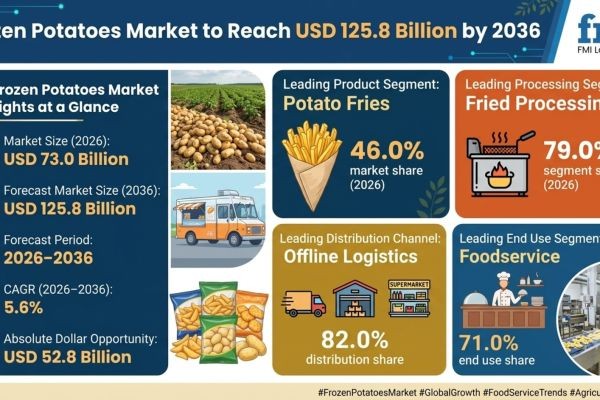
The global frozen potato market is entering a new phase of major expansion as fast-food infrastructure broadens and retail demand for convenient home meal options scales. According to latest insights by future market insights, the market is projected to grow from USD 73.0 billion in 2026 to USD 125.8 billion by 2036, registering a robust 5.6% CAGR during the forecast period. The category is rapidly evolving from a traditional commodity supply model into a highly specialized, specification-driven segment driven by rapid urbanization, evolving dietary profiles, and advanced cold-chain technology.
The market is expected to create an absolute dollar opportunity of USD 52.8 billion between 2026 and 2036. Growth is being fueled by an unprecedented wave of quick-service restaurant (QSR) network expansion across emerging economies, alongside a strong surge in retail channel sales backed by the massive consumer adoption of home air-fryers.
Request a Sample Report: https://www.futuremarketinsights.com/reports/sample/rep-gb-24636
Key Frozen Potatoes Market Highlights at a Glance
- Market Size (2026): USD 73.0 Billion
- Forecast Market Size (2036): USD 125.8 Billion
- Forecast Period: 2026–2036
- CAGR (2026–2036):6%
- Absolute Dollar Opportunity: USD 52.8 Billion
- Leading Product Segment: Potato Fries
- Potato Fries Market Share (2026):0%
- Leading Processing Segment: Fried Processing
- Fried Processing Segment Share (2026):0%
- Leading Distribution Channel: Offline Logistics
- Offline Distribution Share:0%
- Leading End Use Segment: Foodservice
- Foodservice End Use Share:0%
- Fastest-Growing Country: China
- China CAGR:6%
- Report Pages: 342
Why Is the Frozen Potatoes Market Growing?
Several structural shifts in the global food processing and retail landscapes are driving sustained demand for frozen potato selections.
Key Growth Drivers
- Rapid, high-volume expansion of international and domestic quick-service restaurant networks across developing markets, generating immediate, recurring supply pipelines.
- The absolute standardization of side-dish menus globally, anchoring the french fry as the single most consumed accompaniment in the hospitality sector.
- Expanding consumer preference for hyper-convenient retail meal products requiring minimal preparation times at home.
- Widespread consumer acquisition of household air-fryers, stimulating consistent retail purchase velocities for specialty frozen products.
- Technological breakthroughs in battering and coating systems that successfully prolong the crispness and structural integrity of cooked items.
- Massive capital allocations into commercial cold-chain infrastructure, opening up previously inaccessible tier-2 and tier-3 metropolitan areas.
As deep processing infrastructure aligns with modern distribution channels, the structural necessity of frozen potato varieties within commercial kitchens continues to solidify.
"Producers that combine potato sourcing reliability with processing scale and deep QSR chain relationships are positioned to capture incremental volume as foodservice expansion in Asia and the Middle East accelerates frozen potato consumption growth."
Which Product Segment Leads the Frozen Potatoes Market?
Potato Fries continue to assert clear dominance over the product landscape, serving as a core foundation for both industrial commercial foodservice menus and household convenience shelves.
To fulfill highly precise procurement criteria across competing QSR networks, manufacturers continuously engineer distinct cut formats, spanning straight-cut, shoestring, crinkle-cut, and thick steak profiles. Par-fried manufacturing workflows where raw potatoes are systematically blanched, partially dried, and flashed in oil prior to blast freezing guarantee absolute quality standardization and rapid preparation times during high-velocity restaurant shift hours.
Product Segment Highlights
- Potato Fries dictate the industry layout with a commanding 46.0% market share in 2026.
- Core structural placement as the ultimate high-volume margin generator across global fast-food brands.
- Ongoing processing specialization focuses heavily on specialty starch coatings to maximize product hold-time performance.
- High adaptability across home preparation appliances, including conventional ovens and air-fryers.
Why Does Foodservice Control the Bulk of Industry Demand?
The commercial foodservice sector operates as the primary engine for industry volume, absorbing the overwhelming majority of global processing outputs.
Long-term corporate supply agreements executed between multi-national restaurant conglomerates and large-scale agricultural processors provide deep market predictability. While individual household retail purchasing continues to capture vital secondary value, the immense frequency and scale of institutional kitchens, transit catering, and casual dining chains ensure that commercial back-of-house procurement anchors baseline operations.
End Use Segment Highlights
- Foodservice operations capture a massive 71.0% share of total industry demand.
- Scaled procurement is fundamentally tied to international fast-food expansion strategies across developing territories.
- High reliance on fully standardized supply specifications to maintain identical global consumer experiences.
- Highly sensitive to efficient cold-chain transportation links directly connecting regional processing hubs to major urban storage nodes.
Why Does Fried Processing Remain the Global Benchmark?
Par-fried production designs remain heavily entrenched as the global processing standard due to their operational efficiency and unrivaled texture delivery.
Fulfilling strict high-volume food preparation workflows requires products that require minimal terminal kitchen preparation. By handling the complex labor of uniform slicing, enzymatic blanching, and initial par-frying within automated multi-ton facilities, processors remove operational friction from commercial kitchens, allowing end-users to deliver crispy results within minutes.
Processing Segment Highlights
- Fried processing configurations command 79.0% of the industry framework.
- Removes significant back-of-house operational complexities for global restaurant operators.
- Evolving sector investments target next-generation oils to lower absolute fat absorption ratios.
- Baked and alternative processing lines are expanding rapidly within retail segments, growing at premium price points.
How Offline Distribution Networks Secure Supply Chains?
Deeply integrated physical distribution frameworks remain indispensable for managing the complex sub-zero shipping criteria dictated by mass industrial potato logistics.
Specialized foodservice distributors, regional wholesale hubs, and premium cold-storage centers work in unison to move multi-ton agricultural outputs from processing lines to urban retail displays. While online retail channels and quick-commerce home deliveries are expanding fast, they still rely fundamentally on a core physical logistics infrastructure.
Custom Research Available: https://www.futuremarketinsights.com/customization-available/rep-gb-24636
Distribution Channel Highlights
- Offline logistics networks direct 82.0% of all commercial market volumes.
- Vital for managing complex industrial supply chains without triggering critical cold-chain temperature deviations.
- Structured wholesale distribution networks guarantee constant raw material flow to high-frequency restaurant units.
- Hypermarket and supermarket allocations maximize visual retail access for emerging premium home-pack lines.
Market Dynamics
Market Drivers
The continuous worldwide expansion of American and regional quick-service food chains provides an automatic, multiplying foundation for frozen potato demand. Each newly completed restaurant site establishes an immediate, locked-in procurement pipeline requiring standardized, volume-managed frozen deliveries.
Market Restraints
Agricultural supply shocks and absolute production cost volatility present constant operational difficulties for manufacturing plants. Because frozen processing relies entirely on high-volume contracted farming, regional climate disruptions, water scarcity mandates, and varying agricultural crop yields can instantly squeeze processing margins.
Market Trends
Processing and structural alignments continue to evolve.
Major trends include:
- Introduction of specialized, extra-crispy coatings optimized for third-party food delivery apps.
- Growth of retail-facing baked and air-fryer specific product formulations.
- Transitioning packaging specifications toward fully recyclable materials to meet strict regional plastic taxes.
- Integration of direct-to-farm regenerative agriculture frameworks to shield long-term potato crops.
- Geographic expansion of production networks into regional consumer markets to cut down logistics costs.
Regional and Country Outlook
Country Growth Rates
- China — 7.6% CAGR
- India — 7.0% CAGR
- Germany — 6.4% CAGR
- France — 5.9% CAGR
- United Kingdom — 5.3% CAGR
- United States — 4.8% CAGR
- Brazil — 4.2% CAGR
China operates as the primary global growth accelerator through 2036, advancing at a 7.6% CAGR. Massive network expansions by major fast-food brands, combined with a rising affinity for Western-style food formats among urban consumer bases, are driving high-volume institutional orders, while e-commerce cold-chain networks are opening up retail sales in tier-2 cities.
India follows closely with a 7.0% CAGR, supported by extensive food-processing infrastructure investments via federal PLI schemes that are rapidly boosting domestic manufacturing capacity.
Across the European Union, Germany leads at a 6.4% CAGR and France at 5.9%, sustained by deeply institutionalized household frozen food consumption habits and strong local processing hubs like Aviko.
The United Kingdom expands steadily at a 5.3% CAGR, where an established fish-and-chip culture ensures high baseline per-capita fry consumption, while local players modify packaging structures to navigate the UK Plastics Tax.
The United States represents the largest absolute market volume globally, growing at a 4.8% CAGR; mature QSR saturated infrastructure is complemented by an incredibly high rate of home air-fryer ownership, keeping premium oven-ready retail lines in high demand.
Competitive Landscape
The global competitive space features high corporate consolidation among a select group of multi-national processing giants, balanced by regional specialists who leverage proximity logistics to capture localized institutional accounts.
Key Companies
- McCain Foods: The world's largest frozen potato processor, maintaining a vast global processing footprint supported by deep agricultural supply chains.
- Lamb Weston: A leading innovator in specialized fry technologies, utilizing advanced starch coating solutions to capture dominant shares across premier fast-food chains.
- R. Simplot Company: A historical pioneer in large-scale foodservice supply lines, maintaining massive institutional food networks across the Americas and Asia.
- Aviko: Commands a premier presence across European retail and hospitality sectors, utilizing a deep Dutch potato processing heritage.
- Farm Frites: Focuses heavily on serving European and MEA commercial distribution channels through agile, middle-tier processing networks.
Competitive Benchmarking: Global Frozen Potatoes Market
Corporate strategies moving forward are increasingly focused on rolling out strict regenerative farming supply agreements, entering long-term logistics partnerships in developing Asian regions, and scaling processing capacities for healthier baked and air-fryer retail options.
Exclusive Discounts on Full Report: https://www.futuremarketinsights.com/reports/frozen-potatoes-market
Frequently Asked Questions
How big is the frozen potato market in 2026?
The global frozen potato market is estimated to be valued at USD 73.0 billion in 2026.
What will be the size of the frozen potato market in 2036?
The market size for the frozen potato market is projected to reach USD 125.8 billion by 2036.
How much will the frozen potato market grow between 2026 and 2036?
The frozen potato market is expected to grow at a 5.6% CAGR between 2026 and 2036.
What are the key products in the frozen potato market?
The key products in the frozen potato market are Potato Fries, Potato Wedges, Stuffed Potatoes, Potato Slices, Potato Chunks, Potato Dices, Baked Potatoes and Other Products.
Which end use segment is expected to contribute a significant share in the frozen potato market in 2026?
In terms of end use, the foodservice segment is expected to command 71.0% share in the frozen potato market in 2026.
Why Choose FMI: https://www.futuremarketinsights.com/why-fmi
Explore More Related Studies Published by FMI Research
Demand for Caramel Malt in USA : https://www.futuremarketinsights.com/reports/united-states-caramel-malt-market
Demand for Massoia Bark Essential Oil in USA : https://www.futuremarketinsights.com/reports/united-states-massoia-bark-essential-oil-market
Explore In-Depth Food & Beverage Market Insights : https://www.futuremarketinsights.com/industry-analysis/food-and-beverage
About Future Market Insights
Future Market Insights (FMI) is a global provider of market intelligence, consulting, and syndicated research. The company delivers in-depth industry analysis, competitive intelligence, and strategic forecasts across diverse sectors, enabling businesses, investors, and decision-makers to make informed growth decisions based on data-driven insights.
Contact Us
Future Market Insights Inc.
Christiana Corporate, 200 Continental Drive,
Suite 401, Newark, Delaware - 19713, USA
T: +1-347-918-3531
For Sales Enquiries: sales@futuremarketinsights.com
Website: https://www.futuremarketinsights.com






