
Market Overview: Growth Driven by E-commerce Expansion, Automation, and Smart Packaging Integration
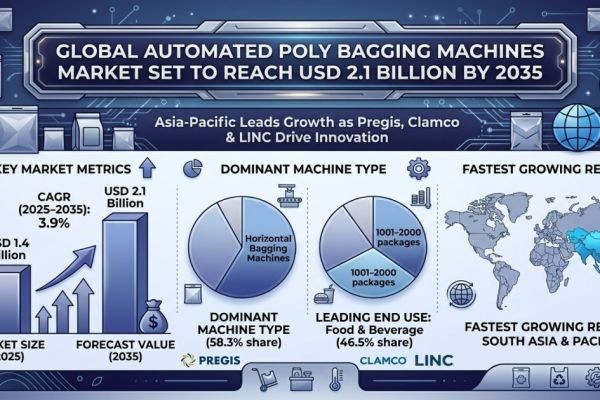
The global automated poly bagging machines market [https://www.futuremarketinsights.com/reports/automated-poly-bagging-machines-market] is experiencing steady growth, projected to expand from USD 1.4 billion in 2025 to USD 2.1 billion by 2035, registering a CAGR of 3.9% during the forecast period. This growth is primarily driven by increasing demand for efficient, high-speed packaging solutions across industries such as e-commerce, food & beverage, pharmaceuticals, and industrial goods.
As businesses face rising labor costs and increasing order volumes, automation has become a necessity rather than a luxury. Automated poly bagging machines offer enhanced speed, precision, and consistency, enabling companies to optimize packaging operations while reducing manual intervention.
With advancements in programmable logic controllers (PLC), touch-screen interfaces, and integration with warehouse management systems (WMS), these machines are becoming smarter and more adaptable. The shift toward smart factories and Industry 4.0 is further accelerating adoption, making automated bagging systems a critical component of modern packaging lines.
Key Market Metrics
- Market Size (2025): USD 1.4 Billion
• Forecast Value (2035): USD 2.1 Billion
• CAGR (2025–2035): 3.9%
• Dominant Machine Type: Horizontal Bagging Machines (58.3% share)
• Leading Capacity Segment: 1001–2000 packages (34.7% share)
• Leading End Use: Food & Beverage (46.5% share)
Key Demand Drivers
- Rapid Growth of E-commerce and Logistics
The surge in online shopping has significantly increased demand for efficient packaging systems. Automated poly bagging machines streamline packaging, labeling, and sorting processes, ensuring faster order fulfillment and reduced delivery times. - Rising Demand for Automation and Cost Efficiency
Businesses are increasingly adopting automation to reduce labor costs and improve productivity. These machines enable continuous, high-speed operations with minimal human intervention, enhancing overall efficiency. - Versatility Across Industries
Automated poly bagging machines are widely used in food & beverage, pharmaceuticals, retail, and industrial sectors. Their ability to handle diverse products and packaging formats makes them highly versatile. - Technological Advancements in Smart Packaging Systems
Integration with advanced technologies such as PLC systems, sensors, and WMS platforms enhances operational precision, traceability, and quality control.
Supply Chain Analysis: Who Supplies Whom
The automated poly bagging machines market operates within a dynamic and interconnected ecosystem:
- Raw Material Suppliers: Provide polyethylene and polypropylene films
• Machine Manufacturers: Design and produce automated bagging systems
• Component Suppliers: Supply motors, sensors, PLCs, and sealing units
• Integrators: Enable system integration with production and logistics lines
• End Users: E-commerce firms, food processors, pharmaceutical companies
• Distributors: Handle installation, maintenance, and after-sales services
This integrated value chain supports innovation, scalability, and efficient delivery of packaging solutions.
Pricing Trends & Cost Dynamics
- Raw Material Costs: Polyethylene and polypropylene price fluctuations impact overall costs
• Automation Investment: Advanced systems require higher upfront capital
• Operational Efficiency Gains: Reduced labor and waste lower long-term costs
• Customization Costs: Tailored systems for specific applications may increase initial investment
Segmentation Insights
By Machine Type
• Horizontal Bagging Machines (Leading Segment – 58.3%)
• Vertical Bagging Machines
By Capacity
• Less than 500 packages
• 501–1000 packages
• 1001–2000 packages (34.7% share)
• More than 2000 packages
By End Use
• Food & Beverage (46.5%)
• Pharmaceuticals
• Building & Construction
• Others (Chemical, retail, etc.)
Regional Analysis
Asia-Pacific: The Growth Engine
Asia-Pacific is emerging as a key growth region due to rapid industrialization, booming e-commerce markets, and increasing adoption of automation in countries like India and China. Strong manufacturing capabilities and expanding logistics networks further support market growth.
North America: Technological Advancement and Early Adoption
North America holds a significant market share due to early adoption of automation technologies and strong presence of leading packaging solution providers.
Europe: Focus on Efficiency and Regulatory Compliance
Europe continues to grow steadily with emphasis on high-quality packaging standards, automation, and sustainability regulations.
Competitive Landscape
The automated poly bagging machines market is moderately fragmented, with global and regional players focusing on innovation, automation, and customization.
Key Players
• Pregis LLC
• Converting Technology
• Tension Packaging & Automation
• Integrated Productivity Systems, LLC
• Clamco
• LINC Systems, LLC
• SIMS Manufacturing Co., Inc.
Key Asian Players
• Wenzhou High Sea Machinery Co., Ltd
• Zhejiang Chovyting Machinery Co., Ltd
• Zhejiang Bangtai Machine Co., Ltd
• Polystar Machinery Co., Ltd
• TEXKOR
Strategic Focus Areas
- Development of high-speed, automated bagging systems
• Integration with smart factory and WMS technologies
• Expansion into emerging markets
• Customization based on industry-specific requirements
• Focus on energy-efficient and cost-effective solutions
Technology & Innovation Trends
- Smart Automation Systems: Integration with PLC and IoT technologies
• Inline Printing & Labeling: Enhanced traceability and branding
• Modular Designs: Scalability and flexibility in operations
• High-Speed Processing: Increased throughput with minimal downtime
• Advanced Sensors: Real-time monitoring and quality control
Challenges
- Environmental Concerns: Polybags are non-biodegradable and difficult to recycle
• Regulatory Restrictions: Bans on single-use plastics in several countries
• High Initial Investment: Advanced machines require significant capital
• Material Dependency: Reliance on plastic materials may impact long-term demand
Opportunities & Investment Outlook
- Growth in E-commerce and Logistics Industry
• Rising Demand for Automated Packaging Solutions
• Expansion in Emerging Markets
• Increasing Adoption in Food & Pharmaceutical Sectors
• Development of Sustainable Packaging Alternatives
Future Outlook (2025–2035)
The automated poly bagging machines market is poised to play a vital role in the evolution of modern packaging systems. Over the next decade, the market will witness:
- Increased adoption of automation and smart manufacturing
• Expansion of high-speed, scalable packaging systems
• Integration with AI-driven monitoring and predictive maintenance
• Growing demand from e-commerce and logistics sectors
• Shift toward sustainable and recyclable packaging solutions
By 2035, companies that successfully combine automation, efficiency, and sustainability will be well-positioned to lead the transformation of the global packaging machinery landscape.
https://www.futuremarketinsights.com/reports/automated-poly-bagging-machines-market






