
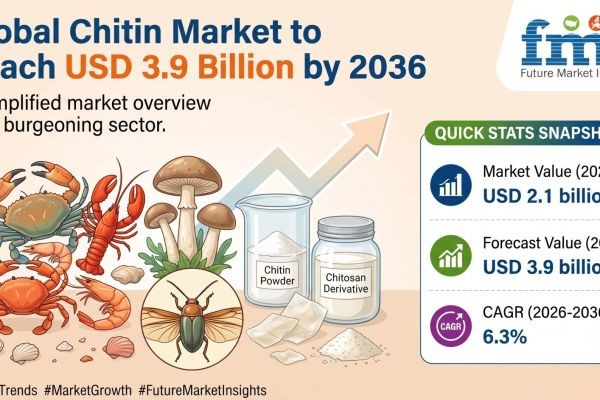
The global chitin market is undergoing a structural transition, moving from simple seafood shell waste recovery into high-value circular biopolymer manufacturing, according to latest insights by Future Market Insights. Extracted from the exoskeletons of crustaceans, insects, and fungal cell walls, chitin and its primary deacetylated derivative chitosan are securing widespread commercial adoption across food preservation, sustainable packaging, water treatment, biomedical care, and agricultural biologicals due to their biocompatible, biodegradable, and natural antimicrobial properties.
The global market, valued at USD 2.1 billion in 2026, is projected to expand at a Compound Annual Growth Rate (CAGR) of 6.3% over the ten-year forecast period, reaching a total market valuation of USD 3.9 billion by 2036, delivering an absolute incremental opportunity of USD 1.8 billion.
Get detailed market forecasts, competitive benchmarking, and pricing trends:
https://www.futuremarketinsights.com/reports/sample/rep-gb-313
Market Performance Overview (2026–2036)
To map out the key downstream derivatives, core end-use application sectors, and regional growth vectors guiding this USD 1.8 billion market expansion, key segment allocations highlight where global commercial demand is concentrated:
- Chitosan Derivative Segment (50.0% share): Commands the derivative category in 2026 due to its superior solubility and chemical reactivity compared to raw chitin, driving high-volume utilization across industrial water treatment flocculants, agricultural seed coatings, and biomedical wound care gels.
- Glucosamine & Chitosan Oligosaccharides: Represent secondary derivative pillars, targeting dietary supplements, joint health, and plant biostimulant markets.
- Food & Beverages End-Use Segment (35.0% share): Dominates end-use applications, driven by the urgent CPG demand for natural antimicrobial coatings to extend shelf life and reduce food spoilage across fresh produce, meats, and seafood.
- Water Treatment, Agrochemicals, & Medical/Pharma: Form secondary application pillars, leveraging bio-based chitosan to replace synthetic chemical flocculants and synthetic crop protection agents.
- China Regional Leadership (6.7% CAGR): Serves as the fastest-growing national market through 2036, supported by massive domestic seafood processing throughput and state-backed circular biomanufacturing initiatives.
Technical Drivers and Circular Economy Shifts
The commercial scaling of chitin and chitosan across industrial processing is propelled by three primary industry catalysts:
Seafood Waste Valorization and Circular Sourcing
Converting shellfish waste from global fisheries into functional biopolymers allows seafood processors to monetize disposal liabilities. Utilizing shell waste provides a sustainable, circular raw material feedstock that satisfies corporate ESG goals.
Natural Food Preservation and Antimicrobial Barrier Coatings
With global food loss and waste generating significant economic losses and greenhouse gas emissions, food manufacturers are deploying edible, chitosan-based barrier coatings. These coatings slow down microbial growth and oxidation in fresh fruit, vegetables, and meats without altering taste or appearance.
Green Chemistry in Water Treatment and Ag-Biologicals
Municipalities and industrial facilities are increasingly replacing synthetic polyacrylamide flocculants with biodegradable chitosan derivatives for complex wastewater treatment. Similarly, agrochemical firms are incorporating fungal and crustacean chitosan into seed treatments to enhance plant immunity and crop yields.
Industrial Infrastructure & Raw Material Constraints
Chitin refiners and biopolymer processors navigate specific operational hurdles:
- Raw Material Supply Volatility: Reliance on wild-caught shellfish landings creates seasonal supply and pricing fluctuations. To ensure supply continuity, refiners are diversifying into farmed aquaculture waste, fungal fermentation, and insect farming (black soldier fly) feedstocks.
- Capital-Intensive Deacetylation Processing: Transforming chitin into high-purity, medical- or food-grade chitosan requires chemical or enzymatic deacetylation, requiring investments in energy-efficient, eco-friendly extraction infrastructure.
Regional Growth Profile
Regional demand reflects high-volume biomanufacturing expansion across Asia alongside regulatory-driven bioplastics adoption in Europe and North America:
- China (6.7% CAGR): The global growth frontrunner, driven by massive aquaculture processing volumes, government biomanufacturing policies, and expanding domestic packaging and agricultural sectors.
- United States (4.8% CAGR): Spurring growth through venture-backed green chemical scale-ups, advanced wastewater treatment demands, and ag-biological seed coating adoption.
- United Kingdom (4.7% CAGR) & Germany (4.6% CAGR): Leading European market activity, governed by strict EU plastic-reduction mandates, EFSA regulatory clearances, and medical-grade chitosan wound care innovations.
- India (4.5% CAGR): Driven by an expanding $72.6 billion domestic bioeconomy and government support for converting coastal seafood waste into high-value biomolecules.
Competitive Landscape
The global chitin market features a combination of vertically integrated seafood waste upcyclers, specialized biopolymer chemical manufacturers, and biotech innovators.
Key market participants profiled in the report include Tidal Vision, Primex Iceland, CuanTec, KitoZyme, Milliken & Company, Heppe Medical Chitosan, Advanced Biopolymers, Meron Biopolymers, Golden-Shell Pharmaceutical, and G.T.C. Bio Corporation. Leading players compete by securing long-term shell waste supply agreements, expanding industrial-scale extraction facilities, and obtaining food/medical-grade regulatory clearances.
Full Report for Detailed Insights: https://www.futuremarketinsights.com/reports/chitin-market
Frequently Asked Questions
What is the projected valuation of the global chitin market by 2036?
The global chitin market is projected to reach USD 3.9 billion by 2036, expanding from an estimated baseline valuation of USD 2.1 billion in 2026 at a CAGR of 6.3%.
Why does Chitosan hold a 50.0% derivative market share?
Chitosan leads the derivative category because its deacetylation gives it superior chemical solubility and reactivity, allowing it to be easily processed into films, powders, and gels for water treatment, biomedical, and food preservation applications.
What main end-use category dominates chitin sales?
Food & Beverages leads end-use demand with a 35.0% market share in 2026, as food processors adopt natural chitosan coatings and preservatives to extend shelf life and combat global food waste.






