
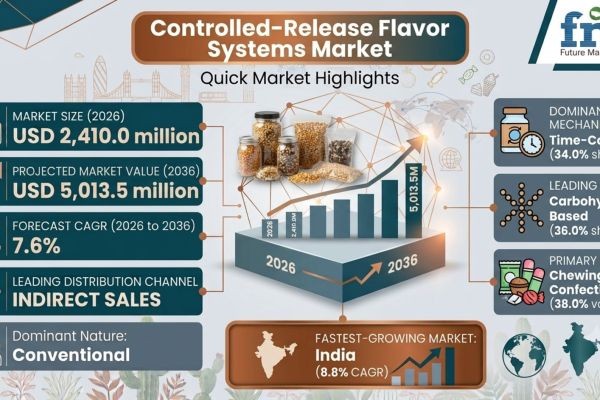
The global controlled-release flavor systems market is executing a vital shift within the modern food, beverage, and oral care manufacturing sectors. Driven by the technical necessities of sugar reduction, high-protein fortification, and intense industrial processing protection, the global market is projected to expand from USD 2,410.0 million in 2026 to USD 5,013.5 million by 2036. This growth represents a highly consistent compound annual growth rate (CAGR) of 7.6% over the ten-year forecast period.
Rather than standard volume-driven aromatic expansion, the market’s development is dictated by highly specialized structural architectures that manage the timing, durability, and release triggers of complex volatile compounds under thermal, chemical, and mechanical stress.
Request a Sample Report: https://www.futuremarketinsights.com/reports/sample/rep-gb-31480
Quick Market Highlights
- Market Size (2026): USD 2,410.0 million
- Projected Market Size (2036): USD 5,013.5 million
- Forecast CAGR (2026 to 2036): 7.6%
- Dominant Release Mechanism: Time-Controlled Release commanding a 34.0% market share
- Leading Delivery Matrix: Carbohydrate-Based Matrices capturing a 36.0% market share
- Primary Industry Application: Chewing Gum and Confectionery accounting for 38.0% of volume
- Fastest-Growing National Market: India, expanding at a leading 8.8% CAGR
- Core Tier-One Competitors: Givaudan, IFF, Symrise, DSM-Firmenich, Sensient Technologies
Processing Resiliency and Staged Perception Powering Corporate Adoption
Modern consumer package goods (CPG) production increasingly subjects ingredients to aggressive processing environments. High-shear extrusion, commercial baking, spray drying, and ultra-high-temperature (UHT) pasteurization tend to strip out or alter unencapsulated top-note flavor elements. To counteract this rapid flavor loss, food scientists are utilizing controlled-release architectures that shield fragile flavor compounds during manufacturing, ensuring they remain inert until specific physiological triggers occur during consumption.
Furthermore, the mainstream push toward health-and-wellness products introduces prominent formulation hurdles. Reducing sucrose levels or integrating heavy plant-based or dairy proteins typically leaves behind unwanted bitter off-notes or a metallic aftertaste. Controlled-release systems address this challenge by providing exact kinetic modulation staggering the release of sweet masking agents or delaying the primary flavor profile until any initial unpleasant active notes pass the consumer's palate.
Mechanistic Dynamics: Time-Based and pH Systems Command the Core
When evaluating the structural pathways through which volatile flavors are unlocked, the industry relies on four primary release dynamics designed around human consumption habits:
- Time-Controlled Release (34.0% Share): Serves as the primary operational standard. This structure is heavily utilized to deliver gradual, sustained taste perception over an extended duration, which is critical for product differentiation in competitive retail lines.
- pH-Triggered Release (27.0% Share): Operates via environment-specific activation, responding directly to oral saliva conditions or localized gastrointestinal shifts to dissolve protective outer membranes.
- Moisture-Activated Release (21.0% Share): Essential for shelf-stable instant powders, dried soup mixes, and dehydrated beverages that require absolute flavor immobilization until rehydration or liquid contact occurs.
- Mechanical Action Release (18.0% Share): Relies heavily on physical mastication forces, leveraging the pressure of chewing to break micro-capsules and unleash targeted bursts of flavor.
Carbohydrate-Based Matrices Anchor Commercial Infrastructure
From a delivery matrix perspective, Carbohydrate-Based Matrices represent the dominant technology, capturing 36.0% of global utilization. The structural prominence of carbohydrates such as modified food starches, maltodextrins, and gum Arabic stems from their superb film-forming capabilities, reliable processing compatibility across massive manufacturing configurations, and predictable dissolution behavior in water.
Polymer and Protein Matrices hold a 28.0% market share, offering enhanced thermal defense and tailored release responses to environmental changes. Lipid-Based Systems account for 22.0% of the landscape, specifically chosen when formulations require delayed fat-soluble dissolution or intense moisture-barrier defense. Advanced Hybrid Multilayer Systems handle the remaining 14.0% share, combining divergent carrier materials to execute highly intricate, multi-phase flavor release profiles.
Confectionery and Beverage Application Verticals Drive Bulk Procurement
The underlying end-use landscape reflects the structural reliance on prolonged sensory engagement:
- Chewing Gum and Confectionery (38.0% Share): Remains the bedrock application sector. Prolonged oral exposure demands flavor systems that do not wash away immediately, forcing producers to utilize multi-tier release technologies to maintain sensory impact over long chewing periods.
- Beverages and Instant Drink Mixes (22.0% Share): Utilized to moderate initial flavor bursts, manage continuous uniform sipping profiles, and prevent top-note aromatic degradation across long distribution cycles.
- Bakery and Snack Foods (17.0% Share): Centered entirely on thermal defense, protecting volatile flavor oils from escaping through high-heat oven cycles.
- Nutritional and Functional Foods (13.0% Share): Deployed specifically to hide functional supplement off-notes and balance taste with product efficacy.
- Oral Care and Specialty Foods (10.0% Share): Employed in retail toothpaste and breath mint formats to sustain lingering freshness after product use.
Technical Validation and Cost Hurdles Constrain Market Scaling
Despite impressive market gains, expanding the commercial reach of these advanced systems involves overcoming deep logistical and economic constraints. Designing custom encapsulation architectures that remain highly stable through extended distribution environments, yet release perfectly upon human contact, requires considerable development time and extensive pilot testing.
Additionally, multi-layer hybrid systems can carry premium ingredient costs, restricting their deployment to high-margin, premium product lines rather than low-margin, mass-commodity items. Navigating global compliance structures also presents a challenge, as different regional jurisdictions maintain varying labeling laws for modified food matrices and encapsulation technologies. This forces corporate developers to conduct exhaustive reviews before deploying a single flavor format across multiple international markets.
Custom Research Available: https://www.futuremarketinsights.com/customization-available/rep-gb-31104
Regional Breakdown: High-Growth Developing Markets Challenge Established Economies
Geographic data indicates an interesting divergence between high-volume production centers and mature market operations:
- India (8.8% CAGR): Leads global market growth. This rapid expansion is propelled by urban consumer shifts toward fortified nutrition powders, instant premixed beverages, and high-heat extruded snacks, all of which must withstand long shipping distances in high ambient temperatures.
- China (8.5% CAGR): Driven by massive industrial food processing scale and intensive corporate efforts to reformulate ready-to-drink (RTD) teas, dairy blends, and health beverages to meet national low-sugar goals.
- Brazil (8.0% CAGR): Anchored heavily by mass-market carbonated drinks, regional confectionery lines, and juice mixes that use encapsulation to stop aromatic volatility in tropical conditions.
- United States (6.9% CAGR): Focused squarely on functional health lines, high-protein meal replacements, clean-label ingredient profiles, and ensuring complete sensory uniformity across long national distribution chains.
- United Kingdom (6.6% CAGR): Strictly driven by compliance-led reformulation, where local sugar-reduction policies and premium supermarket sensory benchmarks necessitate advanced masking and flavor-extension tech.
Collaborative Technical Partnerships Define the Competitive Environment
The global market is dominated by a select group of highly specialized flavor houses possessing advanced micro-encapsulation, spray-cooling, and fluid-bed coating capabilities. Tier-one competitors profiled in the report include Givaudan, IFF, Symrise, DSM-Firmenich, and Sensient Technologies.
As standard commodity ingredients face continuous price pressure, these industry leaders are distinguishing themselves by functioning as strategic innovation partners. Winning companies are securing exclusive, multi-year supply contracts by providing comprehensive sensory modeling, precise batch-to-batch particle uniformity, and customized matrix solutions that directly solve specific thermal or mechanical degradation challenges for global food brands.
Exclusive Discounts on Full Report: https://www.futuremarketinsights.com/reports/controlled-release-flavor-systems-market
Strategic Outlook
The controlled-release flavor systems market is firmly cementing its role as a necessary engineering asset for modern product developers. By successfully merging processing defense with tailored kinetic release, these technologies allow global brands to navigate tough nutritional guidelines without sacrificing the core taste and mouthfeel profiles that drive consumer loyalty. Moving forward, the highest financial rewards will belong to ingredient suppliers who can deliver high-precision, multi-phase flavor release while keeping processing costs manageable for mass-scale commercial lines.
Executive Takeaways
- The global controlled-release flavor systems market is projected to reach USD 5,013.5 million by 2036, advancing at a robust 7.6% CAGR from 2026.
- Time-controlled release mechanisms command the highest utilization share at 34.0%, providing prolonged sensory impact across extended consumption windows.
- Carbohydrate-based matrices lead all delivery carrier materials with a 36.0% market share due to superior film-forming properties and predictable dissolution.
- Chewing gum and confectionery applications remain the single largest commercial driver, accounting for 38.0% of overall system demand.
- India represents the fastest-growing geographical market, expanding at an 8.8% CAGR due to climate-driven volatility management and rapid ready-to-drink product expansion.
- Sourcing protocols are heavily influenced by technical capabilities, with industrial buyers prioritizing batch stability, particle size control, and custom trigger tuning over basic raw material pricing.
Why Choose FMI: https://www.futuremarketinsights.com/why-fmi
Explore More Related Studies Published by FMI Research
Cell-Based Chicken Fat Market : https://www.einpresswire.com/article/903342380/cell-based-chicken-fat-market-to-reach-usd-780-0-million-by-2036-driven-by-sensory-innovation-alternative-protein-demand
Pet Food Preservative Market : https://www.openpr.com/news/4529744/pet-food-preservative-market-to-reach-usd-886-06-million-by-2036
Parenteral Nutrition Market : https://www.openpr.com/news/4529746/parenteral-nutrition-market-to-reach-usd-13-79-billion-by-2036-as
Explore In-Depth Food & Beverage Market Insights : https://www.futuremarketinsights.com/industry-analysis/food-and-beverage
About Future Market Insights (FMI)
Future Market Insights, Inc. (FMI) is an ESOMAR-certified, ISO 9001:2015 market research and consulting organization trusted by global enterprises and Fortune 500 companies. FMI delivers actionable market intelligence, competitive benchmarking, and strategic insights across more than 30 industries and 1,200 markets worldwide.
Contact Us
Future Market Insights Inc.
Christiana Corporate, 200 Continental Drive,
Suite 401, Newark, Delaware - 19713, USA
T: +1-347-918-3531
For Sales Enquiries: sales@futuremarketinsights.com
Website: https://www.futuremarketinsights.com






