
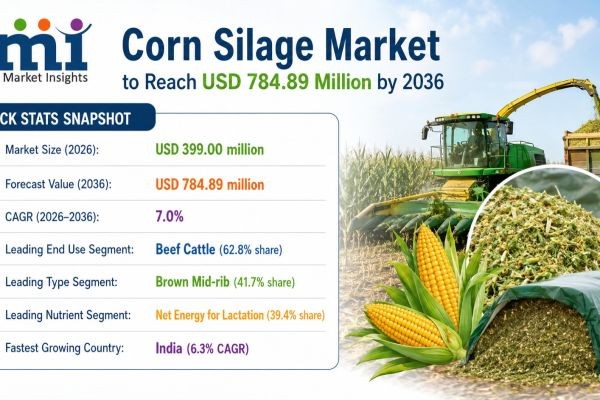
The global corn silage market is transitioning from a commodity bulk forage input into a precision-managed nutritional component across intensive commercial livestock operations, according to latest insights by Future Market Insights. Driven by escalating global demand for animal protein, dairy herd expansion, and genetic advancements in silage-specific corn hybrids, corn silage remains the most cost-effective energy and fiber forage source in temperate farming regions. The global market, valued at USD 372.90 million in 2025, is projected to reach USD 399.00 million in 2026. Advancing at a Compound Annual Growth Rate (CAGR) of 7.0% over the ten-year forecast period, total market valuation is anticipated to hit USD 784.89 million by 2036, opening an absolute incremental opportunity of USD 385.89 million.
Request a Sample Report: https://www.futuremarketinsights.com/reports/sample/rep-gb-12631
Market Performance Overview (2026–2036)
To understand the core livestock applications, hybrid types, and primary nutrient parameters guiding this USD 385.89 million market scale-up, an analysis of leading segment allocations highlights where global demand is concentrated:
- Beef Cattle End Use (62.8% share): Dominates end-use allocation in 2026, serving as the foundational forage in growing and finishing rations across North and South American feedlots where energy density directly governs average daily weight gain.
- Brown Mid-rib (BMR) Hybrid Type (41.7% share): Commands the product type category, favored by dairy nutritionists for its lower lignin content, which delivers 10% to 15% higher Neutral Detergent Fiber (NDF) digestibility compared to conventional field corn.
- Net Energy for Lactation (NEL) Nutrient Priority (39.4% share): Serves as the leading quality procurement criterion, as commercial dairy ration formulation software prioritizes forage metabolizable energy delivery to maximize milk yields without excessive reliance on concentrate feeds.
Technical Drivers and Nutritional Advancement
The adoption of precision-managed corn silage across commercial dairy and beef operations is propelled by three primary industry catalysts:
Dairy Herd Intensification and Fiber Digestibility
Large-scale commercial dairy operations (>1,000 head) treat corn silage as the anchor forage determining total ration cost per liter of milk. Every percentage point increase in corn silage NDF digestibility yields measurable gains in dry matter intake (DMI) and daily milk output, making hybrid selection and precise harvest timing direct drivers of operational profitability.
Genetic Progress in BMR Hybrids
Brown Mid-rib corn hybrids are closing the historical yield gap with conventional field corn. Breakthrough breeding programs have narrowed the BMR yield penalty from 15% down to 5–8% in modern commercial varieties, significantly improving the net economic return for producers prioritizing fiber digestibility.
Import Substitution & Renewable Energy (Biogas) Integration
National government initiatives across India, China, and Japan are incentivizing domestic silage production and processing machinery to reduce reliance on costly imported feedstuffs. Concurrently, expanding Anaerobic Digestion (AD) infrastructure across Europe (notably Germany) and Asia utilizes corn silage as a primary renewable energy feedstock for biogas production.
Industrial Infrastructure & Agronomic Challenges
Forage producers, commercial feedlots, and seed developers face distinct operational constraints:
- Harvest Window and Aerobic Deterioration Risks: Achieving target dry matter content (typically 30–35%) during harvest requires narrow operational timing. Inadequate compaction or oxygen exposure during bunker/bag storage leads to aerobic spoilage, mycotoxin growth, and severe nutrient loss.
- Weather Volatility and Water Management: Climate-induced droughts and unpredictable rainfall patterns impact whole-plant moisture and starch deposition, forcing producers to invest in irrigation infrastructure and inoculants that stabilize fermentation under variable moisture levels.
Regional Growth Outlook
The geographic analysis reflects strong, policy-backed expansion across Asian dairy production centers alongside steady, technology-driven growth in mature Western livestock markets:
- India (6.3% CAGR): The global growth frontrunner, driven by the National Dairy Development Board's (NDDB) initiatives to mechanize forage harvesting and scale organized silage procurement within dairy cooperatives.
- United States (6.1% CAGR): Sourcing a large baseline volume footprint, supported by Midwest feedlots and large-scale Western dairy operations where silage represents 50–60% of total mixed ration dry matter.
- Germany (5.7% CAGR): Anchored by high-digestibility hybrid adoption in the Bavarian dairy sector and sustained demand for silage feedstock in agricultural biogas plants.
- Japan (5.2% CAGR): Driven by concentrated dairy operations in Hokkaido expanding domestic silage production to buffer against international grain transport costs and support high-quality Wagyu beef production.
- China (4.8% CAGR): Supported by state-led dairy self-sufficiency policies, modern animal housing facilities, and expanding domestic forage acreage.
Competitive Landscape
The global corn silage landscape features a combination of seed genetics conglomerates, animal nutrition specialists, and microbial inoculant manufacturers. Companies compete on hybrid agronomic yield, fiber digestibility traits, drought resilience, and biological silage inoculant effectiveness.
Leading market participants include Cargill, Archer Daniels Midland Company (ADM), ForFarmers, Lallemand Animal Nutrition, Mycogen Seeds, Chr. Hansen Holding A/S (Novonesis), DuPont Pioneer, Land O'Lakes, Inc., Nutreco N.V., and KWS SAAT SE & Co. KGaA. Industry leaders are actively investing in region-adapted seed hybrids, precision harvest sensors, and advanced lactic acid bacteria inoculants to optimize fermentation kinetics.
Exclusive Discounts on Full Report: https://www.futuremarketinsights.com/reports/corn-silage-market
Frequently Asked Questions
What is the projected valuation of the global market by 2036?
The global corn silage market is projected to reach USD 784.89 million by 2036, expanding from an estimated baseline valuation of USD 399.00 million in 2026 at a CAGR of 7.0%.
Why do Brown Mid-rib (BMR) hybrids command the largest share among corn types?
BMR hybrids hold a 41.7% share because their reduced lignin genetic profile significantly boosts fiber digestibility in the rumen, increasing voluntary dry matter intake and milk production per cow.
What exclusions govern the physical boundaries of this market report?
The scope strictly limits its focus to fermented whole-plant corn silage, explicitly excluding unfermented fresh green chop corn, standalone corn grain sold as commodity feed, and post-harvest corn stover collected for industrial cellulosic processing.






