
Market Overview: Sustainable Labeling and Automation Fueling Next-Gen Packaging
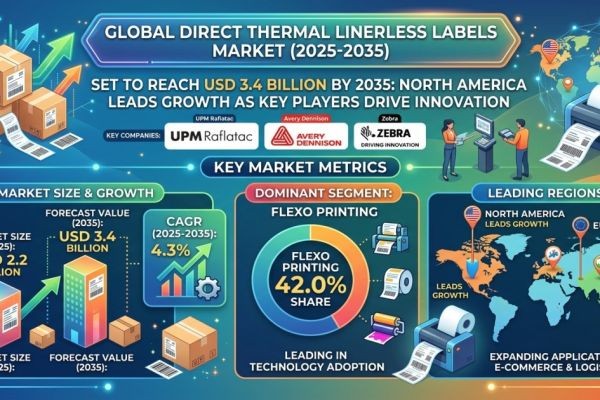
The global direct thermal linerless labels market [https://www.futuremarketinsights.com/reports/direct-thermal-linerless-labels-market] is steadily gaining momentum as industries shift toward eco-efficient and cost-effective labeling solutions. According to industry estimates, the market is projected to grow from USD 2.2 billion in 2025 to USD 3.4 billion by 2035, registering a CAGR of 4.3% during the forecast period.
Direct thermal linerless labels pressure-sensitive labels without backing liner are emerging as a transformative solution in the packaging ecosystem. By eliminating liners, these labels significantly reduce material waste, improve operational efficiency, and lower transportation and storage costs. Their increasing adoption across food, retail, logistics, and healthcare sectors underscores their importance in modern packaging strategies.
The rise of sustainable packaging regulations, combined with advancements in adhesive coatings and printing technologies, is further accelerating market growth. As businesses strive to balance environmental responsibility with operational performance, linerless labeling is becoming a critical enabler.
Key Market Metrics
- Market Size (2025): USD 2.2 Billion
- Forecast Value (2035): USD 3.4 Billion
- CAGR (2025–2035): 4.3%
- Dominant Segment: Flexo Printing (42.0% Share)
- Leading Regions: North America, Asia-Pacific, Europe
Key Demand Drivers
- Sustainability and Waste Reduction Initiatives
The global push toward circular economy models is a primary driver for linerless labels. By eliminating silicone-coated liners, these labels reduce landfill waste and carbon emissions, aligning with zero-waste and green packaging goals.
- E-commerce and Logistics Expansion
The surge in online shopping has increased demand for efficient labeling solutions. Linerless labels offer barcode readability, durability, and fast application making them ideal for shipping, tracking, and inventory management.
- Cost Efficiency and Operational Gains
Businesses benefit from more labels per roll, fewer roll changes, and reduced labor costs. These efficiencies translate into lower overall operational expenses and improved productivity.
- Advancements in Printing Technologies
Flexographic and digital printing innovations are enhancing print quality, speed, and adaptability. This ensures high-resolution, smudge-resistant labels suitable for high-volume applications.
Supply Chain Analysis: Who Supplies Whom
The direct thermal linerless labels market operates within an integrated and innovation-driven supply chain:
- Raw Material Suppliers: Provide paper, films, adhesives, and release coatings
- Technology Providers: Develop printing systems and linerless-compatible machinery
- Label Manufacturers: Companies like UPM Raflatac Inc., Avery Dennison Corporation, and Zebra Technologies Corporation produce advanced linerless labels
- End Users: Food processors, retailers, logistics firms, and healthcare providers
- Distribution Networks: Enable integration into packaging and supply chain systems
Pricing Trends & Cost Dynamics
- Material Savings: Absence of liners reduces raw material consumption
- Freight Efficiency: More labels per roll lower transportation costs
- Technology Investments: Initial costs for compatible printers and retrofits
- Premium Value: High-performance labels with durability and clarity command better margins
Segmentation Insights
By Printing Technology
- Flexo Printing: Dominates with 42% share due to speed and cost efficiency
- Digital Printing: Growing for customization and short runs
- Offset Printing: Used for high-quality, large-scale production
Flexo printing remains the preferred choice due to its compatibility with various substrates and ability to deliver high-speed, high-resolution output.
By End Use
- Food & Beverage (28% Share): Leading segment driven by labeling compliance and traceability
- Retail: Price tagging and product information labeling
- Logistics & Warehousing: Shipping labels and inventory tracking
- Healthcare & Industrial: Specialized labeling requirements
Regional Analysis
North America: Market Leader
North America dominates the market due to advanced logistics infrastructure, strong adoption of automation, and sustainability regulations. The region also leads in technological innovation and early adoption of linerless solutions.
Asia-Pacific: High-Growth Region
Asia-Pacific is witnessing rapid growth driven by expanding e-commerce, rising manufacturing output, and increasing awareness of sustainable packaging in countries like India and China.
Europe: Sustainability-Driven Market
Europe’s strict environmental regulations are encouraging widespread adoption of eco-friendly labeling solutions. The region is also investing in recyclable materials and efficient printing systems.
Competitive Landscape
The market is moderately fragmented, with key players focusing on innovation, sustainability, and scalability.
Key Players
- UPM Raflatac Inc.
- Avery Dennison Corporation
- Zebra Technologies Corporation
- SATO Holdings Corporation
- HERMA GmbH
- Reflex Labels Ltd.
Strategic Focus Areas
- Development of linerless-compatible adhesives
- Investment in high-speed printing technologies
- Expansion into emerging markets
- Customization and smart labeling integration
Technology & Innovation Trends
- Advanced Adhesive Coatings: Improved durability and environmental resistance
- Smart Labeling Integration: Barcode and tracking enhancements
- Flexo Printing Automation: Faster and more efficient production
- Eco-Friendly Materials: Recyclable and biodegradable substrates
- Cold Chain Compatibility: Moisture- and temperature-resistant labels
Challenges
- Initial Equipment Costs: Investment in compatible printers and systems
- Performance Limitations: Sensitivity to heat and environmental factors
- Market Awareness: Slower adoption in developing regions
- Competition from Traditional Labels: Established supply chains for linered labels
Opportunities & Investment Outlook
- Sustainable Packaging Solutions: Strong ROI in eco-friendly labeling
- E-commerce Growth: Increasing demand for efficient logistics labeling
- Emerging Markets: Expansion opportunities in Asia-Pacific and Latin America
- Automation Integration: Enhancing operational efficiency
- Customization Trends: Growth in variable data printing and branding
Future Outlook (2025–2035)
The direct thermal linerless labels market is transitioning from a niche innovation to a mainstream packaging solution. As sustainability becomes a core business priority, linerless labels will play a crucial role in reducing waste and improving efficiency.
Future trends include:
- Widespread adoption of zero-waste packaging systems
- Integration with smart supply chain technologies
- Expansion in food safety and traceability applications
- Increased collaboration between label manufacturers and end users
By 2035, companies that combine sustainability, cost efficiency, and technological innovation will emerge as market leaders. The shift toward linerless labeling is not just a trend—it is a fundamental transformation in how products are packaged, labeled, and delivered in a rapidly evolving global marketplace.
visit the official report page at: https://www.futuremarketinsights.com/reports/direct-thermal-linerless-labels-market






