
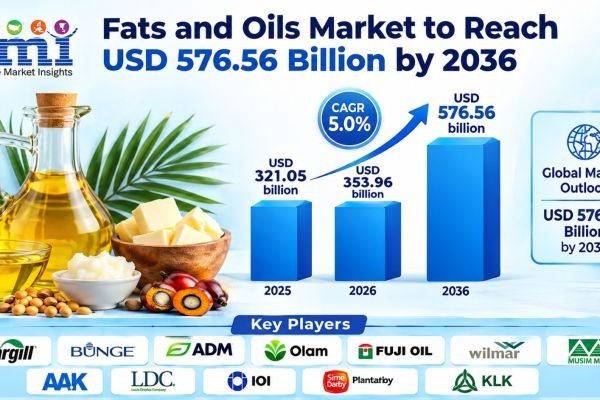
The global fats and oils market is maintaining steady, multi-billion-dollar commercial growth, according to comprehensive market analysis by Future Market Insights. Driven by rising per capita edible oil consumption across developing regions in Asia, Africa, and the Middle East, alongside high-value CPG food manufacturer demand for functional specialty fats (interesterified shortenings, cocoa butter equivalents, and trans-fat-free alternatives in bakery and confectionery), the market represents one of the largest essential commodity categories globally.
The global market, valued at USD 321.05 billion in 2025, is estimated to reach USD 353.96 billion in 2026. Advancing at a Compound Annual Growth Rate (CAGR) of 5.0% over the ten-year forecast period, total market valuation is projected to achieve USD 576.56 billion by 2036, delivering an absolute dollar expansion of USD 222.60 billion.
Request a Sample Report: https://www.futuremarketinsights.com/reports/sample/rep-gb-2863
Market Performance Overview (2026–2036)
To map out the primary product types, core application sectors, and regional growth vectors guiding this USD 222.60 billion market expansion, key segment allocations highlight where commercial volume and value are concentrated:
- Fats Product Type Segment (58.5% share): Commands the leading product category in 2026, encompassing processed shortenings, margarines, cocoa butter substitutes, and animal fats (butter, lard, tallow) essential for texture, stability, and structure in commercial baking and confectionery.
- Food and Beverages Application Segment (41.7% share): Dominates end-use applications over animal feed, industrial oleochemicals, pharmaceuticals, and personal care, driven by baseline cooking, frying, and packaged food preparation.
- Confectionery, Bakery, & Dairy Products: Represent high-value secondary application pillars, specifying custom-tailored melting points and crystal structures to eliminate partially hydrogenated oils.
- China & India Regional Growth Leadership: Lead national expansion rates at 8% CAGR and 6.3% CAGR respectively through 2036, driven by population growth, urban dietary shifts, expanding food processing sectors, and national oilseed self-reliance initiatives (such as India's National Mission on Edible Oils-Oil Palm).
Technical Drivers and Formulation Shifts
The commercial scaling of fats and oils across food and industrial manufacturing is propelled by three primary industry catalysts:
Global Trans-Fat Elimination and Specialty Fat Tailoring
Regulatory frameworks including WHO REPLACE initiatives, US FDA PHO bans, and EU Regulation (EU) 2019/649 (limiting industrial trans-fats to $<2\text{ g}$ per $100\text{ g}$ of fat) have mandated widespread reformulation. CPG brands rely on specialty refiners (such as AAK AB, Fuji Oil, and IOI Corporation) for enzymatically interesterified fats and fractionated lauric shortenings that deliver clean melting profiles without harmful trans-fatty acids.
RSPO Certification and Deforestation-Free Sourcing
Major food conglomerates and European/North American retailers require certified sustainable palm oil (CSPO) under Roundtable on Sustainable Palm Oil (RSPO) mass-balance or segregated models. Brand owners prioritize suppliers (Wilmar, Musim Mas, Sime Darby, KLK) offering verifiable supply chain traceability and compliance with strict deforestation-free mandates (such as EUDR).
High-Oleic Vegetable Oils for Cardiovascular Health Positioning
Consumer preference for heart-healthy lipid profiles is driving procurement of high-monounsaturated vegetable oils (high-oleic sunflower, high-oleic canola, avocado oil). These oils provide superior oxidative stability during high-temperature commercial frying while enabling on-pack claims regarding reduced saturated fat and cardiovascular support.
Industrial Constraints & Commodity Volatility
Fats and oils refiners and CPG procurement managers navigate specific operational hurdles:
- Agricultural Crop Yield and Export Policy Volatility: Spot prices for major vegetable oils (palm, soybean, rapeseed, sunflower) are vulnerable to extreme weather events, seasonal harvest fluctuations, and sudden export policy changes (such as export levies or quotas in Indonesia/Malaysia).
- Traceability and Supplier Qualification Barriers: Establishing fully traceable, identity-preserved supply chains from plantation mills to retail products requires significant auditing and logistics investments, creating compliance friction for mid-tier processors.
Regional Growth Profile
Regional demand reflects massive edible oil consumption scaling in Asia alongside specialty fat premiumization in Western economies:
- China (6.8% CAGR): The global growth frontrunner, driven by the expanding middle-class food processing industry, animal feed energy enrichment, and major domestic refining infrastructure led by Wilmar International and state-backed crushers.
- India (6.3% CAGR): Spurring rapid volume growth as the world's largest edible oil importer, supported by rising per capita consumption and government initiatives (NMEO-OP) expanding domestic oil palm cultivation.
- Germany (5.8% CAGR) & France (5.3% CAGR): Lead European demand, serving as continental refining and trading hubs for non-GMO rapeseed oil, sunflower oil, and certified specialty confectionery fats.
- United Kingdom (4.8% CAGR) & United States (4.3% CAGR): Anchored by large-scale soybean/corn oil processing (Cargill, ADM, Bunge), QSR frying oil demand, and premium bakery fat reformulations.
- Brazil (3.8% CAGR): Leveraging massive domestic soybean crushing and refining capacity to supply South American food processors and international export corridors.
Competitive Landscape
The global fats and oils landscape is led by major ABCD agricultural processing conglomerates alongside specialized confectionery and specialty lipid innovators.
Key market participants profiled in the report include Cargill Incorporated, Bunge Limited, Archer Daniels Midland Company (ADM), Olam Group, Fuji Oil Holdings Inc., Wilmar International Ltd, Musim Mas Holdings, AAK AB, Louis Dreyfus Company, IOI Corporation Berhad, Sime Darby Plantation, and Kuala Lumpur Kepong Berhad (KLK). Major players compete by scaling multi-seed crushing capacity, expanding certified sustainable supply chain footprints, and formulating custom interesterified fat blends for industrial bakeries.
Exclusive Discounts on Full Report: https://www.futuremarketinsights.com/reports/fats-and-oils-market
Frequently Asked Questions
What is the projected valuation of the global fats and oils market by 2036?
The global fats and oils market is projected to reach USD 576.56 billion by 2036, expanding from an estimated baseline valuation of USD 353.96 billion in 2026 at a CAGR of 5.0%.
Why does the Fats segment command a 58.5% market share?
Fats lead the product type category in 2026 due to the high volume of processed shortenings, margarines, specialty confectionery fats (cocoa butter substitutes), and animal fats required for structural integrity, texture, and aeration in commercial food production.
What is driving market growth in China and India?
China (6.8% CAGR) and India (6.3% CAGR) lead global expansion due to rapid population and income growth, expanding packaged food and QSR channels, rising per capita cooking oil intake, and domestic oilseed processing capacity expansions.
FMI Custom Research: Strategic Intelligence for Confident Decision-Making
In today's rapidly evolving business environment, leadership teams need clear, actionable intelligence tailored to their strategic objectives. FMI's Custom Research solutions are designed around specific business questions, enabling executives to evaluate growth opportunities, validate investments, assess competitive dynamics, and reduce uncertainty before making critical decisions.
Key Executive Benefits
- Decision-Ready Insights: Research tailored to your specific business challenges, growth plans, and investment priorities.
- Reduced Strategic Risk: Validate market opportunities, customer demand, and competitive positioning before committing resources.
- Market Entry Confidence: Assess opportunity size, regulatory barriers, channel dynamics, and competitive landscapes with precision.
- Competitive Advantage: Gain proprietary intelligence unavailable through syndicated reports or internal datasets.
- Faster Growth Decisions: Accelerate expansion, product development, portfolio optimization, and investment planning.
- Primary Market Validation: Access real-world customer, buyer, and stakeholder insights that support high-confidence decision-making.
Business Impact
FMI helps organizations transform market complexity into strategic clarity, enabling leadership teams to identify growth opportunities faster, optimize resource allocation, strengthen competitive positioning, and make high-stakes business decisions with confidence.
To explore how FMI Custom Research can support your strategic priorities, connect with our team at - sales@futuremarketinsights.com
About Future Market Insights (FMI)
Future Market Insights (FMI) delivers actionable, decision-focused market intelligence that goes beyond traditional research reports. The company provides:
- In-depth pricing and cost benchmarking analysis
- Demand forecasting based on real industry inputs
- Procurement and buyer behavior insights
- Supply chain and trade flow intelligence
- Technology and application trend analysis across industries
FMI follows a robust bottom-up research methodology, combining insights from industry experts, procurement leaders, manufacturers, and technical professionals to ensure accurate and practical market intelligence.






