
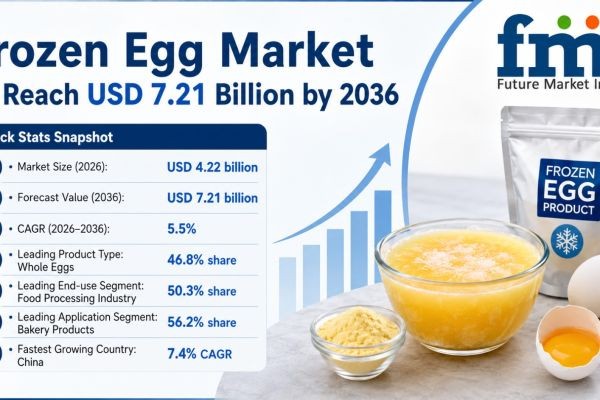
The global frozen egg market is experiencing steady expansion as food manufacturers, industrial bakeries, and foodservice operators transition from fresh shell eggs to pasteurized frozen egg inputs. Valued at USD 4.00 billion in 2025, the market is set to reach USD 4.22 billion in 2026 before ascending to USD 7.21 billion by 2036. According to latest insights by future market insights, this represents a solid 5.5% CAGR over the ten-year forecast period.
Request a Sample Report: https://www.futuremarketinsights.com/reports/sample/rep-gb-14338
The transition toward frozen liquid egg products is driven by stringent food safety standards, labor optimization needs, and the expansion of modern cold chain infrastructure. Frozen egg products undergo rigorous pasteurization, eliminating pathogen risks such as Salmonella, while providing industrial bakers and sauce manufacturers with consistent emulsification, foaming, and binding functionality across batch production runs.
Key Frozen Egg Market Highlights at a Glance
- Market Size (2026): USD 4.22 Billion
- Forecast Market Size (2036): USD 7.21 Billion
- Forecast Period: 2026–2036
- CAGR (2026–2036):5%
- Leading Product Segment: Whole Eggs (46.8% Market Share in 2026)
- Leading End-Use Segment: Food Processing Industry (50.3% Market Share in 2026)
- Leading Application Segment: Bakery Products (56.2% Market Share in 2026)
- Fastest-Growing Country: China (7.4% CAGR)
The frozen egg market is a supply chain maturity play where growth correlates directly with food processing industrialization and cold chain infrastructure development in emerging markets. In mature markets like the United States and Germany, frozen egg penetration is already high among industrial food processors, and growth comes from foodservice conversion and retail consumer adoption of frozen egg products. Nandini Roy Choudhury, Principal Consultant for Food & Beverage at Future Market Insights
Why Is the Frozen Egg Market Growing?
The acceleration of the frozen egg market is fueled by a confluence of supply chain modernization, labor cost optimization, and tightening food safety compliance frameworks.
Key Growth Drivers
- Industrial Food Processing Standardization: Large-scale industrial bakeries and sauce producers require standardized egg inputs with guaranteed protein functionality and zero batch-to-batch variability.
- Expansion of Cold Chain Infrastructure: Cold storage and refrigerated transport growth in emerging Asia-Pacific markets enable distribution to processing hubs previously reliant on shell eggs.
- Foodservice Efficiency & Labor Reduction: Commercial kitchens and restaurant chains adopt pre-portioned frozen eggs to lower preparation labor, reduce waste from shell breakage, and maintain HACCP compliance.
- Pasteurization & Pathogen Control: Compliance with international food hygiene regulations (such as USDA FSIS and EU Regulation No 853/2004) favors pasteurized, temperature-controlled liquid egg products.
Which Segments Lead the Market?
By Product Type
Whole Eggs command a dominant 46.8% market share in 2026. Frozen whole eggs serve as the most versatile, broadly applicable format across bakery, confectionery, and ready-meal production, delivering a natural balance of fats, proteins, and emulsifiers without requiring custom blend modifications.
By End-Use
The Food Processing Industry accounts for 50.3% of total end-use revenue in 2026. Industrial food manufacturers procure frozen egg products via long-term supply contracts specifying exact microbiological, protein, and emulsification metrics to support continuous automated production.
By Application
Bakery Products leads the application landscape with a 56.2% market share in 2026. Egg functionality specifically leavening in cakes, lamination in pastries, and structural binding in breads is irreplaceable, anchoring high-volume, recurring procurement.
Regional and Country Outlook
Emerging Asian economies are recording the fastest expansion rates as cold chain logistics scale across secondary and tertiary urban centers:
- China: Leads globally with a projected 4% CAGR through 2036, driven by massive industrialization across commercial bakery operations and expanding cold storage infrastructure.
- India: Follows with a 9% CAGR, supported by organized bakery sector growth, quick-service restaurant (QSR) expansion, and rising adoption of pasteurized ingredients.
- Germany: Forecast to grow at a 3% CAGR, backed by advanced industrial bakery infrastructure, leadership in organic/free-range egg processing, and strict EU food hygiene compliance.
- United States: Expected to post a 2% CAGR, driven by foodservice labor-shortage mitigation programs and clean-label cage-free product reformulation.
- United Kingdom: Projected at a 7% CAGR, supported by sandwich manufacturing, prepared meal production, and Lion Code food safety standards.
- Japan: Tracks at a 1% CAGR, supported by high-precision confectionery manufacturing, wagashi production, and stringent MHLW pasteurization requirements.
Competitive Landscape
The market is consolidating around vertically integrated egg producers, specialized processors with blast-freezing expertise, and global food ingredient suppliers providing custom functional specification blends.
Key Companies Profiled
- Ballas Egg
- Crystal Lake LLC
- Cargill Inc.
- Pace Farm
- Sonstegard Foods
- Michael Foods Inc.
- Rembrandt Enterprises
- Ovobest
- Bouwhuis Enthoven
- Igreca
Exclusive Discounts on Full Report: https://www.futuremarketinsights.com/reports/frozen-egg-market
Frequently Asked Questions
What is the global market size for frozen eggs in 2026 and 2036?
The global frozen egg market is valued at USD 4.22 billion in 2026 and is projected to reach USD 7.21 billion by 2036.
What is the anticipated Compound Annual Growth Rate (CAGR)?
The market is forecast to expand at a CAGR of 5.5% between 2026 and 2036.
Which product type leads global sales?
Frozen whole eggs account for a 46.8% share in 2026 due to their versatile functional applications across food manufacturing.
Which end-use industry holds the largest market share?
The Food Processing Industry leads with a 50.3% market share in 2026.
FMI Custom Research: Strategic Intelligence for Confident Decision-Making
In today's rapidly evolving business environment, leadership teams need more than market data they need clear, actionable intelligence tailored to their strategic objectives. FMI's Custom Research solutions are designed around the specific business questions organizations need answered, enabling executives to evaluate growth opportunities, validate investments, assess competitive dynamics.
Key Executive Benefits
- Decision-Ready Insights tailored to business priorities
- Reduced Strategic Risk through validated market intelligence
- Market Entry Confidence with detailed competitive analysis
- Competitive Advantage supported by proprietary research
- Faster Growth Decisions through customized strategic insights
- Primary Market Validation from industry stakeholders
- Global Industry Expertise across diverse sectors
- Proven Track Record with thousands of consulting engagements
Business Impact
FMI helps organizations transform market complexity into strategic clarity, enabling leadership teams to identify growth opportunities faster, optimize resource allocation, strengthen competitive positioning, and make high-stakes business decisions with confidence.
To explore how FMI Custom Research can support your strategic priorities, please connect with our team at - sales@futuremarketinsights.com






