
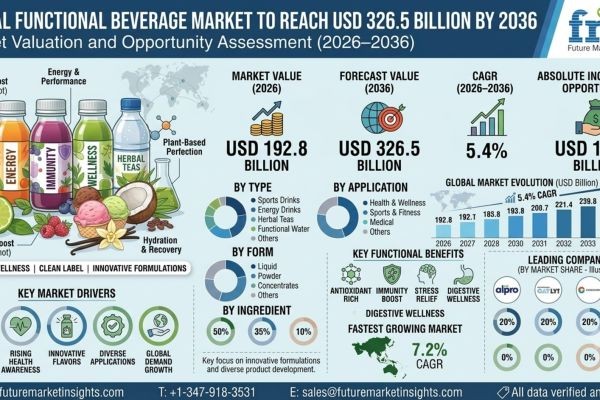
The global functional beverage market is undergoing a significant expansion, driven by accelerating consumer demand for preventive nutrition, digestive wellness, and convenient ready-to-drink (RTD) performance enhancement, according to latest insights by Future Market Insights. Driven by advancements in bioactive strain microencapsulation, clean-label formulation strategies, and widespread retail availability, functional drinks are securing high-volume integration across daily lifestyle routines.
The global market, valued at USD 192.8 billion in 2026, is projected to advance at a Compound Annual Growth Rate (CAGR) of 5.4% over the ten-year forecast period, achieving a total valuation of USD 326.5 billion by 2036, delivering an absolute incremental opportunity of USD 133.7 billion.
Get detailed market forecasts, competitive benchmarking, and pricing trends:
https://www.futuremarketinsights.com/reports/sample/rep-gb-103
Market Performance Overview (2026–2036)
To map out the primary product types, core active ingredients, and regional growth vectors guiding this USD 133.7 billion market scale-up, key segment allocations highlight where commercial demand is concentrated:
- Energy Drinks Product Segment (39.0% share): Commands product format preference in 2026, driven by high consumer demand for immediate mental focus, physical stamina, convenient distribution through convenience stores, and sustained energy delivery.
- Probiotics Active Ingredient Segment (30.0% share): Represents the primary active ingredient category, supported by extensive clinical validation of gut-brain axis benefits, microencapsulation technologies protecting live cultures during pasteurization, and consumer focus on gut microbiome health.
- Sports Drinks, Nutraceutical Beverages, Dairy-Based, & Enhanced Waters: Form secondary product pillars, catering to hydration, electrolyte replenishment, cognitive performance (nootropics), and daily protein needs.
- India & China Regional Leadership: Lead national growth rates at 1% CAGR and 6.2% CAGR respectively through 2036, driven by rapid urbanization, expanding middle-class disposable incomes, e-commerce retail networks, and government preventive healthcare initiatives.
Technical Drivers and Formulation Shifts
The commercialization of functional beverages across mass retail and specialty health channels is propelled by three primary industry catalysts:
Bioactive Strain Stabilization and Microencapsulation
Traditionally, adding delicate bioactives (like probiotic live cultures, enzymes, and sensitive vitamins) to liquid matrices caused rapid degradation over shelf life. Beverage formulators are utilizing microencapsulation and cap-dispensing technologies to shield live bacteria and vitamins from light, oxygen, and liquid moisture until consumption.
Clean-Label Transparency and Organic Sourcing
Consumers scrutinize ingredient panels, seeking functional drinks free of artificial colors, high-fructose corn syrup, and synthetic chemical preservatives. Brands are incorporating certified organic botanical extracts (green tea, adaptogenic roots), natural fruit juices, and plant-derived sweeteners (stevia, monk fruit).
AI-Driven Personalized Nutrition and Nootropic Integration
Beyond general hydration, the market is expanding into condition-specific functions. Formulators are blending adaptogens (ashwagandha, rhodiola) and nootropics (L-theanine, Alpha-GPC) into RTD teas and enhanced waters to target mental clarity, stress reduction, and sleep support.
Industrial Infrastructure & Distribution Dynamics
Beverage CPG brand owners and ingredient suppliers face specific operational and technical hurdles:
- Flavor-Masking at High Inclusion Rates: Concentrating functional minerals, botanical adaptogens, or amino acids in liquid beverages introduces astringency or bitterness, requiring advanced taste-masking systems and natural fruit acidity buffers.
- Cold-Chain vs. Ambient Shelf-Life Management: Live-culture probiotic beverages require continuous chilled logistics ($\text{2--4}^\circ\text{C}$) to guarantee Colony Forming Unit (CFU) counts at expiry, driving higher distribution and retail refrigeration costs compared to ambient shelf-stable drinks.
Regional Growth Profile
Regional demand reflects high-velocity adoption across emerging Asian markets alongside precision nutrition trends in Western economies:
- India (7.1% CAGR): The global growth frontrunner, driven by rising middle-class awareness of lifestyle diseases, expanding retail channels, and a cultural affinity for natural, holistic wellness ingredients.
- China (6.2% CAGR): Spurring rapid volume expansion through state dietary guidelines emphasizing wellness, expanding e-commerce distribution, and the blending of Traditional Chinese Medicine (TCM) botanicals into RTD drinks.
- Brazil (5.8% CAGR): Driven by high demand for sports nutrition, tropical superfood sourcing (guarana, acai), and strong outdoor exercise culture.
- Germany (5.3% CAGR) & United States (4.9% CAGR): Represent mature, high-value demand centers supported by sports nutrition integration, clean-label transparency mandates, and advanced corporate wellness programs.
- United Kingdom (4.7% CAGR): Expanding through NHS preventive nutrition frameworks, workplace wellness initiatives, and mental focus/cognitive drink launches.
Competitive Landscape
The global functional beverage landscape features a combination of multinational beverage conglomerates, global energy drink giants, and specialized functional wellness brands.
Key market participants profiled in the report include The Coca-Cola Company, PepsiCo, Red Bull, Monster Beverage Corporation, Nestlé S.A., Danone, Dr Pepper Snapple Group, GlaxoSmithKline, Keurig Dr Pepper, and Abbott Laboratories. Major CPG leaders compete by acquiring niche wellness beverage startups, investing in proprietary ingredient delivery systems, and expanding international distribution footprints.
Full Report for Detailed Insights: https://www.futuremarketinsights.com/reports/global-functional-beverages-market
Frequently Asked Questions
What is the projected valuation of the global functional beverage market by 2036?
The global functional beverage market is projected to reach USD 326.5 billion by 2036, expanding from an estimated baseline valuation of USD 192.8 billion in 2026 at a CAGR of 5.4%.
Why do Energy Drinks command a 39% market share?
Energy drinks lead the product category in 2026 because they provide immediate, targeted performance benefits (alertness, stamina) and benefit from established global distribution channels in convenience stores and supermarkets.
What ingredient category dominates functional beverage sales?
Probiotics lead the ingredient segment with a 30% market share in 2026, as clinically validated digestive and immune health claims drive widespread consumer adoption across fermented waters, dairy drinks, and functional juices.
FMI Custom Research: Strategic Intelligence for Confident Decision-Making
In today's rapidly evolving business environment, leadership teams need clear, actionable intelligence tailored to their strategic objectives. FMI's Custom Research solutions are designed around specific business questions, enabling executives to evaluate growth opportunities, validate investments, assess competitive dynamics, and reduce uncertainty before making critical decisions.
Key Executive Benefits
- Decision-Ready Insights: Research tailored to your specific business challenges, growth plans, and investment priorities.
- Reduced Strategic Risk: Validate market opportunities, customer demand, and competitive positioning before committing resources.
- Market Entry Confidence: Assess opportunity size, regulatory barriers, channel dynamics, and competitive landscapes with precision.
- Competitive Advantage: Gain proprietary intelligence unavailable through syndicated reports or internal datasets.
- Faster Growth Decisions: Accelerate expansion, product development, portfolio optimization, and investment planning.
- Primary Market Validation: Access real-world customer, buyer, and stakeholder insights that support high-confidence decision-making.
Business Impact
FMI helps organizations transform market complexity into strategic clarity, enabling leadership teams to identify growth opportunities faster, optimize resource allocation, strengthen competitive positioning, and make high-stakes business decisions with confidence.
To explore how FMI Custom Research can support your strategic priorities, connect with our team at - sales@futuremarketinsights.com
About Future Market Insights (FMI)
Future Market Insights (FMI) delivers actionable, decision-focused market intelligence that goes beyond traditional research reports. The company provides:
- In-depth pricing and cost benchmarking analysis
- Demand forecasting based on real industry inputs
- Procurement and buyer behavior insights
- Supply chain and trade flow intelligence
- Technology and application trend analysis across industries
FMI follows a robust bottom-up research methodology, combining insights from industry experts, procurement leaders, manufacturers, and technical professionals to ensure accurate and practical market intelligence.






