
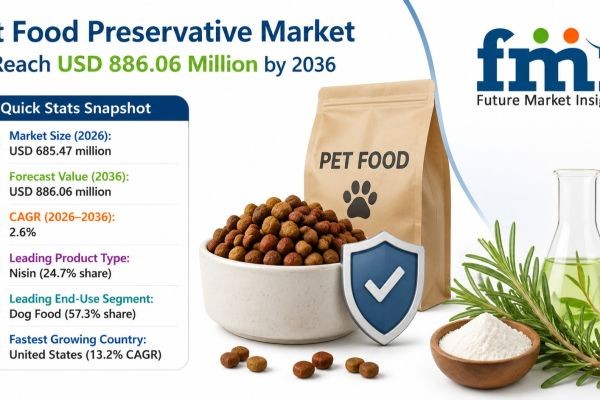
The global pet food preservative market is advancing steadily as antimicrobial and antioxidant ingredient systems become central to modern companion animal nutrition safety, according to latest insights by Future Market Insights. Driven by strict safety regulations across the FDA and European Union, expanding global export trade, and a widespread shift toward human-grade ingredient transparency, pet food manufacturers are aggressively updating their preservation toolkits.
The global market, valued at USD 667.64 million in 2025, is projected to reach USD 685.47 million in 2026. Expanding at a Compound Annual Growth Rate (CAGR) of 2.6% over the ten-year forecast period, total market valuation is anticipated to hit USD 886.06 million by 2036, yielding an absolute incremental revenue opportunity of USD 200.59 million.
Request a Sample Report: https://www.futuremarketinsights.com/reports/sample/rep-gb-19358
Market Performance Overview (2026–2036)
To understand the primary ingredient types and application sectors guiding this USD 200.59 million market scale-up, an analysis of leading segment allocations highlights where global demand is concentrated:
- Nisin Product Type (24.7% share): Commands the product category in 2026. As a naturally derived bacteriocin, nisin provides robust antimicrobial protection while satisfying the clean-label claims increasingly demanded by premium pet owners.
- Dog Food End-Use Application (57.3% share): Dominates end-use applications, driven by high global manufacturing volumes across dry kibble, wet cans/pouches, and semi-moist treat formats compared to feline products.
- USA Geographic Leadership (13.2% CAGR): Outpaces global growth as the world's largest premium pet food market, accelerating the replacement of synthetic preservatives with natural antioxidant and antimicrobial systems.
Technical Drivers and Sourcing Dynamics
The integration of advanced preservation systems across commercial pet food processing is propelled by three primary industry catalysts:
Clean-Label & Human-Grade Ingredient Shift
Pet humanization has shifted consumer scrutiny directly onto ingredient decks. Premium pet food brand owners are phasing out artificial synthetic preservatives (like BHA, BHT, and ethoxyquin) in favor of naturally derived alternatives such as nisin, natamycin, organic acid blends, and botanical extracts (e.g., rosemary and tocopherols).
Global Export Trade & Multi-Jurisdiction Compliance
As international trade in commercial pet food expands, products face varying storage temperatures, humidity levels, and transit timelines. To guarantee shelf stability without lipid oxidation (fat rancidity) or pathogen contamination (Salmonella, mold, yeast), manufacturers require validated preservation systems that comply with global regulatory frameworks.
Formulated Product Safety Mandates
Pet food safety recalls cause severe financial and brand damage. Both dry kibble (susceptible to fat oxidation over long shelf cycles) and high-moisture wet or semi-moist foods (prone to microbial degradation) require precise, matrix-specific preservative dosing to maintain nutritional integrity from factory floor to feeding bowl.
Industrial Infrastructure & Formulation Hurdles
Preservative suppliers and pet food processing engineers face distinct operational constraints:
- Thermal & Processing Stability: Natural preservatives and delicate botanical extracts often exhibit higher heat sensitivity during high-shear extrusion or retort canning, requiring precise encapsulation or post-extrusion application to prevent activity loss.
- Cost & Availability vs. Synthetic Parity: Sourcing certified organic or high-purity natural extracts carries higher raw material costs compared to legacy synthetic chemicals, forcing procurement teams to balance shelf-life targets against formula cost thresholds.
Regional Growth Outlook
The geographic analysis highlights rapid adoption across high-value premium markets alongside expanding organized manufacturing hubs:
- United States (13.2% CAGR): The global growth frontrunner, driven by a massive pet population, high per-capita spending on human-grade pet care, and extensive brand reformulation programs.
- China (12.8% CAGR): Spurring rapid volume expansion as domestic pet ownership surges and organized commercial manufacturing replaces traditional or informal feeding practices.
- Germany (9.6% CAGR): Leading European market demand under strict EU feed additive standards, where consumer preference for organic, non-GMO, and clean-label pet food is deeply entrenched.
- Japan (4.9% CAGR): Supported by a long-standing cultural affinity for pets, rigorous quality control standards, and high demand for specialized senior pet and small-breed nutrition.
- Australia & New Zealand (3.2% CAGR): Anchored by strong regional export operations in premium freeze-dried treats and raw/natural pet foods requiring specialized natural preservation.
Competitive Landscape
The global pet food preservative landscape features a combination of major multinational chemical and biosolutions corporations, specialized animal nutrition houses, and natural ingredient suppliers. Companies compete on technical matrix validation, regulatory filing capabilities, and application-specific liquid/powder delivery formats.
Prominent market participants include BASF SE, Kemin Industries, Inc., Kerry Inc., Cargill, Incorporated, E.I. DuPont de Nemours and Company, DSM Nutritional Products, Camlin Fine Sciences Ltd., Balchem Inc., Bentoli, Caldic B.V., Altrafine Gums, Bill Barr & Company, and Trouw Nutrition USA. Leading manufacturers are actively investing in validated efficacy data packages for dry versus wet matrices and multi-jurisdiction regulatory filings to support global brand exports.
Exclusive Discounts on Full Report: https://www.futuremarketinsights.com/reports/pet-food-preservative-market
Frequently Asked Questions
What is the projected valuation of the global market by 2036?
The global pet food preservative market is projected to reach USD 886.06 million by 2036, expanding from an estimated baseline valuation of USD 685.47 million in 2026 at a CAGR of 2.6%.
Why does Nisin lead the Product Type segment?
Nisin commands a 24.7% market share because it functions as an effective natural antimicrobial bacteriocin, allowing manufacturers to achieve reliable pathogen control while maintaining clean-label claims on product packaging.
What exclusions govern the boundaries of this market report?
The scope strictly limits its focus to active antimicrobial and antioxidant preservative inputs sold to commercial pet food manufacturers, explicitly excluding human-grade food preservatives sold into non-pet channels, standalone packaging barrier materials, veterinary prescription pharmaceuticals, and general dietary supplements without preservation functionality.






