
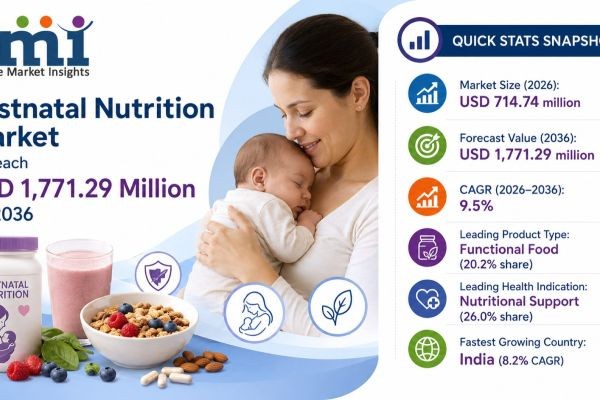
The global postnatal nutrition market is transitioning from an informal dietary practice into a structured, medically backed category, according to latest insights by Future Market Insights. Driven by clinical recognition of post-pregnancy nutrient depletion, lactation-driven metabolic stress, and postpartum mood regulation, healthcare professionals are increasingly prescribing targeted supplementation protocols for new mothers. The global industry, valued at USD 652.73 million in 2025, is projected to reach USD 2,714.7 million in 2026. Advancing at a rapid Compound Annual Growth Rate (CAGR) of 9.5% over the ten-year forecast period, total market valuation is anticipated to hit USD 6,771.2 million by 2036, opening an absolute incremental opportunity of USD 4,056.5 million.
Request a Sample Report: https://www.futuremarketinsights.com/reports/sample/rep-gb-19811
Market Performance Overview (2026–2036)
To understand the primary product formats, health indications, and sales channels driving this USD 4.06 billion market scale-up, an analysis of leading segment allocations highlights where global demand is concentrated:
- Functional Food Product Type (20.2% share): Leads the product category in 2026, driven by consumer preference for convenient, on-the-go nutrient delivery via fortified snack bars, protein-enriched biscuits, and meal replacement shakes.
- Nutritional Support Health Indication (26.0% share): Commands the primary health indication framework, serving as the broad base covering general post-pregnancy micronutrient replenishment (folate, iron, calcium, and B-vitamins).
- Targeted Indication Growth: Sub-segments addressing specific conditions including iron replenishment (combating postpartum anemia), milk production enhancement (galactagogue blends with fenugreek and brewer's yeast), and brain health/mood support (DHA, EPA, and choline for mental well-being) are expanding at higher growth rates.
Technical Drivers and Formulation Innovation
The integration of specialized postnatal products across clinical and consumer wellness corridors is propelled by three primary industry catalysts:
Clinical Evidence of Maternal Nutrient Depletion
Postpartum women face acute depletion of vital nutrients such as iron, calcium, magnesium, zinc, and omega-3 fatty acids to support breast milk synthesis and physical recovery. Obstetricians and midwives are establishing evidence-based postnatal supplementation protocols, making nutritional restoration a formal extension of prenatal care.
Commercialization of Galactagogue & Lactation Formulations
Breast milk supply remains a primary functional concern for nursing mothers. Formulators are pairing traditional galactagogues (fenugreek, blessed thistle, brewer's yeast) with essential vitamins in accessible, clean-label formats such as lactation teas, cookies, and ready-to-drink (RTD) smoothies.
Mental Well-Being, Mood Support, and Brain Health
Rising awareness surrounding postpartum depression and cognitive fatigue ("mom brain") is driving demand for brain health and mood-balancing nutrients. Including high-dose algal DHA, EPA, choline, and adaptogens targets both cognitive health for mothers and neurodevelopmental benefits passed to infants through breast milk.
Industrial Infrastructure & Formulation Constraints
Maternal health brands and contract manufacturers must navigate specific operational hurdles:
- Clean Label & Allergen Standards: New mothers demonstrate high sensitivity toward ingredient purity. Formulating without artificial sweeteners, synthetic additives, or common allergens while sourcing grass-fed dairy proteins and organic botanicals increases raw material sourcing costs.
- Flavor-Masking Complexities in Fortified Foods: Incorporating high concentrations of iron, omega-3 oils, and bitter botanical extracts (such as fenugreek) into functional snacks or beverages without compromising palatability requires advanced microencapsulation and flavor-modulation techniques.
Regional Growth Outlook
The geographic analysis reflects rapid market acceleration across emerging Asian economies alongside steady, recommendation-led growth in Western markets:
- India (8.2% CAGR): The global growth frontrunner, propelled by a high national birth rate, rising urban middle-class disposable income, and the modernization of traditional postpartum confinement food practices into packaged, branded products.
- United States (5.6% CAGR): Sourcing a large baseline volume footprint (projected to represent 23.6% of global sales by 2036), driven by high physician recommendation rates, e-commerce subscription models, and focused demand for postpartum mental health and vitamin D support.
- Japan (5.6% CAGR): Characterized by strong maternal health supplement categories, high willingness-to-pay for premium clinical nutrition, and physician-guided recovery protocols.
- China (4.3% CAGR): Driven by expanding organized maternity care centers, rising urban consumer spending on premium functional foods, and digital cross-border health procurement.
- Germany (4.2% CAGR): Supported by strict EU clean-label health claim compliance, strong pharmacy-led distribution networks, and innovative launches in RTD recovery beverages and fortified snacks.
Competitive Landscape
The postnatal nutrition market features a strategic balance between multinational clinical nutrition giants and specialized, regional direct-to-consumer (DTC) maternal health labels. Global players leverage extensive research and development alongside pharmacy distribution networks, while agile local brands focus on clean-label, organic, and localized ingredient formulations.
Leading companies operating in the global market include Nestlé (Materna), Abbott Laboratories (Similac), Danone, GlaxoSmithKline (Pregnacare), Mead Johnson Nutrition, Procter & Gamble, BioCare Copenhagen, Vitabiotics, Evonik Industries, Herbalife Nutrition, The Honest Company, New Chapter, Enfamil, Ortho Molecular Products, and Garden of Life.
Exclusive Discounts on Full Report: https://www.futuremarketinsights.com/reports/postnatal-nutrition-market
Frequently Asked Questions
What is the projected valuation of the global market by 2036?
The global postnatal nutrition market is projected to reach USD 6,771.2 million by 2036, expanding from an estimated baseline valuation of USD 2,714.7 million in 2026 at a CAGR of 9.5%.
Why does Nutritional Support command the largest health indication share?
Nutritional Support holds a 26.0% share because general micronutrient replenishment addresses universal postpartum depletion experienced by virtually all new mothers following childbirth.
What exclusions govern the boundaries of this market report?
The scope strictly limits its focus to maternal postnatal nutrition products, explicitly excluding prenatal nutrition formulated for pregnancy, infant formulas and baby foods, and general non-targeted women's health supplements.






