
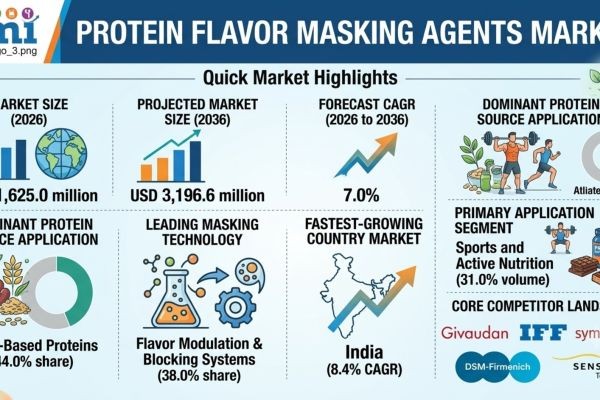
The global protein flavor masking agents market is developing into a vital, highly specialized branch of the functional taste modulation industry. Valued at USD 1,625.0 million in 2026, the market is projected to climb to USD 3,196.6 million by 2036, sustaining a steady compound annual growth rate (CAGR) of 7.0%.
This growth highlights an essential reality in modern food science: as brands push protein concentrations higher to satisfy active lifestyle consumer trends, they hit a major sensory bottleneck. Pure protein isolates and concentrates introduce unpleasant earthy, bitter, beany, and sulfurous notes. Because traditional sweeteners cannot fully hide these complex off-notes, targeted flavor masking agents have become mandatory formulation insurance for high-volume consumer packaged goods (CPG) brands.
Request a Sample Report: https://www.futuremarketinsights.com/reports/sample/rep-gb-31469
Quick Market Highlights
- Market Size (2026): USD 1,625.0 million
- Projected Market Size (2036): USD 3,196.6 million
- Forecast CAGR (2026 to 2036):0%
- Dominant Protein Source Application: Plant-Based Proteins capturing a 44.0% market share
- Leading Masking Technology: Flavor Modulation and Blocking Systems commanding a 38.0% share
- Primary Application Segment: Sports and Active Nutrition accounting for 31.0% of volume
- Fastest-Growing Country Market: India, advancing at an impressive 8.4% CAGR
- Core Competitor Landscape: Givaudan, IFF, Symrise, DSM-Firmenich, Sensient Technologies
Overcoming the Bitterness Barrier in Better-for-You Reformulations
The massive surge in global protein consumption brings substantial taste challenges. Whether dealing with dairy-derived whey isolates or increasingly popular plant alternatives like pea, soy, or fava bean, increasing the protein load changes the product's natural taste profile. For example, plant proteins routinely release unpalatable green, beany notes, while whey processing often leaves behind a metallic, cooked-milk or slightly sulfuric aftertaste.
Modern flavor masking agents do not simply cover up these flavors with heavy top-note perfumes. Instead, they operate through precision biochemical and physical mechanisms often blocking bitter taste receptors on the human tongue or binding directly with off-flavor volatile molecules before they can escape. This technology is especially vital in modern low-sugar or zero-sugar formats. Without structural sugar bulk to naturally soften harsh edges, protein off-notes become starkly exposed, making high-performance masking agents the only way to safeguard consumer enjoyment and secure repeat brand sales.
Protein Sources: Plant-Based Alternatives Demand the Most Intensive Masking
The specific flavor defects manufacturers must target vary significantly across different raw protein bases:
- Plant-Based Proteins (44.0% Share): The largest segment by far. Plant isolates (pea, soy, pulse) carry complex, persistent earthy and beany profiles that require advanced, multi-layered masking systems to achieve consumer-accepted neutrality.
- Dairy Proteins (26.0% Share): Primarily focused on neutralizing bitter fractions, astringent heat defects, and cooked notes in concentrated whey and casein products.
- Animal Proteins (17.0% Share): Deployed across clinical feeds, savory bone broths, and collagen-infused products to smooth out distinct metallic or heavy mineral basenotes.
- Fermentation-Derived Proteins (13.0% Share): An emerging sector targeting the unique, deeply savory, or mushroom-like flavor attributes introduced by precision-fermented and mycoprotein ingredients.
Receptor-Level Modification Steers Key Masking Technologies
When categorized by the underlying technology used to repair taste profiles, Flavor Modulation and Blocking Systems lead the industry with a 38.0% share. These versatile systems act on human taste pathways to broadly lower off-note perception without introducing unwanted sweetness or synthetic aromatic notes.
Encapsulation-Based Masking controls 27.0% of the market, physical isolating bitter elements inside microscopic protective barriers that only break apart during chewing or swallowing. Bitterness Suppressors hold 21.0%, delivering highly targeted, molecule-specific locking mechanisms directly to the tongue's bitter taste receptors. Aroma-Based Masking accounts for the remaining 14.0%, leveraging pleasant, highly compatible top-note profiles to creatively direct the consumer's taste perception away from underlying processing notes.
Custom Research Available: https://www.futuremarketinsights.com/customization-available/rep-gb-31104
Sports Nutrition and Dairy Alternatives Lead Commercial Adoption
The deployment of taste-masking technologies is heavily focused on functional, active-lifestyle categories where flavor neutrality directly determines market survival:
- Sports and Active Nutrition (31.0% Share): The dominant demand sector, covering high-protein lifestyle powders, ready-to-mix muscle builders, and performance drinks.
- Plant-Based Dairy Alternatives (24.0% Share): Highly reliant on masking systems to provide clean, mild bases for oat, almond, and soy milks, ensuring they mimic traditional milk's easy-drinking profile.
- Protein Beverages and Ready-to-Drink (RTD) Shakes (21.0% Share): Driven by the technical requirement for clean flavor release under extreme ultra-high temperature (UHT) factory pasteurization.
- Bakery and Nutrition Bars (14.0% Share): Utilized to neutralize the dry, floury, and chalky aftertaste common in high-density meal replacement and protein snack bars.
- Medical and Clinical Nutrition (10.0% Share): Highly important for improving patient compliance by making concentrated, life-sustaining medical nutrition liquids taste appealing.
Processing Integrity Constraints and Clean-Label Scrutiny Slow Growth
While market fundamentals are exceptionally strong, flavor masking technologies operate under strict application boundaries. A major challenge involves survival through extreme manufacturing environments. Certain enzymatic and aroma-based masking systems can degrade when subjected to the intense heat and mechanical pressure of high-moisture twin-screw cooking or long thermal spray-drying cycles, forcing manufacturers to find innovative ways to preserve ingredient performance.
Furthermore, changing global clean-label policies introduce ongoing reformulation pressures. Modern health-conscious buyers look closely at ingredient labels, showing a clear preference for items marked as "Natural Flavor" rather than synthetic Chemical Blockers. Meeting these clean-label standards while managing the higher costs of multi-component, natural masking mixtures presents an ongoing puzzle for global R&D teams working on tight budgets.
Regional Development: Nutrient Taxes and Fortification Shifts Accelerate Sales
Geographic market performance shows distinct, localized trends influenced by regional tastes and shifting consumer eating behaviors:
- India (8.4% CAGR): Leading the growth pipeline as urban consumers actively embrace a wider variety of plant-protein health shakes, fortified foods, and clinical nutrition drinks.
- China (8.1% CAGR): Driven by large-scale beverage manufacturing centers that rely on dependable, cost-efficient masking agents to standardize flavor outcomes across huge production runs.
- Brazil (7.7% CAGR): Sparked by new nutritional label warnings, pushing developers to reduce sugars and use masking agents to hide resulting protein off-notes in tropical-themed wellness beverages.
- United States (6.4% CAGR): Advancing through a mature, highly technical sports nutrition and alternative dairy ecosystem that demands non-GMO, clean-label flavor modulators.
- United Kingdom (6.0% CAGR): Heavily influenced by national health guidelines and strict grocery chain standards, encouraging brands to focus on flavor neutrality in everyday meal-replacement options.
Global Flavor Science Leaders Pivot Toward Specialized Co-Development
The global protein flavor masking agents market is highly consolidated, with market activity led by tier-one global flavor and fragrance houses: Givaudan, IFF, Symrise, DSM-Firmenich, and Sensient Technologies.
Competitive strategies have shifted away from supplying generic, off-the-shelf maskers. Because an agent that works perfectly for a soy isolate might fail completely when added to a pea or whey matrix, these companies operate as collaborative tech partners. They combine analytical aroma mapping, trained sensory panel evaluations, and cross-ingredient compatibility studies to deliver highly customized, protein-specific taste solutions that help brands bring palatable products to market efficiently.
Exclusive Discounts on Full Report: https://www.futuremarketinsights.com/reports/protein-flavor-masking-agents-market
Strategic Outlook
The global protein flavor masking agents market has cemented its status as an indispensable enabler of nutritional innovation. By systematically resolving the core taste challenges of high-density protein formulations, these targeted modulation systems allow food scientists to confidently push nutritional boundaries. Moving forward, the highest financial rewards will go to flavor houses that engineer highly stable, low-dosage, natural masking systems that preserve pristine flavor clarity across multiple plant and fermentation-derived protein platforms.
Executive Takeaways
- The global protein flavor masking agents market is on track to hit USD 3,196.6 million by 2036, maintaining a steady 7.0% CAGR.
- Plant-based protein applications represent the primary demand segment, claiming 44.0% of the market due to the intense earthy notes found in plant alternatives.
- Flavor Modulation and Blocking Systems lead the technology space with a 38.0% share, favored for their ability to suppress bitterness at the tongue's receptor level.
- Sports and active nutrition products continue to serve as the primary retail channel, commanding 31.0% of total industry volume.
- India represents the fastest-growing market hub globally, expanding at an 8.4% CAGR as premium protein fortification crosses into mainstream foods.
- Ingredient sourcing is heavily focused on processing-resilient, clean-label masking solutions that can survive high-heat environments without altering product textures.
Why Choose FMI: https://www.futuremarketinsights.com/why-fmi
Explore More Related Studies Published by FMI Research
Demand for Taurine in EU: https://www.einpresswire.com/article/903331217/eu-taurine-market-outlook-hits-usd-145-73-million-by-2036-ajinomoto-kyowa-hakko-qianjiang-lead-growth
Compound Chocolate Market : https://www.openpr.com/news/4532795/soy-beverage-market-to-reach-usd-47-28-billion-by-2036-as-global
Oat Protein Market : https://www.openpr.com/news/4532798/oat-protein-market-to-reach-usd-98-15-million-by-2036-as-demand
Explore In-Depth Food & Beverage Market Insights : https://www.futuremarketinsights.com/industry-analysis/food-and-beverage
About Future Market Insights (FMI)
Future Market Insights, Inc. (FMI) is an ESOMAR-certified, ISO 9001:2015 market research and consulting organization trusted by global enterprises and Fortune 500 companies. FMI delivers actionable market intelligence, competitive benchmarking, and strategic insights across more than 30 industries and 1,200 markets worldwide.
Contact Us
Future Market Insights Inc.
Christiana Corporate, 200 Continental Drive,
Suite 401, Newark, Delaware - 19713, USA
T: +1-347-918-3531
For Sales Enquiries: sales@futuremarketinsights.com
Website: https://www.futuremarketinsights.com






