
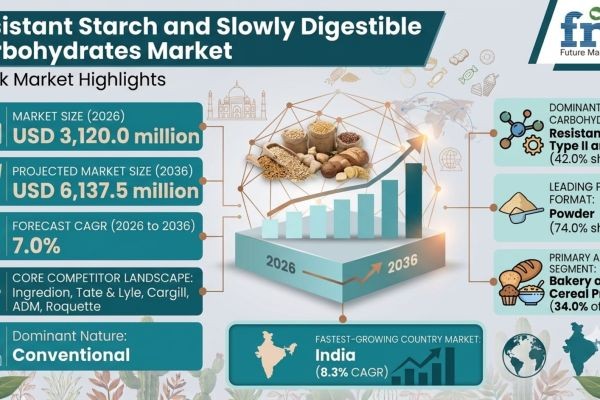
The global resistant starch and slowly digestible carbohydrates market is experiencing robust growth as the food and beverage industry adapts to escalating demands for metabolic health solutions. Valued at USD 3,120.0 million in 2026, the market is forecasted to scale to USD 6,137.5 million by 2036, expanding at a steady compound annual growth rate (CAGR) of 7.0%.
This development marks a definitive structural evolution away from rapidly digestible, high-glycemic starches. Modern ingredient technology is pivoting toward specialized carbohydrate networks that deliver a controlled, prolonged release of glucose into the bloodstream, preserving consumer metabolic balance and providing sustained energy without forcing product developers to compromise on structural texture or taste.
Request a Sample Report: https://www.futuremarketinsights.com/reports/sample/rep-gb-31475
Quick Market Highlights
- Market Size (2026): USD 3,120.0 million
- Projected Market Size (2036): USD 6,137.5 million
- Forecast CAGR (2026 to 2036):0%
- Dominant Carbohydrate Type: Resistant Starch Type II and III capturing a 42.0% market share
- Leading Physical Format: Powder formats commanding a 74.0% share
- Primary Application Segment: Bakery and Cereal Products accounting for 34.0% of volume
- Fastest-Growing Country Market: India, advancing at an impressive 8.3% CAGR
- Core Competitor Landscape: Ingredion, Tate & Lyle, Cargill, ADM, Roquette
Balancing Postprandial Glucose Responses to Power Health and Wellness Portfolios
As modern lifestyle changes increase the global prevalence of metabolic conditions like diabetes and obesity, consumers are actively seeking functional foods that provide a low glycemic index alongside prolonged satiety. Conventional starches break down rapidly in the upper digestive system, causing sharp spikes in blood glucose. Resistant starches and slowly digestible alternatives function entirely differently: they actively withstand standard enzymatic breakdown, slowing down digestion kinetics or arriving intact in the colon to serve as highly effective prebiotics.
For food formulators, these functional carbohydrates act as highly reliable, clean-label sugar and fat replacers. They exhibit excellent process stability under extreme thermal baking and high-shear extrusion conditions, enabling commercial producers to lower total available carbohydrate loads in mainstream products while seamlessly preserving crumb structure, moisture control, and premium mouthfeel.
Carbohydrate Categorization: Natural and Highly Tolerant Systems Lead the Industry
The commercial deployment of metabolic carbohydrate networks relies on specialized ingredient classes tailored to specific structural and digestion profiles:
- Resistant Starch Type II and III (42.0% Share): Establishes the largest segment in global demand. Backed by extensive clinical data highlighting superior gut microbiome support and postprandial glucose moderation, these naturally derived starch systems are highly preferred for clean-label applications.
- Slowly Digestible Starch (24.0% Share): Broadly chosen by formulators to deliver stable, long-lasting energy release curves in daily health products, effectively avoiding the "crash" linked to simple sugars.
- Resistant Starch Type IV (18.0% Share): A chemically modified variation engineered for specialized high-temperature manufacturing environments, offering extreme functional versatility across complex food matrices.
- Slowly Digestible Sugars and Oligosaccharides (16.0% Share): Deployed primarily where product specifications require a delicate balance of functional sweetness alongside controlled digestive properties.
Industrial Flow Compatibility Positions Powder as the Leading Format
From a physical processing standpoint, Powder formats dominate the market structure with a commanding 74.0% share. Industrial processors prioritize dry powders due to their effortless integration into automated dry-blending systems, accurate dosing capabilities, and reliable shelf-life stability under ambient warehouse conditions.
Granular formats represent 16.0% of the industry, specified where manufacturers require distinct particulate inclusions or physical crunch, such as in cluster granolas and multi-grain breakfast cereals. Liquid configurations hold the remaining 10.0% share, utilized almost exclusively in ready-to-drink functional beverages, infant formulas, and specialized clinical medical nutrition tubes where rapid, uniform liquid dispersion is non-negotiable.
Custom Research Available: https://www.futuremarketinsights.com/customization-available/rep-gb-31104
Staple Foods Drive High-Volume Ingredient Integration
The deployment of slowly digestible carbohydrates is concentrated in staple retail categories requiring comprehensive nutritional optimization:
- Bakery and Cereal Products (34.0% Share): Remains the primary application engine as commercial bakeries aggressively reformulate pan breads, tortillas, crackers, and breakfast cereals to deliver higher fiber claims and reduced glycemic impacts.
- Dairy and Dairy Alternatives (21.0% Share): Utilized to build up rich texture and mouthfeel in low-sugar yogurts, frozen desserts, and plant-based milk alternatives without increasing the available carbohydrate load.
- Beverages and Drink Mixes (17.0% Share): Heavily relied upon in sports hydration formulas and nutritional drink mixes to supply sustained stamina while maintaining low viscosity.
- Processed and Convenience Foods (16.0% Share): Integrated into frozen meals and shelf-stable packaged snacks to replace basic starches with health-forward, slow-release alternatives.
- Nutrition and Medical Foods (12.0% Share): Formulated deep into diabetic meal options, enteral nutrition, and geriatric formulas where absolute glucose control is critical.
Shear Vulnerability and Labeling Complexities Limit Broad Scale Adoption
Despite favorable tailwinds, the global market faces explicit processing and regulatory boundaries. Specific varieties of natural resistant starches are inherently vulnerable to high thermal shear or intense mechanical friction. If processed incorrectly, they lose their crystalline integrity, converting back into rapidly available carbohydrates and neutralizing intended health claims.
Furthermore, navigating regional regulatory frameworks poses a significant challenge. Global brands frequently encounter differing classification guidelines regarding how resistant starches count toward official dietary fiber metrics versus active carbohydrate loads, extending product validation timelines and complicating international marketing rollouts.
Global Regional Vectors: Urbanization and Age-Specific Formulations
Geographic deployment shows distinct, localized market drivers across primary growth hubs:
- India (8.3% CAGR): Leads global expansion as domestic food brands target the country's surging diabetic population with fortified staple flours, low-glycemic breakfast foods, and localized medical nutrition lines.
- China (8.0% CAGR): Driven forward by national healthy aging initiatives, forcing large-scale processors to utilize slow-release carbohydrates in specialized elderly nutrition and hospital clinical foods.
- Brazil (7.6% CAGR): Prompted by modern front-of-pack nutritional labeling rules, driving massive sugar-reduction and carbohydrate-rebalancing programs across mass-market beverage portfolios.
- United States (6.4% CAGR): Advancing rapidly due to mainstream wellness diets, clean-label verification standards, and aggressive product differentiation in high-protein nutrition bars and active sports lines.
- United Kingdom (6.2% CAGR): Strongly focused on retail-driven compliance strategies, swapping out simple starches in everyday bread and cereal formulations to align with national healthy weight and glycemic control guidelines.
Tier-One Ingredient Specialists Forge Collaborative Technical Alliances
The international market is characterized by consolidated supply chains managed by elite multi-national texturizing firms, notably Ingredion, Tate & Lyle, Cargill, ADM, and Roquette.
To anchor long-term supply agreements, these market leaders are shifting away from basic ingredient distribution. Instead, they are positioning themselves as complete co-development partners, providing proprietary clinical trial validation data, advanced rheology modeling, and specialized application test lines to accelerate development cycles for global consumer packaged goods (CPG) brands.
Exclusive Discounts on Full Report: https://www.futuremarketinsights.com/reports/resistant-starch-and-slowly-digestible-carbohydrates-market
Strategic Outlook
The resistant starch and slowly digestible carbohydrates market is successfully transforming from a premium niche supplement into an essential structural tool for the global food sector. By effectively bridging the gap between metabolic wellness requirements and high-efficiency industrial processing, these ingredients offer a viable path forward for large-scale dietary reformulation. Moving forward, the most competitive market players will be those who can optimize starch structures against thermal processing breakdown, protecting physiological slow-release properties even in high-throughput manufacturing lines.
Executive Takeaways
- The global resistant starch and slowly digestible carbohydrates market is on track to hit USD 6,137.5 million by 2036, maintaining a steady 7.0% CAGR.
- Type II and III resistant starches remain the absolute category leader with a 42.0% market share, valued for their premium natural labeling status and clinical validity.
- Industrial powder formats account for 74.0% of the market, offering optimal blend uniformity and dosing accuracy in large-scale food plants.
- Bakery and cereal products represent the largest volume consumer, driving 34.0% of application demand via healthier carbohydrate redesigns.
- India represents the fastest-growing geographical market, expanding at an 8.3% CAGR due to widespread consumer focus on diabetes management and glycemic control.
- Procurement priorities are moving rapidly toward verified digestion kinetics and high process stability, forcing suppliers to innovate beyond simple, unrefined commodity starches.
Why Choose FMI: https://www.futuremarketinsights.com/why-fmi
Explore More Related Studies Published by FMI Research
Demand for Water Flavouring Drops in EU : https://www.einpresswire.com/article/903336654/eu-water-flavouring-drops-market-to-reach-usd-15-68b-by-2036-global-growth-led-by-waterdrop-coca-cola-nestl
Mushroom Fermenter Market : https://www.openpr.com/news/4529753/mushroom-fermenter-market-to-reach-usd-2-91-billion-by-2036-as
Drum to Hopper Blends Market : https://www.openpr.com/news/4530938/drum-to-hopper-blends-market-to-reach-usd-1-637-73-million-by-2036
Explore In-Depth Food & Beverage Market Insights : https://www.futuremarketinsights.com/industry-analysis/food-and-beverage
About Future Market Insights (FMI)
Future Market Insights, Inc. (FMI) is an ESOMAR-certified, ISO 9001:2015 market research and consulting organization trusted by global enterprises and Fortune 500 companies. FMI delivers actionable market intelligence, competitive benchmarking, and strategic insights across more than 30 industries and 1,200 markets worldwide.
Contact Us
Future Market Insights Inc.
Christiana Corporate, 200 Continental Drive,
Suite 401, Newark, Delaware - 19713, USA
T: +1-347-918-3531
For Sales Enquiries: sales@futuremarketinsights.com
Website: https://www.futuremarketinsights.com






