
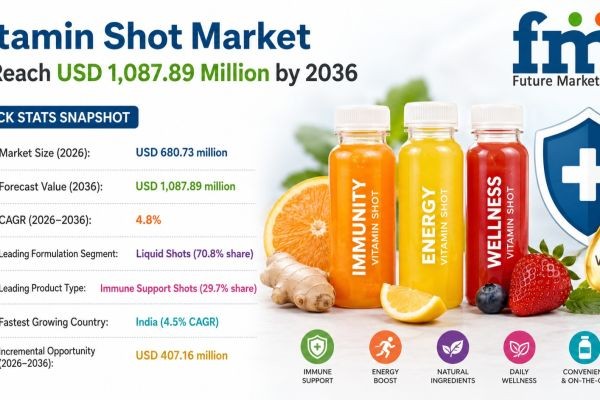
The global vitamin shot market is undergoing a steady commercial evolution, as consumers increasingly migrate away from traditional tablet and pill-based dietary supplements toward convenient, high-bioavailability liquid formats, according to latest insights by Future Market Insights. Driven by busy urban lifestyles, growing preventive healthcare spending, and heightened interest in rapid micronutrient absorption, single-serve concentrated vitamin shots are securing dedicated shelf space across mass retail, pharmacy chains, and digital storefronts. The global market, valued at USD 649.55 million in 2025, is projected to reach USD 680.73 million in 2026. Advancing at a Compound Annual Growth Rate (CAGR) of 4.8% over the ten-year forecast period, total industry valuation is anticipated to reach USD 1,087.89 million by 2036, yielding an absolute incremental opportunity of USD 407.16 million.
Request a Sample Report: https://www.futuremarketinsights.com/reports/sample/rep-gb-19341
Market Performance Overview (2026–2036)
To understand the core formulation types, functional benefits, and sales avenues guiding this USD 407.16 million market scale-up, an analysis of leading segment allocations highlights where global demand is concentrated:
- Liquid Shots Formulation (70.8% share): Commands the majority of the market in 2026, reflecting strong consumer preference for ready-to-consume, no-preparation formats that provide faster oral absorption than solid pills or capsules.
- Immune Support Shots Product Type (29.7% share): Represents the top-performing application area in 2026, driven by sustained post-pandemic consumer demand for vitamin C, vitamin D, and zinc-infused immunity formulations.
- Preventive Healthcare & Energy Boost Applications: Drive rapid volume growth among active 30-to-49-year-old demographics seeking clean-label vitality, B-complex energy enhancement, and athletic recovery support.
Technical Drivers and Regulatory Innovation
The integration of vitamin shot products across health, wellness, and retail corridors is propelled by three primary industry catalysts:
On-the-Go Rapid Absorption Mechanics
Modern consumers with time-constrained schedules are prioritizing "pill-free" supplementation alternatives. Single-serve liquid shots deliver pre-measured, high-potency micronutrient payloads directly to the oral mucosa and digestive tract, optimizing bioavailability while offering unmatched portability.
Tightening Global Regulatory Oversight
Regulatory scrutiny regarding functional beverage claims is escalating globally. The FDA's restructured Human Foods Program in the United States and the EU's Directive 2002/46/EC amendments (authorizing novel vitamin sources like calcidiol monohydrate) require manufacturers to invest in clinically validated dosing, clean-label sourcing, and transparent third-party testing credentials to secure vendor placement.
Convergence with Functional Wellness & Bioactives
Formulators are expanding beyond basic single-vitamin shots by blending vitamins (B12, C, D3, E) with functional botanicals, antioxidants, adaptogens, and minerals (magnesium, selenium, zinc). These multi-functional blends target holistic wellness concerns, including cognitive focus, stress mitigation, and skin elasticity/collagen support.
Industrial Infrastructure & Supply Chain Challenges
Vitamin shot producers and nutraceutical brand managers face specific operational constraints:
- Cold-Chain & Liquid Shelf-Life Stability: Maintaining active micronutrient potency and preventing flavor oxidation in liquid formulations over extended supply chain lifecycles requires specialized cold-chain logistics or advanced protective barrier packaging.
- Divergent International Regulatory Thresholds: Navigating varied regional qualification standards such as Japan's FOSHU framework, India's FSSAI registration requirements, and European Novel Food rules presents compliance complexity for cross-border e-commerce brands.
Regional Growth Outlook
The geographic analysis reflects steady, health-conscious demand across mature Western markets alongside rapid, infrastructure-backed expansion in Asia-Pacific:
- India (4.5% CAGR): The global growth frontrunner, driven by expanding domestic nutraceutical manufacturing, rising middle-class disposable income, and growing adoption of preventive wellness in urban tier-1 and tier-2 cities.
- Japan (4.4% CAGR): Spurring high-value growth, supported by deep institutional consumer familiarity with functional beverages under the established FOSHU regulatory system.
- Germany (4.3% CAGR): Leading European market activity, underpinned by strict EU health claim regulations, eco-friendly VerpackG packaging compliance, and strong consumer preference for clinically verified clean-label products.
- United States (4.0% CAGR): Sourcing a large baseline volume footprint, where large pharmacy chains and direct-to-consumer e-commerce platforms actively expand shelf space for ready-to-drink energy and immunity shots.
- United Kingdom (3.8% CAGR): Supported by post-Brexit import protocol recalibrations and strong digital subscription channel growth.
- China (3.7% CAGR): Driven by fast-paced urban lifestyles in major metropolitan hubs (Beijing, Shanghai), where busy professionals seek convenient, on-the-go wellness solutions.
Competitive Landscape
The global vitamin shot landscape is characterized by a combination of pharmaceutical manufacturers, specialized nutraceutical brand houses, and compounding wellness centers. Competition centers on third-party certification, cold-chain handling, ingredient transparency, and delivery format innovation.
Key market participants profiled in the global industry include AdvaCare Pharma, Pfizer, Vitana X, Vitalounge, House of Bratz, Reviv, Sriya, Zeon Biotech, SKG Caring Health, SwisscheM, Empower Pharmacy, Kexing Pharma, and American Regent. Leading manufacturers are actively prioritizing certified organic ingredients, sugar-free formulations, and multi-nutrient functional blends to differentiate their products on competitive retail shelves.
Exclusive Discounts on Full Report: https://www.futuremarketinsights.com/reports/vitamin-shot-market
Frequently Asked Questions
What is the projected valuation of the global market by 2036?
The global vitamin shot market is projected to reach USD 1,087.89 million by 2036, expanding from an estimated baseline valuation of USD 680.73 million in 2026 at a CAGR of 4.8%.
Why does the Liquid Shots formulation lead the market?
Liquid shots hold a 70.8% share in 2026 because they offer a ready-to-consume, no-preparation format that delivers concentrated micronutrients with faster absorption compared to solid pills or capsules.
What exclusions govern the physical boundaries of this market report?
The scope strictly covers consumer-facing single-serve vitamin shot products (liquid, powder sachets, gel, freeze-dried), explicitly excluding intravenous (IV) vitamin infusions, clinical prescription injectables, standard multivitamin tablets/gummies, and functional beverages exceeding 250 ml in serving size.






