
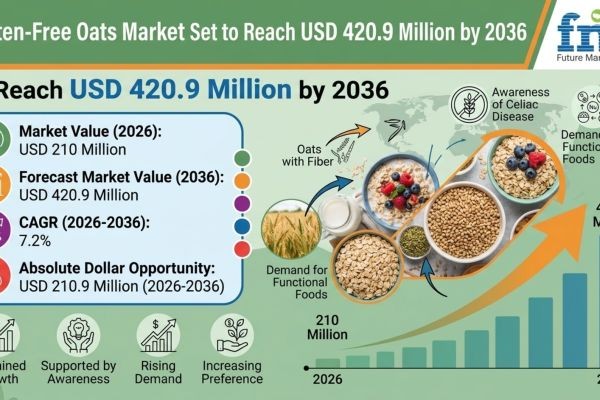
The global gluten-free oats market is entering a period of sustained growth, supported by rising awareness of celiac disease, expanding demand for functional foods, and increasing consumer preference for fiber-rich breakfast products. Valued at USD 210 million in 2026, the market is projected to reach USD 420.9 million by 2036, registering a CAGR of 7.2% during the forecast period. The industry is expected to create an absolute dollar opportunity of USD 210.9 million between 2026 and 2036.
Demand growth is no longer driven solely by consumers requiring gluten-free diets for medical reasons. The broader adoption of oats for heart health, digestive wellness, weight management, and clean-label nutrition is significantly expanding the consumer base. Certified gluten-free oats have emerged as a preferred grain among health-conscious households, food manufacturers, and specialty nutrition brands.
The market remains characterized by strict supply chain controls designed to prevent cross-contamination with wheat, barley, and rye. While these certification requirements create cost premiums, they also serve as a key competitive differentiator. Manufacturers capable of ensuring purity from cultivation through packaging are well positioned to capitalize on growing consumer trust and increasing demand from both retail and food processing sectors.
Request a Sample Report : https://www.futuremarketinsights.com/reports/sample/rep-gb-14738
Market Overview
The gluten-free oats market was valued at USD 195.9 million in 2025 and is anticipated to grow to USD 210 million in 2026. Over the next decade, market revenues are forecast to double, reaching USD 420.9 million by 2036.
Gluten-free oats occupy a unique position within the broader health foods industry. Unlike conventional oat products, gluten-free oats require dedicated farming, harvesting, processing, transportation, and packaging systems to eliminate cross-contamination risks. These products are specifically designed for consumers with celiac disease, gluten intolerance, or those seeking healthier grain alternatives.
The increasing popularity of plant-based diets, clean-label foods, and functional nutrition products is further reinforcing market growth. Oats' recognized benefits, including beta-glucan content, cholesterol reduction support, and digestive health enhancement, are attracting mainstream consumers beyond the gluten-sensitive population.
Key Growth Drivers
The primary growth catalyst remains the increasing prevalence and diagnosis of celiac disease and gluten sensitivity globally. Consumer education initiatives, advocacy organizations, and improved diagnostic capabilities continue to enhance awareness regarding certified gluten-free foods.
A second major growth driver is the broader health and wellness movement. Oats have gained significant recognition as a nutrient-dense grain rich in soluble fiber, protein, vitamins, and minerals. FDA-approved heart health claims associated with oat beta-glucan have strengthened consumer confidence, particularly in North America.
Expanding retail accessibility is also accelerating adoption. Health-food stores, supermarkets, hypermarkets, and online grocery platforms are increasing shelf space dedicated to gluten-free products. This broader availability enables manufacturers to reach mainstream consumers rather than relying solely on specialty retail channels.
Additionally, food manufacturers are increasingly incorporating certified gluten-free oats into granola bars, baked goods, breakfast cereals, and plant-based dairy alternatives, creating a robust B2B demand stream.
Technology & Innovation Trends
Innovation within the gluten-free oats industry is focused on product diversification, supply chain traceability, and convenience-driven formats.
Manufacturers are investing in advanced testing technologies capable of verifying gluten levels below the internationally recognized threshold of 20 parts per million (ppm). Enhanced traceability systems are being implemented to monitor products from cultivation through retail distribution, strengthening consumer confidence and regulatory compliance.
The market is also witnessing increased innovation in flavored and instant oat products. Companies are introducing fruit-based, nut-inspired, and protein-enriched variants designed for consumers seeking convenient breakfast and snacking solutions.
Digital retail channels and direct-to-consumer subscription models are emerging as important growth platforms, particularly among younger health-conscious demographics seeking premium nutrition products.
Market Challenges & Restraints
Despite strong growth prospects, the market faces several operational and economic challenges.
Maintaining certified gluten-free integrity throughout the supply chain significantly increases production costs. Dedicated farming practices, segregated harvesting equipment, specialized processing facilities, extensive batch testing, and certification programs can result in prices that are 40% to 80% higher than conventional oats.
These price premiums limit adoption among cost-sensitive consumers, particularly in emerging markets where gluten-free products remain relatively niche.
Supply chain complexity also creates barriers to entry for new participants. Establishing trusted gluten-free production systems requires significant capital investment, rigorous quality assurance protocols, and strong relationships with certification bodies.
Custom Research Available : https://www.futuremarketinsights.com/customization-available/rep-gb-14738
Segment Analysis
Product segmentation remains heavily concentrated around rolled oats, which are expected to account for 48% of total market revenue in 2026. Their versatility in porridge, overnight oats, granola, and baking applications continues to make them the preferred choice among consumers.
Whole oat groats, including steel-cut varieties, occupy the premium segment, appealing to consumers seeking minimally processed products and enhanced texture. Meanwhile, instant oats are gaining traction among urban professionals and younger consumers prioritizing convenience.
From a flavor perspective, natural gluten-free oats dominate the market with a 64% share in 2026. Plain and unsweetened varieties remain popular due to their flexibility in meal preparation and compatibility with health-focused diets.
Price segmentation reflects the structural realities of the industry. Premium products command significant market attention due to certification requirements, organic positioning, clean-label attributes, and enhanced nutritional offerings.
Household consumers remain the largest end-user segment, driven primarily by daily breakfast consumption. However, food processing applications are becoming increasingly important as manufacturers integrate certified gluten-free oats into functional food products and specialty formulations.
Regional Analysis
North America continues to lead global market development, with the United States emerging as the fastest-growing country and expected to register a CAGR of 7.5% through 2036.
The U.S. market benefits from strong consumer awareness, established gluten-free retail infrastructure, supportive FDA regulations, and widespread recognition of oat-related health benefits. The country's mature food processing sector also contributes significantly to ingredient demand.
Japan is projected to expand at a CAGR of 7.2%, supported by growing health-consciousness, increased adoption of Western breakfast habits, and expanding distribution networks for specialty nutrition products.
South Korea follows closely with a CAGR of 7.1%, driven by modern retail expansion, online grocery growth, and increasing consumer interest in functional foods.
The United Kingdom is expected to achieve 7.0% CAGR, supported by strong porridge consumption traditions and educational initiatives led by celiac advocacy organizations.
Across Europe, regulatory frameworks governing allergen labeling and the strong oat cultivation capabilities of Scandinavian producers continue to support market expansion.
Competitive Landscape
Competition within the gluten-free oats market revolves around product purity, certification credibility, retail accessibility, brand trust, and product innovation.
The market includes both specialized gluten-free manufacturers and multinational food companies with dedicated gluten-free product lines. Trust remains a critical purchasing factor, particularly among consumers with medically necessary dietary restrictions.
Supply chain transparency, quality assurance systems, and consistent certification standards serve as major competitive differentiators.
Leading Companies Analysis
Bob's Red Mill Natural Foods maintains a leading position due to its extensive certified gluten-free product portfolio and strong distribution network throughout North America.
General Mills has strengthened its position through gluten-free cereal and oat offerings that leverage the company's established retail relationships and brand recognition.
The Quaker Oats Company continues to expand its certified gluten-free portfolio, utilizing its global market presence and expertise within the oat category.
Nature's Path Foods remains influential within the organic and natural foods segment, while B&G Foods, Bakery on Main, Purely Elizabeth, and Nairn's continue to expand specialty product offerings targeted at premium consumer segments.
Investment & Strategic Developments
Recent investments highlight growing industry emphasis on convenience and premiumization.
In 2025, Bob's Red Mill expanded its certified gluten-free oat portfolio through the introduction of flavored instant oat cups designed for on-the-go consumption. The development reflects increasing consumer demand for convenient yet nutritionally balanced breakfast solutions.
During the same year, General Mills launched a certified gluten-free steel-cut oat range aimed at premium consumers seeking minimally processed breakfast alternatives.
Investments across the sector continue to focus on processing capacity expansion, supply chain traceability, certification infrastructure, and product innovation.
Future Outlook
The outlook for the gluten-free oats market remains highly favorable through 2036. Continued growth in celiac disease awareness, increasing consumer focus on preventive health, and rising demand for clean-label functional foods are expected to sustain long-term expansion.
Manufacturers that successfully balance affordability with rigorous gluten-free certification standards will be best positioned to capture emerging opportunities. Product innovation in flavored, protein-enriched, and convenience-oriented formats is likely to accelerate market penetration among mainstream consumers.
Growing adoption within food manufacturing applications will provide an additional growth avenue beyond traditional retail channels, creating a more diversified demand base.
Conclusion
The global gluten-free oats market is transitioning from a niche dietary category into a broader functional food segment supported by medical necessity, nutritional science, and consumer wellness trends. With revenues projected to rise from USD 210 million in 2026 to USD 420.9 million by 2036, the industry is positioned for sustained expansion.
While supply chain complexity and premium pricing remain challenges, increasing consumer trust, product innovation, and expanding retail accessibility continue to strengthen market fundamentals. As health-conscious consumers seek nutrient-rich, certified gluten-free alternatives, oats are expected to remain a cornerstone ingredient in the evolving global wellness and specialty nutrition landscape.
Exclusive Discounts on Full Report: https://www.futuremarketinsights.com/reports/gluten-free-oats-market
Why Choose FMI : https://www.futuremarketinsights.com/why-fmi
Explore More Related Studies Published by FMI Research
Demand for Yeast in EU : https://www.einpresswire.com/article/903342835/eu-drives-yeast-market-expansion-to-usd-1-46-billion-by-2036-backed-by-kerry-group-angel-yeast-fmi-report
Natural Tea Extract Market : https://www.openpr.com/news/4516970/natural-tea-extract-market-evolves-from-traditional-botanical
Explore In-Depth Food & Beverage Market Insights:
https://www.futuremarketinsights.com/industry-analysis/food-and-beverage
About Future Market Insights (FMI)
Future Market Insights, Inc. (FMI) is an ESOMAR-certified, ISO 9001:2015 market research and consulting organization trusted by global enterprises and Fortune 500 companies. FMI delivers actionable market intelligence, competitive benchmarking, and strategic insights across more than 30 industries and 1,200 markets worldwide.
Contact Us:
Future Market Insights Inc.
Christiana Corporate, 200 Continental Drive,
Suite 401, Newark, Delaware - 19713, USA
T: +1-347-918-3531
For Sales Enquiries: sales@futuremarketinsights.com
Website: https://www.futuremarketinsights.com






