
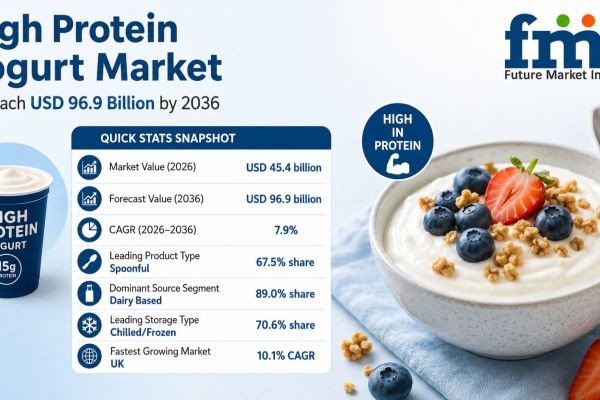
The global high protein yogurt market is experiencing a profound structural shift, transitioning from a specialty fitness niche into a mainstream daily dietary standard, according to latest insights by future market insights. As consumers increasingly substitute empty-calorie snacks with functional whole foods, protein is being reclassified from an occasional muscle-recovery supplement into an essential daily macronutrient foundation. The global industry, valued at USD 45.4 billion in 2026, is projected to expand at a strong Compound Annual Growth Rate (CAGR) of 7.9% over the ten-year forecast period. By 2036, total industry valuation is anticipated to reach USD 96.9 billion, opening an absolute incremental opportunity of USD 51.5 billion.
Request a Sample Report: https://www.futuremarketinsights.com/reports/sample/rep-gb-12012
Market Performance Overview (2026–2036)
To understand the core formulation configurations and transactional pathways guiding this USD 51.5 billion market scale-up, a detailed segment share analysis highlights where commercial volume is concentrated:
- Spoonful Product Type (67.5% share): Dominates the product architecture in 2026, because concentrating protein naturally elevates the structural viscosity of a fermented matrix, aligning seamlessly with consumer expectations for thick, filling textures.
- Dairy Based Source Segment (89.0% share): Commands the market by source, leveraging a mature, global ultrafiltration and centrifugal separation infrastructure alongside the complete amino acid profile intrinsic to bovine milk.
- Chilled / Frozen Storage Type (70.6% share): Leads the distribution framework, dictated by the absolute biological requirement to maintain live probiotic culture viability alongside dense macronutrient payloads.
Technical Drivers and Sourcing Catalysts
The continuous expansion of the global high protein yogurt market is propelled by a combination of evolving nutritional expectations and industrial manufacturing advancements:
Shift from Powders to Functional Whole Foods
A primary catalyst in this segment is the consumer migration away from isolated sports nutrition powders toward functional, cultured whole foods. This structural dietary shift has forced retail category managers to expand refrigerated shelf perimeter space for dense whole-food options that easily integrate into daily breakfast and snack routines.
Satiety-Driven Formulation Over Sugars
Escalating consumer scrutiny surrounding added carbohydrates and synthetic sweetening compounds is pushing formulation scientists to achieve consumer satiety through protein density rather than sugar volume. Cultured matrices are increasingly engineered as clean-label, low-sugar platforms that directly support metabolic health, portion control, and healthy aging metrics.
Membrane Filtration Technology Capital
To avoid the grittiness and chalkiness historically associated with manual powder fortification, leading dairy processors are investing heavily in advanced membrane filtration and texturization hardware. Leveraging pre-existing dairy capex to produce concentrated curds natively through ultrafiltration protects the smooth, astringency-free mouthfeel required to win mainstream customer loyalty.
Industrial Infrastructure Challenges
Global dairy cooperatives and functional food brands face complex rheological and logistics limits:
- Rheological Resistance in Fluids: Suspending massive protein payloads (e.g., 20 grams per serving) within fluid, drinkable high protein formats requires complex hydrocolloid stabilization systems. Processors who miscalculate these stabilizer ratios face rapid phase separation and product sedimentation.
- Strict Cold-Chain Preservation: Subjecting dense protein formats to high-heat ambient shelf-stabilization pasteurization denatures whey structures and causes irreversible gelation. Supply chain directors must preserve strict, continuous chilled logistics to keep bacteria cultures alive and maintain texturizing standards.
Regional Growth Outlook
The geographic analysis reflects monumental growth velocity across expanding European private labels and demographic-driven East Asian functional networks:
- United Kingdom (10.1% CAGR): Leading regional expansion within Europe, driven by aggressive supermarket private-label penetration that commoditizes premium functional formats, bringing high-protein options to everyday mass-market pricing tiers.
- Japan (9.6% CAGR): Propelled by a hyper-fragmented convenience store retail matrix and an aging population requiring highly digestible, protein-dense fermented structures to counter sarcopenia and age-related muscle loss.
- India (8.5% CAGR): Spurring rapid development via massive domestic milk production loops, direct capital injections into localized ultrafiltration plants, and upgraded regional cold-chain logistics that transform standard dahi formats into value-added variants.
- Germany (6.1% CAGR): Dictated by an intense density of discount retail networks, forcing plant operations directors to optimize raw milk separation efficiencies to lock in high-volume, long-term supply agreements.
- United States (5.7% CAGR): Sustaining a dominant baseline value footprint globally, where formulators are layering premium claims (such as A2 or grass-fed milk sources) on top of base protein density to maintain premium price points in an overcrowded functional cooler space.
Competitive Landscape
The global high protein yogurt landscape is shaped by a strategic combination of multinational scale, clean-label formulation capabilities, and specialized value-chain integration. Market volume distributions, multi-regional separation assets, and broad brand equity platforms are led by industry heavyweights including Danone S.A., Chobani LLC, FAGE International S.A., Green Valley Creamery, and Lactalis.
To insulate themselves from price-based commoditization and pass strict retail curation screenings, dominant players are prioritizing investments in advanced lactase and protease enzymatic treatments to smooth out curds without relying on controversial texturizing chemicals. Furthermore, manufacturers are actively branching into savory yogurt applications (such as high-protein dips) to capture incremental sales channels outside the traditional morning consumption window.
Full Report for Detailed Insights: https://www.futuremarketinsights.com/reports/high-protein-yogurt-market
Frequently Asked Questions
What is the projected valuation of the global market by 2036?
The global high protein yogurt market is projected to reach USD 96.9 billion by 2036, expanding upward from an estimated baseline valuation of USD 45.4 billion in 2026 at a CAGR of 7.9%.
Why does the Spoonful product type command a dominant 67.5% share?
Concentrating active whey and casein naturally thickens the fermented curd structure, meaning formulation scientists face far less rheological resistance when targeting a spoonable texture compared to stabilizing a fluid, drinkable format.
What exclusions govern the operational boundaries of this report?
The commercial scope strictly limits its focus to fermented dairy or plant-based matrices engineered for high macronutrient density via straining or fortification, explicitly excluding standard yogurts with naturally occurring baseline protein levels, ambient protein waters, and general non-fermented meal replacement shakes.
FMI Custom Research: Strategic Intelligence for Confident Decision-Making
In today's rapidly evolving business environment, leadership teams need more than market data they need clear, actionable intelligence tailored to their strategic objectives. FMI's Custom Research solutions are designed around the specific business questions organizations need answered, enabling executives to evaluate growth opportunities, validate investments, assess competitive dynamics.
Key Executive Benefits
- Decision-Ready Insights tailored to business priorities
- Reduced Strategic Risk through validated market intelligence
- Market Entry Confidence with detailed competitive analysis
- Competitive Advantage supported by proprietary research
- Faster Growth Decisions through customized strategic insights
- Primary Market Validation from industry stakeholders
- Global Industry Expertise across diverse sectors
- Proven Track Record with thousands of consulting engagements
Business Impact
FMI helps organizations transform market complexity into strategic clarity, enabling leadership teams to identify growth opportunities faster, optimize resource allocation, strengthen competitive positioning, and make high-stakes business decisions with confidence.
To explore how FMI Custom Research can support your strategic priorities, please connect with our team at - sales@futuremarketinsights.com






