
The global industrial plant-derived cleaning ingredients market is entering a pivotal "Bio-Performance Parity" phase, according to latest insights by Future Market Insights. Plant-based surfactants (such as alkyl polyglucosides or APGs), bio-solvents, and enzymatic cleaning polymers are achieving cleaning efficacy equivalent to traditional petrochemical alternatives. This performance evolution is shifting CPG procurement decisions away from sustainability premiums toward total cost-of-formulation economics.
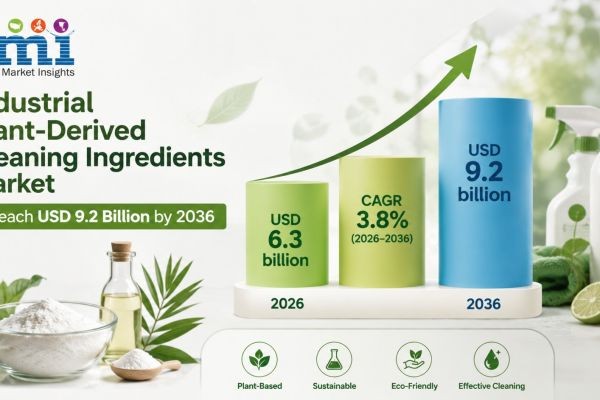
The global market, valued at USD 6.1 billion in 2025, is estimated to reach USD 6.3 billion in 2026. Advancing at a Compound Annual Growth Rate (CAGR) of 3.8% over the ten-year forecast period, total market valuation is projected to achieve USD 9.2 billion by 2036, delivering an absolute incremental opportunity of USD 2.9 billion.
Request a Sample Report: https://www.futuremarketinsights.com/reports/sample/rep-gb-1870
Market Performance Overview (2026–2036)
To map out the primary ingredient types, distribution pathways, core application sectors, and regional growth vectors guiding this USD 2.9 billion market scale-up, key segment allocations highlight where global demand is concentrated:
- Organic Ingredient Type Segment (61.2% share): Commands the leading ingredient category in 2026, supported by high consumer and industrial demand for certified organic, bio-based surfactants and bio-enzyme blends free of synthetic petrochemicals, VOCs, or artificial phosphates.
- Offline Distribution Channel Segment (57.8% share): Dominates distribution over online channels, as direct industrial B2B sales, bulk ingredient supply contracts, and established chemical distribution networks handle large-scale CPG procurement.
- Household Application Segment (29.7% share): Represents the primary application area, as home care brands incorporate plant-derived surfactants and enzymes into eco-friendly laundry detergents, hard surface sprays, and automatic dishwashing liquids.
- China & India Regional Growth Leadership: Lead national expansion rates at 1% CAGR and 4.8% CAGR respectively through 2036, driven by tightening wastewater biodegradability standards, domestic oleochemical capacity additions, and expanding CPG manufacturing.
Technical Drivers and Formulation Shifts
The commercial expansion of plant-derived cleaning ingredients across household, industrial, and institutional channels is propelled by three primary industry catalysts:
APG Surfactant Scale and Cost Parity
Global capacity expansions for Alkyl Polyglucosides (APGs) such as BASF's facility expansions in Thailand and Cincinnati, USA are narrowing the cost gap between plant-derived non-ionic surfactants and petrochemical alternatives. High-volume APG production lowers unit costs, enabling CPG formulators to achieve 1:1 drop-in cost parity.
Bio-Enzymatic and Polymer Technology Partnerships
Strategic alliances between biotechnology leaders (such as BASF partnering with IFF to scale Designed Enzymatic Biomaterials) are introducing next-generation bio-enzymes and plant-derived polymers into fabric care and industrial cleaning. These biomaterials deliver superior stain removal, odor neutralization, and grease degradation at low temperatures.
Tightening Ecotoxicity and Biodegradability Regulations
Regulatory frameworks such as the US EPA Safer Choice program and EU Ecolabel standards enforce strict aquatic toxicity and aerobic biodegradability limits. Conventional petrochemical surfactants often fail these environmental thresholds without costly reformulation, creating mandatory compliance-driven demand for plant-based alternatives.
Industrial Constraints & Supply Chain Risks
Ingredient producers and CPG formulation teams navigate specific operational hurdles:
- Oleochemical Feedstock Price Volatility: Plant-based surfactants rely heavily on coconut oil, palm kernel oil, corn, and sugarcane feedstocks. Agricultural crop harvest yield variations and global tropical oil price fluctuations directly impact raw material input costs for bio-surfactants.
- Multi-Jurisdiction Certification Divergence: Differing regional eco-label criteria and bio-based content verification methods force multinational ingredient suppliers to maintain parallel testing, certification, and traceability infrastructure across export markets.
Regional Growth Profile
Regional demand reflects strict biodegradability policies in Western Europe and North America alongside rapid industrial and CPG expansion in Asia-Pacific and Latin America:
- China (5.1% CAGR): The global growth frontrunner, driven by Ministry of Ecology wastewater biodegradability enforcement (GB/T 15818 standards) and CPG home care leaders (Blue Moon, Liby) reformulating with coconut/palm-kernel-derived surfactants.
- India (4.8% CAGR): Spurring rapid volume growth as Bureau of Indian Standards (BIS) develops eco-label criteria and domestic oleochemical refiners (Godrej Industries, Galaxy Surfactants) scale bio-surfactant production.
- Germany (4.4% CAGR) & France (4.0% CAGR): Leading European market demand, governed by mandatory EU Ecolabel bio-carbon content thresholds and corporate sustainability targets from Henkel and Reckitt Benckiser.
- United Kingdom (3.6% CAGR) & United States (3.2% CAGR): Driven by EPA Safer Choice certifications, CPG brand line expansions (Mrs. Meyer's, Green Works), and localized APG manufacturing scale-ups.
- Brazil (2.9% CAGR): Leveraging local Amazonian and agricultural plant feedstocks (coconut oil, palm kernel oil) to supply bio-based ingredients to regional personal care and cleaning formulators.
Competitive Landscape
The global industrial plant-derived cleaning ingredients landscape features a combination of multinational chemical conglomerates, specialized oleochemical refiners, and industrial biotechnology innovators.
Key market participants profiled in the report include BASF SE (holding ~18.6% market share), Procter & Gamble, Dow, Henkel AG & Co. KGaA, Sasol, SOLVAY, Croda International PLC, STEPAN Company, Huntsman International LLC, Eastman Chemical Corporation, Clariant, Westlake Chemicals Corporation, Albemarle Corporation, Reckitt Benckiser Group plc, Clorox Inc., Kimberly-Clark Corporation, and 3M. Major players compete by expanding global APG production lines, launching biodegradable odor-neutralizing technologies (such as Croda's NeutraFresh BD), and forming enzymatic bio-polymer R&D partnerships.
Exclusive Discounts on Full Report: https://www.futuremarketinsights.com/reports/plant-derived-cleaning-ingredients-market
Frequently Asked Questions
What is the projected valuation of the global industrial plant-derived cleaning ingredients market by 2036?
The global industrial plant-derived cleaning ingredients market is projected to reach USD 9.2 billion by 2036, expanding from an estimated baseline valuation of USD 6.3 billion in 2026 at a CAGR of 3.8%.
Why does the Organic Ingredient segment command a 61.2% market share?
Organic ingredients lead product categories in 2026 because CPG formulators and industrial cleaning buyers prioritize certified bio-based surfactants and bio-enzymes that meet strict non-toxic, eco-label biodegradability standards.
What main application category dominates plant-derived cleaning ingredient demand?
Household applications hold a 29.7% market share in 2026, as home care brands incorporate bio-surfactants and enzymes into laundry detergents, surface sprays, and dishwashing products to fulfill consumer demands for eco-friendly, non-toxic cleaning.
FMI Custom Research: Strategic Intelligence for Confident Decision-Making
In today's rapidly evolving business environment, leadership teams need clear, actionable intelligence tailored to their strategic objectives. FMI's Custom Research solutions are designed around specific business questions, enabling executives to evaluate growth opportunities, validate investments, assess competitive dynamics, and reduce uncertainty before making critical decisions.
Key Executive Benefits
- Decision-Ready Insights: Research tailored to your specific business challenges, growth plans, and investment priorities.
- Reduced Strategic Risk: Validate market opportunities, customer demand, and competitive positioning before committing resources.
- Market Entry Confidence: Assess opportunity size, regulatory barriers, channel dynamics, and competitive landscapes with precision.
- Competitive Advantage: Gain proprietary intelligence unavailable through syndicated reports or internal datasets.
- Faster Growth Decisions: Accelerate expansion, product development, portfolio optimization, and investment planning.
- Primary Market Validation: Access real-world customer, buyer, and stakeholder insights that support high-confidence decision-making.
Business Impact
FMI helps organizations transform market complexity into strategic clarity, enabling leadership teams to identify growth opportunities faster, optimize resource allocation, strengthen competitive positioning, and make high-stakes business decisions with confidence.
To explore how FMI Custom Research can support your strategic priorities, connect with our team at - sales@futuremarketinsights.com
About Future Market Insights (FMI)
Future Market Insights (FMI) delivers actionable, decision-focused market intelligence that goes beyond traditional research reports. The company provides:
- In-depth pricing and cost benchmarking analysis
- Demand forecasting based on real industry inputs
- Procurement and buyer behavior insights
- Supply chain and trade flow intelligence
- Technology and application trend analysis across industries
FMI follows a robust bottom-up research methodology, combining insights from industry experts, procurement leaders, manufacturers, and technical professionals to ensure accurate and practical market intelligence.






